Spanish
 English


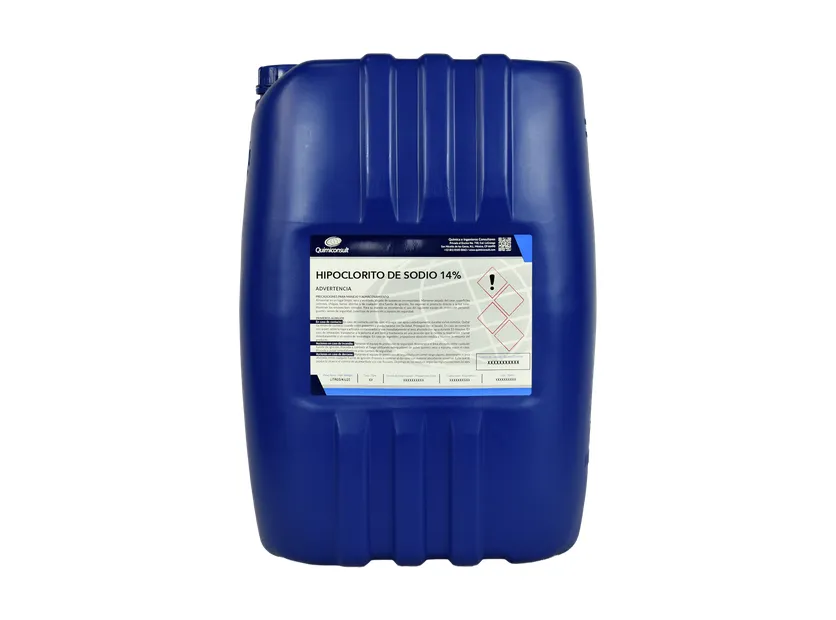
SODIUM HYPOCHLORITE 14%
View All Prices
| Quantity | Unit Price |
|---|---|
| kg | |
| 1 - 99 | USD 1.28 |
| 100 - 199 | USD 1.26 |
| 200 - 499 | USD 1.25 |
| 500 - 999 | USD 1.24 |
| 1000 - 4999 | USD 1.23 |
| 5000 - 9999 | USD 1.22 |
| 10000 - 17999 | USD 1.21 |
| 18000+ | USD 1.20 |
Sodium Hypochlorite 14% Description — Industrial Liquid Chlorine (Bleach / Lye)
At Quimiconsult we distribute 14% Sodium Hypochlorite, a high-concentration industrial-grade liquid chlorine for water disinfection, sanitation of surfaces and facilities, wastewater treatment and bleaching. Also known as chlorine, liquid chlorine, bleach or lye, sodium hypochlorite is one of the most versatile and economical disinfectants and oxidizers in industry. It is offered at a nominal concentration of 14% as a reference; keep in mind that, by its nature, sodium hypochlorite is an unstable product: its available chlorine decreases naturally with time, heat and light, so the concentration is a starting value and dosing should be based on measured available chlorine, not on a fixed percentage guaranteed at the point of use.
The Sodium Hypochlorite offered by Quimiconsult is a light greenish-yellow, alkaline (pH 11 – 13) sodium hypochlorite (NaOCl) solution with broad-spectrum disinfecting, bleaching, deodorizing and oxidizing action. It is suitable for water treatment plants, the food and beverage industry, livestock and poultry operations, industrial laundries, fiber and paper bleaching, and general sanitation, wherever effectiveness and a good cost per unit of active chlorine are sought. To get the most out of its available chlorine, proper handling and storage are key (see "Care"), and when the chlorine needs to last longer, there is the stabilized version, Clorsan DS.
As an established supplier in San Nicolás de los Garza, Nuevo León, we distribute 14% Sodium Hypochlorite with nationwide coverage, along with a technical data sheet (TDS), safety data sheet (SDS), certificate of analysis (CoA) per batch and technical support for dosing. For anyone looking for a reliable supplier of 14% sodium hypochlorite, industrial liquid chlorine, bleach, lye or chlorine for water treatment, this is the option in Quimiconsult's catalog.
What is sodium hypochlorite and what is it used for?
Sodium hypochlorite (NaOCl) is a sodium salt of hypochlorous acid, in an alkaline aqueous solution, that acts as a powerful broad-spectrum oxidizer and biocide. When dissolved, it releases available chlorine (hypochlorous acid / hypochlorite ion) that destroys bacteria, viruses, fungi, spores, algae and biofilm by oxidizing their cell structures, and that also bleaches by oxidizing organic pigments and deodorizes by oxidizing odor-causing compounds.
It is the most widely used chlorinated disinfectant in the world because of its effectiveness, broad spectrum and low cost. With a nominal concentration of 14%, it delivers a high load of available chlorine per liter at the start of its shelf life. However, sodium hypochlorite is intrinsically unstable: its available chlorine is gradually lost over time, and that loss is accelerated by heat, light and trace metals. That is why good practice is to dose by measured available chlorine and take care of storage; its alkaline nature (pH 11 – 13) helps moderate that decomposition and makes it compatible with alkaline cleaning processes.
Sodium Hypochlorite 14% technical specifications
Substance:
Sodium hypochlorite (aqueous solution)
Common names:
Chlorine, liquid chlorine, bleach, lye, sodium hypochlorite solution
Formula:
NaOCl
Nominal concentration:
14% (sodium hypochlorite) — initial reference value; decreases naturally over time
Appearance:
Light greenish-yellow liquid
Odor:
Characteristic (chlorine)
pH:
11 – 13 (alkaline)
Nature:
Oxidizer / oxysalt; disinfectant and bleach
CAS number:
7681-52-9
UN number:
1791
The exact available chlorine, density and packaging values for each batch are given on the technical data sheet (TDS) and certificate of analysis (CoA). The concentration can be adjusted to the customer's requirement within the range of commercial hypochlorite.
How does sodium hypochlorite work?
The power of sodium hypochlorite comes from the available chlorine it releases in solution:
Oxidation and biocidal action. Hypochlorous acid (HOCl) penetrates the cell wall and membrane of microorganisms and oxidizes their proteins and nucleic acids, inactivating them quickly and across a broad spectrum (bacteria, viruses, fungi, spores and algae).
Bleaching. It oxidizes and decolorizes organic pigments (stains, natural colorants), which is why it is used as a bleach for fibers, textiles, paper and surfaces.
Deodorization and oxidation of contaminants. It oxidizes odor-causing compounds (sulfides, amines) and certain organic and inorganic contaminants in water.
In general terms, the higher the starting concentration, the more available chlorine per liter and the less product volume for the same target dose. Since available chlorine declines over time, the actual dose should always be calculated from the measured available chlorine at the time of use, not from the nominal percentage.
Sodium Hypochlorite 14% applications
The dose and regulatory compliance must be validated for each application.
Water treatment and disinfection
Disinfection of drinking water, wells, cisterns, tanks and distribution networks, and disinfection of process water. It is the most widespread chlorination method for ensuring residual chlorine and microbiologically safe water. (For water for human use and consumption, verify the dose and compliance with the applicable regulations, e.g. NOM-127-SSA1.)
Wastewater treatment
Effluent disinfection, odor control, oxidation of sulfides and organic matter, and microbiological control in wastewater treatment plants.
Food and beverage industry
Disinfection of surfaces, equipment, floors and facilities, and disinfection of process water, as a chlorinated agent within sanitation programs. (For food contact, verify grade, dose, rinsing and applicable regulations.)
Livestock, poultry and agricultural industry
Disinfection of facilities, pens, cages, equipment and drinkers, and disinfection of water in livestock and poultry operations.
Post-harvest and fruit and vegetable wash water
Disinfection of wash water and post-harvest process lines, to reduce the microbial load on fruits and vegetables.
Textile, paper and pulp bleaching
Bleaching of fibers, textiles, paper and pulp, and in industrial laundries, taking advantage of its strong oxidizing action.
Institutional cleaning and disinfection
Disinfection of surfaces, floors and areas in institutional, commercial, educational and service settings; general sanitation and odor control.
Cooling towers and water systems
Control of biofilm, algae and microbiological load in cooling towers and recirculating water circuits.
Swimming pools and recreational water treatment
Water disinfection in swimming pools and recreational systems, maintaining the right residual chlorine.
Directions for use and dosing
Sodium Hypochlorite is dosed according to the application, the system's organic and microbiological load and the target residual chlorine. Since hypochlorite is unstable and its concentration declines over time, the dose should be calculated from the measured available chlorine, not from the nominal percentage; prepare dilutions with good-quality water and check the available chlorine before dosing, especially in critical applications.
General recommendations:
- Dose by available chlorine, not just by volume, and adjust to the system's chlorine demand.
- Check the residual chlorine after application (free/total chlorine test kits).
- Prepare working solutions on the day of use whenever possible, since dilutions lose chlorine faster than the concentrate.
- Validate the dose and regulatory compliance of each application (drinking water, food, etc.).
Quimiconsult's technical team helps define the dosing protocol for your process.
Care, safety, handling and storage
14% Sodium Hypochlorite is a corrosive and oxidizing product, classified as DANGER under the GHS; it must be handled following its current Safety Data Sheet (SDS). Its hazard statements include: may be corrosive to metals (H290), harmful if swallowed (H302), causes severe skin burns and serious eye damage (H314/H318), harmful if inhaled (H332) and very toxic to aquatic life (H400).
Critical incompatibility — never mix with acids or ammonia:
- Mixing hypochlorite with an acid (descalers, acid sanitizers, acid cleaners, even vinegar) releases toxic chlorine gas.
- Mixing with ammonia or products containing it forms toxic chloramines.
- Also keep away from reducing agents, nitrogen compounds and metals such as copper, nickel and cobalt, which catalyze its decomposition.
Personal protective equipment (PPE): wear safety glasses (and a face shield for severe exposure), chemical-resistant gloves, protective clothing and footwear; avoid contact with skin, eyes and clothing, and inhalation of mists or vapors; handle in ventilated areas. Wash after handling.
First aid (general guidance): skin contact, rinse with plenty of water for at least 15 minutes and remove contaminated clothing; eye contact, rinse with water for several minutes and seek immediate medical attention; ingestion, do not induce vomiting, rinse the mouth and seek medical attention; inhalation, move to fresh air. Always consult the current SDS.
Storage care (to preserve the chlorine): sodium hypochlorite loses available chlorine with time, heat and light. To preserve its concentration:
- Store in a cool, dry, ventilated place protected from direct sunlight (ideally below 30 °C).
- Keep the original container closed and corrosion-resistant, away from heat sources.
- Rotate inventory (first in, first out) and avoid prolonged storage; the solution weakens over the months.
- Keep away from acids, ammonia, reducing agents and incompatible metals.
- Do not discharge into bodies of water or drains; dispose of the product and containers in accordance with applicable environmental legislation.
Need the chlorine to last longer? If your operation stores the product for weeks, works in a hot climate or requires very consistent dosing, consider Clorsan DS, our stabilized sodium hypochlorite, which keeps its available chlorine much longer than standard hypochlorite (see its product page).
Sodium Hypochlorite 14% compared with other options
14% nominal concentration vs. lower concentrations (10 – 13%): a higher starting concentration delivers more available chlorine per liter at the outset, which can reduce the volume needed for the same dose. Since all hypochlorite loses chlorine over time, this benefit is best realized with inventory rotation and good storage; in every case, the dose is calculated from measured available chlorine.
Sodium Hypochlorite 14% (standard) vs. Clorsan DS (stabilized): both are sodium hypochlorite with the same disinfecting power; the standard is the most cost-effective option for frequent consumption, while Clorsan DS keeps its available chlorine much longer (ideal for prolonged storage, hot climates or very consistent dosing).
Sodium hypochlorite (chlorine) vs. peracetic acid (Anticel): hypochlorite is the widely used, cost-efficient chlorinated disinfectant and bleach; peracetic acid (the Anticel line) is a chlorine-free, residue-free, no-rinse oxidizing sanitizer for surfaces and process equipment. They are chosen according to the application; a chlorinated product and an acid must never be mixed (it releases chlorine gas).
Frequently asked questions about Sodium Hypochlorite 14%
What is 14% sodium hypochlorite? It is a sodium hypochlorite solution (liquid chlorine, bleach, lye) with a nominal concentration of 14%, a broad-spectrum chlorinated disinfectant and oxidizer for water treatment, sanitation, bleaching and industrial disinfection. The 14% is the initial reference value; due to the nature of the product, available chlorine decreases over time.
What is it used for? To disinfect water (drinking water, wells, cisterns, networks), treat wastewater, disinfect surfaces and equipment in the food, livestock and service industries, bleach textiles and paper, and control biofilm and algae in cooling towers and swimming pools, among other uses.
Does the product always arrive at exactly 14%? 14% is the nominal reference concentration. Sodium hypochlorite is a naturally unstable product: its available chlorine declines with time, heat and light, so the actual concentration depends on the time elapsed and the storage conditions. That is why we recommend dosing by measured available chlorine and, if you need the chlorine to last longer, considering the stabilized version, Clorsan DS.
What must it NOT be mixed with? Never with acids (releases toxic chlorine gas) or ammonia (forms toxic chloramines). Nor with reducing agents. Always handle it separately and rinse between products.
How is the chlorine best preserved? By storing it in a cool, dry, dark place, in a closed container, and rotating inventory, since chlorine is lost with time, heat and light. If you need greater stability, consider Clorsan DS (stabilized hypochlorite).
Can it be used to disinfect drinking water? Yes, it is the most widespread chlorination method; the dose and residual chlorine must be adjusted and comply with the applicable regulations (e.g. NOM-127-SSA1 for water for human use and consumption).
Where to buy 14% sodium hypochlorite in Mexico? At Quimiconsult we distribute it with availability from Monterrey, Nuevo León, and shipping throughout Mexico. Contact us at +52 (81) 8105 0063 for a quote, technical data sheet and dosing advice.
Other names and related terms
Sodium hypochlorite, sodium hypochlorite 14%, 14% sodium hypochlorite, chlorine, liquid chlorine, industrial liquid chlorine, bleach, industrial bleach, lye, sodium hypochlorite solution, chlorine for water treatment, chlorine for potabilization, industrial sodium hypochlorite, chlorine-based disinfectant, chlorine for disinfection, sodium hypochlorite for water, NaOCl, sodium hypochlorite price, sodium hypochlorite Monterrey, sodium hypochlorite supplier Mexico, sodium hypochlorite distributor.
Why buy Sodium Hypochlorite 14% from Quimiconsult?
Quimiconsult is a Mexican company with more than 30 years of experience in specialty chemicals, combining the manufacture of its own formulations with the distribution of raw materials and supplies for water treatment, sanitation and industrial cleaning. When you buy 14% Sodium Hypochlorite from Quimiconsult you get:
- Industrial-grade liquid chlorine (14% nominal concentration), with a certificate of analysis (CoA) per batch reporting the actual available chlorine of each delivery —so you can dose with certainty.
- Documentation (TDS and SDS) and technical support for safe and effective dosing.
- The option to step up to Clorsan DS (stabilized hypochlorite, Quimiconsult's own formulation) when a longer chlorine life is required.
- The complete disinfection, sanitation and water treatment family from a single domestic supplier.
- Nationwide availability and logistics from Monterrey, Nuevo León.
Does your water treatment, food, livestock or sanitation operation need a reliable sodium hypochlorite? Contact us at +52 (81) 8105 0063: we'll review your application and propose the right concentration, dose and protocol.
Related products
14% Sodium Hypochlorite is part of Quimiconsult's disinfection, sanitation and water treatment portfolio. Related products:
- Clorsan DS — stabilized sodium hypochlorite that keeps its available chlorine much longer; the premium option for prolonged storage, hot climates or very consistent dosing.
- Anticel Peracetic Acid (5% / 15%) — broad-spectrum, chlorine-free, no-rinse oxidizing sanitizer for surfaces and equipment (alternative/complement; never mix with hypochlorite).
- Sanidet / Quaternary Ammonium — sanitizers for surfaces and facilities.
- Sequestrants and antiscalants (sodium tripolyphosphate, EDTA, sodium gluconate, PBTC) — for hardness and scale control in water treatment.
- Caustic soda (sodium hydroxide) — for pH adjustment and alkaline cleaning.
- CIP/COP cleaning detergents — for the cleaning stage ahead of disinfection.
Related categories: Disinfectants and chlorine agents · Water treatment and potabilization · Sanitizers and sanitation · Industrial bleaches · Supplies for the food, livestock and service industries.
Looking for a reliable sodium hypochlorite or want to build a complete disinfection and water treatment program? Contact us and we'll review the options in our catalog for your application.