Spanish
 English


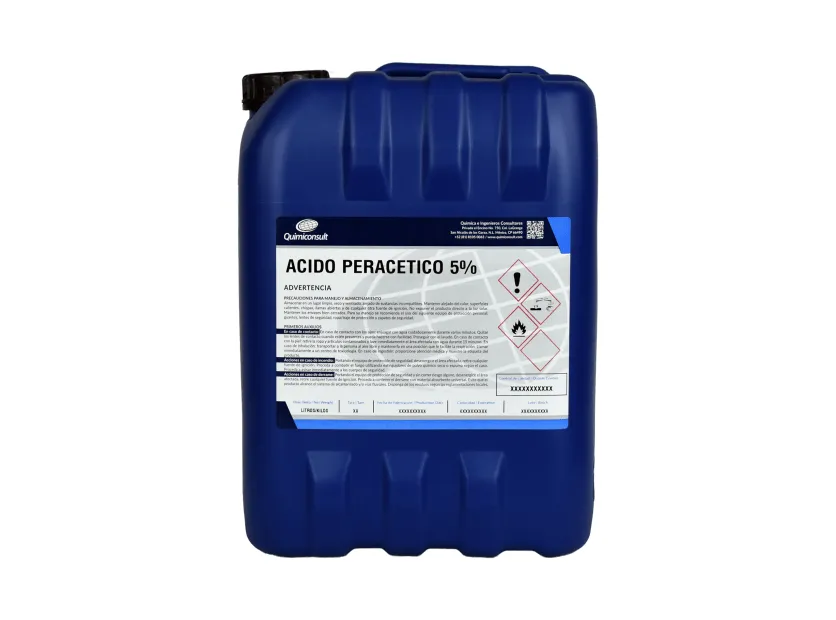
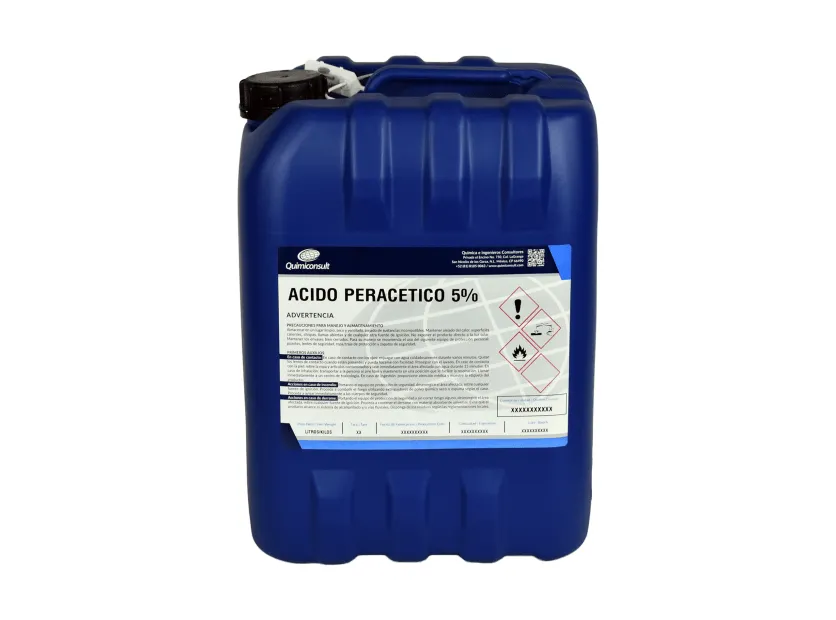
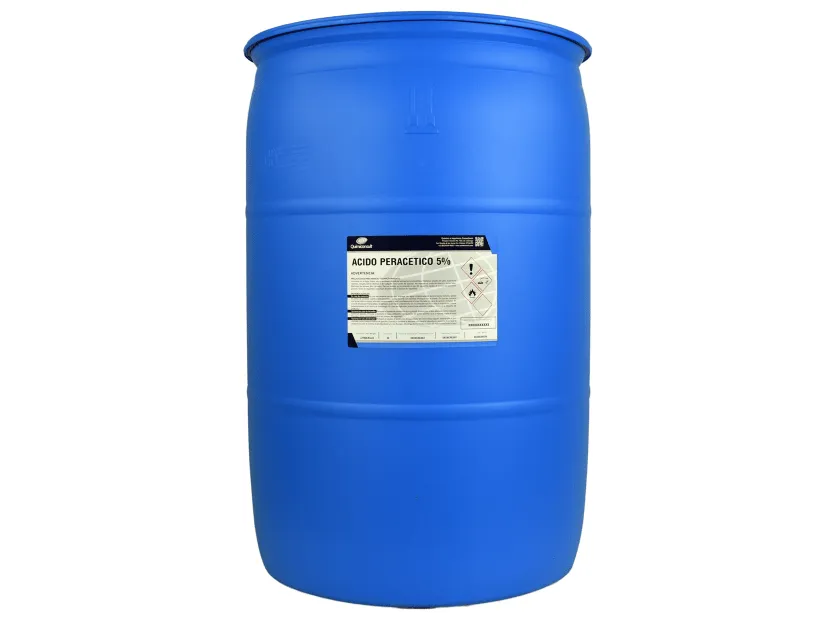
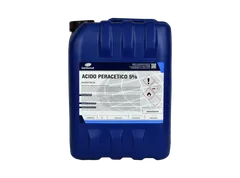
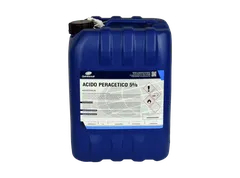
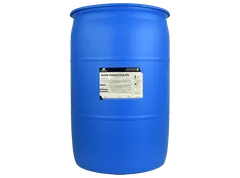
ANTICEL PERACETIC ACID 5%
View All Prices
| Quantity | Unit Price |
|---|---|
| kg | |
| 1 - 99 | USD 2.09 |
| 100 - 199 | USD 2.00 |
| 200 - 499 | USD 1.92 |
| 500 - 999 | USD 1.85 |
| 1000 - 4999 | USD 1.78 |
| 5000 - 9999 | USD 1.72 |
| 10000 - 17999 | USD 1.67 |
| 18000+ | USD 1.62 |
Product description, Anticel Oxy 5% peracetic acid industrial disinfectant
At Quimiconsult we produce Anticel Oxy, a 5% peracetic acid solution with a high hydrogen peroxide content (minimum 26%), formulated to deliver a dual oxidizing action that combines the biocidal efficacy of peracetic acid with the disinfecting and bleaching power of hydrogen peroxide. This formulation, unique within our Anticel line, is designed for industrial disinfection, sanitization and microbiological control applications that call for a product that is easier to handle than higher concentrations of peracetic acid, yet with a total oxidizing capacity that exceeds what its PAA concentration alone might suggest.
Anticel Oxy is a broad-spectrum biocide with excellent performance against Gram-negative and Gram-positive bacteria, fungi, yeasts, viruses and resistant structures such as endospores and mold spores. Its action is instantaneous on contact with the protective cell structures of microorganisms, including the cell wall and cell membrane, and it also deactivates elementary cellular metabolic functions involved in protein synthesis. Its mechanism of action is based on oxidation of the outer cell membrane through electron transfer: the stronger the oxidizing agent, the faster electrons are transferred to the microorganism and the faster it is inactivated and dies.
What sets Anticel Oxy apart from the rest of the Anticel line is its composition profile: while the 15% and 20% formulations contain between 5 and 8% hydrogen peroxide, Anticel Oxy contains a minimum of 26% hydrogen peroxide combined with 5% peracetic acid. This high proportion of hydrogen peroxide boosts the solution's total oxidizing capacity and provides a synergistic effect in which both components work in a complementary way: peracetic acid directly attacks microbial cell membranes with its fast biocidal action, while hydrogen peroxide contributes additional oxidation, bleaching action on organic matter and deeper penetration into biofilms and organic residues adhering to surfaces.
Like all peracetic acid solutions in the Anticel line, the product breaks down into completely harmless by-products: oxygen, water and acetic acid (vinegar), making it a no-rinse disinfectant when used within the concentrations established by FDA 21 CFR regulations. Unlike chlorinated disinfectants, it does not generate halogenated by-products or trihalomethanes, making it an environmentally responsible, highly biodegradable option.
Anticel Oxy is highly water-soluble, phosphorus-free and remains effective against a wide range of microorganisms even in high-hardness water, whether cold or warm. It does not require pH control to achieve effective microbial control, working under both acidic and slightly alkaline conditions. Its lower peracetic acid concentration makes it the ideal choice for operations looking to begin the transition from chlorinated disinfectants to peracetic acid with an easier-to-handle product, or for applications where the required use concentrations are low and more concentrated formulations are not justified.
Anticel Oxy 5% peracetic acid is available in Monterrey, Nuevo León, with shipping throughout Mexico, specialized technical assistance and quality documentation for industrial applications.
Benefits of Anticel Oxy 5% peracetic acid as an industrial disinfectant
Anticel Oxy offers a set of technical and operational advantages that position it as a versatile disinfection solution, especially valued in settings where ease of handling, dual oxidizing action and operational safety are priorities.
The most distinctive benefit of Anticel Oxy is its dual oxidizing action, derived from the combination of 5% peracetic acid with 26% hydrogen peroxide. This synergy provides biocidal and oxidative cleaning capacity beyond what either component would achieve on its own. Peracetic acid provides fast, broad-spectrum biocidal action, while the high hydrogen peroxide content contributes additional oxidizing power that is particularly effective at removing organic residues, bleaching stained surfaces and penetrating biofilm layers where microorganisms shelter from conventional disinfectants.
The microbiological efficacy of Anticel Oxy is proven through standardized challenge tests. The product passes the 99.99% reduction for Staphylococcus Aureus ATCC 6538, Escherichia Coli ATCC 11229 and Salmonella Typhimurium ATCC 14028 under analytical method NMX-BB-040-SCFI-1999. It also passes the 99.99% reduction challenge for Escherichia Coli O157:H7 ATCC 43890 with a contact time of just 30 seconds under analytical method 960.09. These results confirm that, despite its lower peracetic acid concentration, Anticel Oxy maintains the same demonstrable microbiological efficacy as the higher-concentration formulations in the Anticel line.
Ease of handling is another significant operational benefit. With a 5% peracetic acid concentration, the risks associated with handling the product are lower than with the 15% or 20% formulations, which simplifies safety protocols, reduces the need for specialized personal protective equipment and makes training operating staff easier. This is especially valuable for small and mid-sized operations, restaurants, industrial kitchens, low-volume packing houses and establishments that do not have staff dedicated exclusively to handling concentrated chemicals.
Its no-rinse disinfectant status remains intact. Because it breaks down into oxygen, water and acetic acid, Anticel Oxy leaves no toxic residues or compounds that could contaminate food or alter its organoleptic properties. Production lines can return to production without an additional rinse step, saving water, time and labor.
The product's stability for at least 1 year under normal storage conditions allows inventory to be held without worrying about premature degradation of the active ingredient. Anticel Oxy is phosphorus-free, and its ability to work efficiently in high-hardness water, both cold and warm, eliminates the need for costly water pretreatment.
Finally, the high hydrogen peroxide content of Anticel Oxy gives it a capacity to bleach and remove organic stains on surfaces that formulations with higher PAA and lower H2O2 concentrations do not offer with the same intensity. This is particularly useful in industries where the visual appearance of surfaces and equipment is assessed during audits and inspections, such as food processing plants, industrial kitchens and foodservice establishments.
Industrial applications of Anticel Oxy 5% peracetic acid
Anticel Oxy covers the same range of authorized applications as the higher-concentration formulations in the Anticel line, with the added advantage of easier handling and its dual oxidizing action. Its profile makes it especially suitable for moderate-volume operations, plants transitioning from chlorinated disinfectants and applications where manual dosing without automated systems is standard practice.
In the food and beverage processing industry, Anticel Oxy is a food-grade disinfectant used for cleaning piping in CIP (Clean in Place) systems and for washing and disinfecting equipment, surfaces and facilities. Its high hydrogen peroxide content makes it especially effective at removing biofilm and adhered organic residues in tanks, heat exchangers and piping systems, where the dual oxidizing action of PAA and H2O2 works synergistically to dissolve and eliminate the biofilms that shield microorganisms from conventional disinfectants.
In the meat industry, the product is applied to decontaminate carcasses of cattle, goats and other species at concentrations of 90 to 220 ppm under 21 CFR 173.370, with no subsequent rinse required. For lower-volume slaughterhouses and processing plants that lack sophisticated automated dosing systems, Anticel Oxy offers the advantage of simpler handling when preparing use solutions manually.
In the poultry industry, Anticel Oxy is used to disinfect chicken carcasses in the Chiller (30 to 40 ppm recommended) and PreChiller (10 to 20 ppm recommended). Its lower PAA concentration makes dosing calculations easier and reduces the margin of error when preparing solutions, which is particularly relevant in operations with frequent staff turnover or where chemical-handling training is an ongoing challenge.
In postharvest disinfection of fruits and vegetables, Anticel Oxy provides control of decay and spoilage caused by microorganisms present in process water and on the surface of freshly harvested, cut and processed produce. Concentrations for rinse water are 60 to 80 ppm under 21 CFR 173.315. The high hydrogen peroxide content provides an additional benefit in this application, as it helps remove organic residues and soil adhering to the surface of fruits and vegetables during washing, complementing the disinfecting action of peracetic acid.
For surface disinfection, Anticel Oxy is used as a no-rinse sanitizer at concentrations of 100 to 200 ppm under 21 CFR 178.1010, and as a disinfectant followed by a rinse at concentrations of 220 to 400 ppm. Applications include disinfecting direct-contact equipment in food plants, shock treatment to eliminate fungi and Listeria, and corrective disinfection. The bleaching action of hydrogen peroxide is especially appreciated in surface disinfection applications where organic stains built up in joints, seals, conveyor belts and porous surfaces are a recurring problem.
The product is suitable for sanitizing in organic production as approved by the NOP (National Organic Program), allowing its use in certified organic plants. This compatibility is especially valuable for smaller-scale organic producers such as orchards, regional packing houses and cooperatives that need an effective peracetic acid sanitizer that is easier to handle than the higher industrial concentrations.
In the livestock and poultry sector, Anticel Oxy is recommended for disinfecting livestock facilities, plants, slaughterhouses, hatcheries, poultry houses, stables, warehouses, equipment, cages, drinkers, feeders and livestock vehicles. For small and mid-sized farms, and for livestock operations where staff lack specialized training in handling concentrated chemicals, Anticel Oxy is the safest and most practical option in the peracetic acid family.
In irrigation water treatment, the concentration must not exceed 80 ppm under 21 CFR Part 173 D. For small to mid-sized growers and greenhouses, the 5% concentration makes direct dosing into irrigation systems easy without the need for complex dilution equipment.
Like the higher-concentration formulations, Anticel Oxy shares applications in the pulp and paper industry for slime and biofouling control, in the treatment of cooling and recirculation water in cooling systems (even in the presence of ammonia), in the treatment of oilfield process water and wastewater, in agricultural irrigation, and in the microbiological control of pigment dispersions in the coatings industry. In all of these non-food industrial applications, the dual oxidizing action of PAA and H2O2 provides a versatility that can be advantageous depending on the specific process conditions.
Peracetic acid variants available at Quimiconsult
At Quimiconsult we have developed a complete line of peracetic acids in different concentrations and formulations to meet the specific needs of each industry and process. Anticel Oxy is our formulation with the lowest PAA concentration but the highest hydrogen peroxide content, giving it a unique profile within the portfolio.
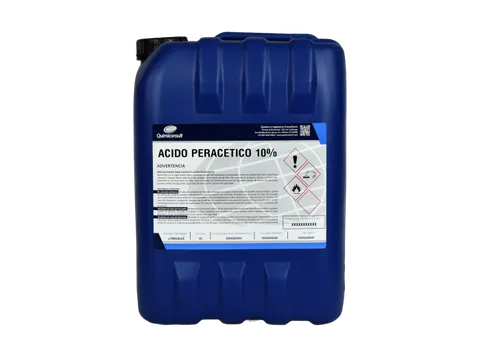
Anticel Peracetic Acid 10% (SKU INPTF018) is the next step up in PAA concentration, offering a balance between dosing capacity and ease of handling. It is often chosen by plants that need more dosing efficiency than the 5% offers without going to the highest concentrations.
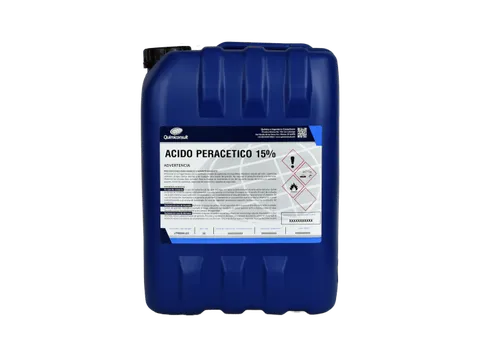
Anticel Peracetic Acid 15% (SKU INPTF020) is our most requested reference for general disinfection applications. It holds OMRI, NSF Nonfood Compounds, Kosher Pareve Pessach and SADER certifications, the broadest regulatory backing in our line. For plants that require these specific certifications, Anticel 15% is the right formulation.
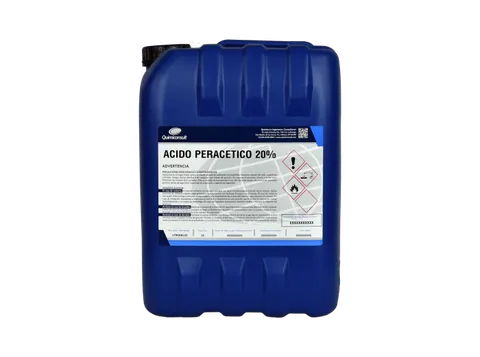
Anticel Peracetic Acid 20% is our highest-PAA formulation, designed for large-scale operations where efficiency per kilogram and reduced storage volumes are decisive factors.
Anticel PRO is a specialized variant with self-regulating acidity, formulated specifically for direct contact with meat carcasses and chicken carcasses, as well as for postharvest disinfection of sensitive fruits and vegetables. Its self-regulating technology minimizes the over-discoloration and damage to animal and plant tissue that conventional peracetic acids can cause.
Our portfolio also includes complementary products such as SANIDET (SKU INPTF027), a base disinfectant that complements the sanitization program, and fourth-generation quaternary ammonium compounds (SKU INMPQ084), which provide residual disinfection with a prolonged bacteriostatic effect.
Our technical team can advise on selecting the most appropriate formulation for each point of application. A common setup in mid-sized plants is to use Anticel Oxy for surface sanitization and manual dosing applications, while the higher-concentration formulations are reserved for the higher-demand automated dosing systems.
Directions for use and dosage of Anticel Oxy 5% peracetic acid
Anticel Oxy can be applied by three main methods: injection into process water, spraying or immersion. Because of its lower peracetic acid concentration, the dosing volumes needed to reach use concentrations are proportionally larger than with the 15% or 20% formulations, which should be taken into account when sizing preparation tanks and dosing systems.
For no-rinse surface sanitization, a concentration of 100 to 200 ppm is recommended under FDA regulation 21 CFR 178.1010. For surface disinfection followed by a rinse, the concentration increases to a range of 220 to 400 ppm.
For carcass decontamination in the meat industry, recommended concentrations range from 90 to 220 ppm under 21 CFR 173.370, with no subsequent rinse required. For the poultry industry, 30 to 40 ppm is recommended in the Chiller and 10 to 20 ppm in the PreChiller.
For fruit and vegetable rinse water, concentrations are 60 to 80 ppm under 21 CFR 173.315. In irrigation water, the concentration must not exceed 80 ppm under 21 CFR Part 173 D.
Anticel Oxy does not require pH control to achieve effective microbial control, working under both acidic and slightly alkaline conditions. This operational simplicity is one of its main attractions for plants where sanitization procedures need to be as straightforward as possible.
Dosing should be monitored regularly with peracetic acid-specific test strips or with automated measuring equipment. Bear in mind that the high hydrogen peroxide content of Anticel Oxy can interfere with some PAA measurement methods unless strips or equipment designed to work in the presence of H2O2 are used, so we recommend verifying that the monitoring method is compatible with this product's specific composition.
For operations that dose manually, we recommend preparing working solutions in non-metallic containers, using clean water and following the dilution tables provided by our technical team. Solutions should be prepared immediately before use or within a reasonable period, keeping the prepared solution protected from sunlight and heat to preserve its efficacy.
Physicochemical properties of Anticel Oxy 5% peracetic acid
Knowing the physicochemical properties of Anticel Oxy is essential for its correct handling, storage and dosing. Its composition profile is unique within the Anticel line and must be understood to make the most of its capabilities.
Anticel Oxy is a colorless liquid with a strong, characteristic acetic acid odor. Its composition includes peracetic acid at a minimum concentration of 5%, hydrogen peroxide at a minimum concentration of 26% and acetic acid in a range of 5 to 10%. The proportion of hydrogen peroxide is significantly higher than in the 15% and 20% formulations of the Anticel line (where H2O2 is 5 to 8%), giving it superior oxidizing and bleaching characteristics.
The product's density is in the range of 1.00 to 1.15 g/cc, and its pH in a 1.0% solution is 2.5 to 3.5. It is 100% soluble in aqueous media, which makes it easy to dilute and incorporate into any application system. Its high biodegradability ensures that the degradation by-products (oxygen, water and acetic acid) are completely benign to the environment.
The product is a strong, highly reactive oxidizing agent, stable under the recommended storage and handling conditions. It is classified as a Type F organic peroxide, UN number 3109, hazard class 5.2 (8) and packing group II. Under the NFPA rating, it has a health hazard rating of 3, flammability of 2 and reactivity of 4.
Certifications of Anticel Oxy 5% peracetic acid
Anticel Oxy is registered with SADER (Secretaría de Agricultura y Desarrollo Rural), the Mexican authority responsible for regulating inputs used in the agri-food and livestock industries. This registration confirms that the product complies with the applicable national regulations for use in food processing establishments, livestock facilities and other environments regulated by this agency.
The Quimiconsult production plant where Anticel Oxy is manufactured is SQF (Safe Quality Food) certified, a standard recognized by the GFSI (Global Food Safety Initiative) that audits the entire quality and food safety management system of the manufacturing process. From receipt of raw materials to packaging and distribution, every stage is controlled under a certified management system, providing confidence that the product comes from a manufacturing process with quality controls audited to international standards.
For plants that require additional certifications such as OMRI for organic production, NSF Nonfood Compounds or Kosher for their sanitization products, Quimiconsult offers Anticel Peracetic Acid 15% (SKU INPTF020), which holds the broadest set of certifications in our peracetic acid line.
Storage and handling of Anticel Oxy 5% peracetic acid
Proper storage and handling of Anticel Oxy are essential to maintain product integrity, ensure staff safety and comply with applicable regulations. Although its lower peracetic acid concentration compared with the 15% and 20% formulations may suggest an easier-to-handle product, it is important to remember that Anticel Oxy contains a minimum of 26% hydrogen peroxide, which likewise classifies it as an organic peroxide with strong oxidizing properties that require rigorous precautions.
The product must be stored in a cool, well-ventilated place within a temperature range of minus 15°C to 40°C. It must be kept exclusively in its original container, which has a vented seal designed to safely release any gas buildup. It must never be transferred to containers that lack this venting system. The container must remain tightly closed when not in use and protected from direct sunlight.
Anticel Oxy must be stored away from reducing agents, combustible materials, acids, bases, metals, heavy metal salts and flammable organic materials. It must never be mixed with bleach or other chlorine-treated products, as this combination can generate chlorine gas. Product drying on clothing or other combustible materials may cause fire.
For safe handling, staff must wear personal protective equipment including chemical splash goggles, chemical-resistant impermeable gloves, safety shoes and a suitable protective suit. In case of exposure to vapors or mists, a full-face respirator must be used. All handling must be done outdoors or in well-ventilated areas.
The product is classified as corrosive to skin (Category 1), causes serious eye damage (Category 1), may cause respiratory irritation (Category 3) and may catch fire when heated (H242), under the Globally Harmonized System (GHS) according to NOM-018-STPS-2015.
In case of eye contact, rinse cautiously with water for several minutes and seek immediate medical attention. In case of skin contact, immediately remove all contaminated clothing and wash with plenty of soap and water. If swallowed, rinse the mouth without inducing vomiting and contact a doctor immediately. If inhaled, move the person to fresh air and keep at rest.
It is an essential requirement that everyone who handles this product be trained in the recommendations contained in the Safety Data Sheet.
Other names and synonyms for Anticel Oxy 5% peracetic acid
Anticel Oxy may also be identified as Anticel Oxy 5%, Anticel peracetic acid 5%, Anticel PAA 5% or simply as 5% peracetic acid, terms used in industrial settings to refer to this low-PAA sanitizing solution with a high hydrogen peroxide content. These names appear in technical documentation, sanitization programs, SSOP procedures and purchasing specifications.
In some contexts, the product may be described as a low-concentration peracetic acid sanitizer, PAA 5% disinfectant, oxidizing biocide with hydrogen peroxide, dual oxidizing action sanitizer, ready-to-use peracetic acid or easy-to-handle no-rinse disinfectant. These terms reflect both its composition and its positioning in the industrial sanitizer market.
Within the family of peracetic acid sanitizers, Anticel Oxy stands out for its high hydrogen peroxide content, which differentiates it from other manufacturers' 5% peracetic acids that typically contain lower proportions of H2O2. This distinction is relevant for users looking not only for disinfection but also for oxidizing and bleaching power to remove organic residues and stains from surfaces.
In purchasing and procurement it is common to see searches such as 5% peracetic acid price, low-concentration peracetic acid, PAA 5% for food, easy-to-handle sanitizer, peracetic acid for packing houses, sanitizer for industrial restaurants, disinfectant for industrial kitchens, peracetic acid for small businesses, sanitizer for poultry farms or oxidizing surface disinfectant, where functional descriptions are used to find options available on the market. These variations help purchasing, quality and sanitation managers in operations of all sizes identify the right solution for their disinfection programs.
In transport and regulatory documentation, Anticel Oxy is identified under its UN designation as Organic peroxide type F, liquid (Peracetic acid), UN number 3109, hazard class 5.2 (8), packing group II.