Spanish
 English



OPTISAN 100
View All Prices
| Quantity | Unit Price |
|---|---|
| kg | |
| 1+ | USD 3.38 |
Need more? Message us and we'll help you source the volume you're after.
Message us on WhatsApp Message usOptisan 100 Description — Fast-Acting, Broad-Spectrum 1% PHMB Biocide for Surface Disinfection
At Quimiconsult we offer Optisan 100, a fast-acting, broad-spectrum biocide formulated with 1% PHMB (polyhexamethylene biguanide) in an alcohol-based solution, developed for surface disinfection in the food and beverage industry, hospitals, veterinary establishments and livestock facilities. Optisan 100 is active against bacteria, yeasts and amoebae —including Listeria monocytogenes, Salmonella, Escherichia coli O157:H7, Staphylococcus aureus, Pseudomonas aeruginosa and Legionella pneumophila— and, thanks to its specific mode of action, microorganisms do not develop resistance to it.
What sets it apart from other disinfectants is its high wetting power: Optisan 100 lowers surface tension and increases the contact area, carrying its biocidal action into the microcracks of equipment, tables and conveyors, where the microorganisms that survive conventional cleaning take refuge. Its alcohol base also allows micro-fogging of hard-to-reach areas such as cold rooms, ducts, storage areas and transport equipment.
Optisan 100 is a purified product that leaves no off-flavours in food, dilutes easily even in cold water, is active across a wide pH range (4.5 to 12.0) and is gentle on operators' skin. For anyone looking for a PHMB disinfectant, a surface sanitizer for food plants, a biocide for livestock facilities or a chlorine-odour-free disinfectant for hospitals and veterinary establishments, Optisan 100 is the technical answer in the Quimiconsult catalogue, available from Monterrey, Nuevo León, with shipping throughout Mexico.
Optisan 100 technical characteristics
Optisan 100 is a clear liquid with a minimum active (PHMB) content of 1.0%, a density of 0.80 to 1.00 g/cm³ at 20 °C and a pH of 5.00 to 7.50 in a 1.0% solution. Its active ingredient, polyhexamethylene biguanide, is a cationic polymeric biocide that binds to microbial membranes, destabilizes them and blocks their metabolic functions, without relying on oxidation the way chlorine or peracetic acid do. That is why Optisan 100 stays active across a wide pH range (4.5 to 12.0) and has none of the characteristic odour of chlorinated disinfectants.
The alcohol-based solution does two jobs: it improves wetting and the penetration of the active into the surface, and it lets the product be applied by micro-fogging to reach areas that conventional spraying misses. Because it dilutes easily, working solutions can be prepared with cold water, with no heating needed.
Optisan 100 technical specifications
Description:
Fast-acting, broad-spectrum biocide, 1% PHMB
Active ingredient:
PHMB (polyhexamethylene biguanide)
Active content:
Minimum 1.0%
Appearance:
Clear liquid
pH (1.0% solution):
5.00 – 7.50
Active pH range:
4.50 – 12.0
Density (20 °C):
0.80 – 1.00 g/cm³
Base:
Alcohol solution, suitable for micro-fogging
Use concentration:
0.02 – 2.8% depending on the application
Shelf life:
One year
Pack size:
20 kg jerrycan
Quimiconsult SKU:
INPTF082
Optisan 100 comes with its Technical Data Sheet (TDS), available for download on this page, and any additional documentation your audit and supplier-approval processes require.
How does Optisan 100 work? Wetting + action on the cell membrane
Optisan 100 controls microbial growth through a combination of three mechanisms:
High wetting and penetration into microcracks. Optisan 100 lowers the surface tension of the solution and increases its contact area with the surface. It reaches the microcracks, joints and rough spots of equipment, tables and conveyors, where microorganisms shelter and where a low-wetting disinfectant cannot reach.
Destruction of the bacterial envelope. Cationic PHMB binds to the cell wall and membrane of microorganisms, destabilizes them and causes them to lose their integrity. This is a physical, specific action on the membrane, so bacteria, fungi and yeasts do not develop resistance to it.
Deactivation of metabolic functions. Once inside the cell, Optisan 100 deactivates basic metabolic functions in the cytoplasm, such as protein synthesis and primary enzymatic activity, preventing the microorganism from recovering and multiplying.
Optisan 100 antimicrobial spectrum
The Optisan 100 technical data sheet reports its minimum inhibitory concentration (MIC) against a broad panel of microorganisms. The MIC is not the effective use level —given in the dosage section— but shows the product's broad intrinsic spectrum of activity:
- Gram-positive bacteria: Bacillus subtilis (6 ppm), Streptococcus faecalis (20 ppm), Streptococcus lactis (80 ppm), Staphylococcus aureus (120 ppm) and Listeria monocytogenes (120 ppm).
- Gram-negative bacteria: Legionella pneumophila (20 ppm), Pseudomonas putida (100 ppm), Enterobacter cloacae (160 ppm), Proteus vulgaris (160 ppm), Pseudomonas aeruginosa (160 ppm), Escherichia coli O157:H7 (320 ppm), Salmonella choleraesuis (489 ppm) and Salmonella typhimurium (640 ppm).
- Yeasts: Rhodotorula rubra (30 ppm), Candida albicans (1,200 ppm) and Saccharomyces cerevisiae (1,200 ppm).
- Amoebae: Acanthamoeba polyphaga (20 ppm).
This spectrum covers the main pathogens of concern in food safety (Listeria, Salmonella, E. coli O157:H7, S. aureus), the spoilage organisms that undermine sanitary quality, and the organisms associated with water and air-conditioning systems, such as Legionella and the free-living amoebae that harbour it.
Optisan 100 applications
Optisan 100 is effective across a wide range of industrial disinfection applications, mainly as a disinfectant for pre-cleaned hard surfaces. The concentration and protocol should be validated with the Quimiconsult technical team for the type of surface, the microbial load and the application method.
Food and beverage processing plants
Disinfection of production equipment, work tables, conveyors and utensils, as well as process, storage and refrigeration areas. Its high wetting power carries the active into equipment microcracks, and as a purified product it leaves no off-flavours in food. Micro-fogging treats cold rooms, ceilings and hard-to-reach ducts.
Breweries: acid descaling disinfection
As a component of acid descaling disinfectant solutions in breweries, at 1.6 to 2.8%, taking advantage of Optisan 100's activity across a wide pH range.
Canning and bottling plants: tunnel pasteurization
Microbial control of tunnel pasteurizer water in canning and bottling plants, at very low dosages (0.02 to 0.04%).
Hospitals, institutions and veterinary establishments
Disinfection of pre-cleaned hard surfaces in hospitals, clinics, institutions and veterinary establishments that need a broad-spectrum disinfectant with no chlorine odour that is gentle on staff's skin.
Livestock facilities
Disinfection of livestock facilities, pens, handling areas, equipment and animal transport vehicles. Its alcohol base allows micro-fogging of barns and enclosed spaces.
Air conditioning and water treatment
Treatment of air-conditioning unit water, at 0.04 to 0.4%, to control microorganisms such as Legionella pneumophila and the free-living amoebae that harbour it.
Optisan 100 directions for use and dosage
The Optisan 100 technical data sheet recommends the following concentrations, expressed as % Optisan 100 (w/w) in the sanitizing solution:
Disinfection of pre-cleaned hard surfaces (hospitals, veterinary and food processing establishments):
0.4 – 0.8%
Air-conditioning water treatment:
0.04 – 0.4%
Acid descaling disinfection in breweries:
1.6 – 2.8%
Tunnel pasteurization (canning and bottling plants):
0.02 – 0.04%
Application methods: spraying, immersion, mopping and micro-fogging. Always apply to clean surfaces: organic matter reduces the efficacy of any disinfectant, so Optisan 100 should be used after the cleaning step with a suitable detergent.
Good practice: prepare the solution with good-quality water (cold is fine); keep to the concentration given for each application; and validate the protocol with microbiological counts after disinfection. The Quimiconsult technical team supports the trial and adjustment stage.
Where Optisan 100 fits in the cleaning and disinfection programme
Optisan 100 is the final stage of a cleaning and disinfection programme. A typical food-industry cycle follows this sequence:
- Pre-rinse with water to remove gross soil.
- Alkaline cleaning to remove fat and protein, with a detergent such as Alkaplus (open surfaces, high foam) or CLK Premium (CIP).
- Rinse with water.
- Acid cleaning where there is mineral scale, with a detergent such as Lactac.
- Rinse with water.
- Disinfection with Optisan 100 on the clean surface, by spraying, immersion or micro-fogging.
Optisan 100 compared with other disinfectants
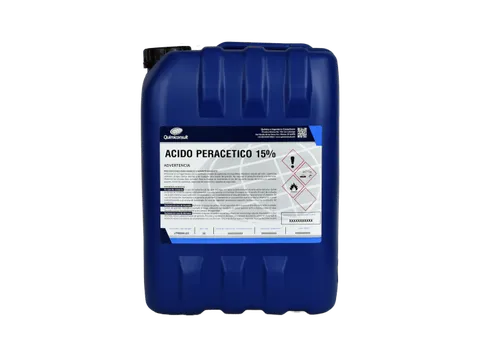
Optisan 100 (PHMB) vs. peracetic acid (Anticel line): peracetic acid is a broad-spectrum oxidizing sanitizer, ideal for CIP and process surfaces, that breaks down into harmless residues. Optisan 100 is not an oxidizer: it acts on the cell membrane, has no pungent odour, and its alcohol base allows micro-fogging of hard-to-reach areas. The choice depends on the application method and the type of facility.
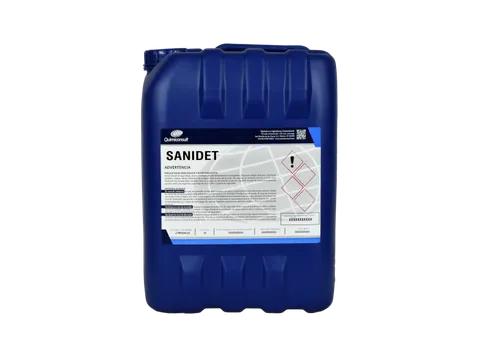
Optisan 100 vs. quaternary ammonium compounds (Sanidet, Nexide QS): both are cationic surface disinfectants. Optisan 100 stands out for its activity across a very wide pH range (4.5 to 12.0) and because microorganisms do not develop resistance to it, an advantage in disinfectant-rotation programmes.
Optisan 100 vs. chlorinated disinfectants (DXL, sodium hypochlorite): chlorinated products are powerful oxidizers but have a characteristic odour and can corrode metals and irritate skin. Optisan 100 has no chlorine odour, is gentle on operators' skin and leaves no off-flavours in food.
Optisan 100 vs. iodophors (Iodactive line): iodophors are the standard in livestock applications such as teat dipping. Optisan 100 is aimed at disinfecting surfaces, facilities and water, and can be part of a rotation programme with them.
Optisan 100 safety, handling and storage
Handle Optisan 100 according to the recommendations in its current Safety Data Sheet (SDS). Although it is gentle on operators' skin at use concentrations, personal protective equipment is recommended when handling the concentrate: safety glasses, chemical-resistant gloves and protective clothing. Because of its alcohol base, keep it away from heat and ignition sources.
Storage: keep in the original closed container in a cool, dry, ventilated place, away from direct sunlight. The product's shelf life is one year. Dispose of leftover product and empty containers in accordance with current environmental regulations.
Optisan 100 frequently asked questions
What is Optisan 100 and what is it used for?
Optisan 100 is a fast-acting, broad-spectrum biocide based on 1% PHMB (polyhexamethylene biguanide) in an alcohol solution. It is used to disinfect hard surfaces in food and beverage plants, hospitals, veterinary establishments and livestock facilities, and to treat air-conditioning water and tunnel pasteurizers.
What is PHMB?
PHMB, or polyhexamethylene biguanide, is a cationic polymeric biocide that acts on the cell membrane of bacteria, fungi and yeasts. It is not an oxidizer, has no chlorine odour and is widely used in surface disinfection and healthcare.
Which microorganisms is it effective against?
Its technical data sheet reports activity against bacteria such as Listeria monocytogenes, Salmonella, E. coli O157:H7, Staphylococcus aureus, Pseudomonas aeruginosa and Legionella pneumophila; yeasts such as Candida albicans and Saccharomyces cerevisiae; and amoebae such as Acanthamoeba polyphaga.
Do microorganisms develop resistance to Optisan 100?
No. Because of its specific mode of action on the cell membrane, bacteria, fungi and yeasts do not develop resistance to Optisan 100.
At what concentration is it used?
0.4 to 0.8% for disinfecting pre-cleaned surfaces; 0.04 to 0.4% in air-conditioning water; 1.6 to 2.8% for acid descaling disinfection in breweries; and 0.02 to 0.04% in tunnel pasteurization.
Can it be applied by fogging?
Yes. Its alcohol base is designed for fine micro-fogging of hard-to-reach areas such as cold rooms, ducts and enclosed spaces.
Does it leave a taste or odour in food?
No. Optisan 100 is a purified product free of contaminants that could cause off-flavours in food, and it has none of the characteristic odour of chlorinated disinfectants.
Is it harmful to operators' skin?
At use concentrations, Optisan 100 is gentle on operators' skin. When handling the concentrate, follow the protective-equipment recommendations in its SDS.
How long does it keep in storage?
Its shelf life is one year in the original closed container, stored in a cool, dry place away from sunlight.
Where can I buy Optisan 100 in Mexico?
From Quimiconsult, available from Monterrey, Nuevo León, with shipping throughout Mexico, in a 20 kg jerrycan. Call us on +52 (81) 8105 0063 for advice on the disinfection protocol, the optimal concentration and a quote.
Other names and terms related to Optisan 100
In purchase requests, specification sheets and online searches, Optisan 100 is referred to by functional and active-ingredient descriptions:
Optisan, Optisan 100, PHMB disinfectant, 1% PHMB, polyhexamethylene biguanide, polyhexanide, polymeric biguanide, broad-spectrum biocide, fast-acting biocide, surface disinfectant, surface sanitizer, food plant disinfectant, food industry disinfectant, chlorine-free sanitizer, hospital disinfectant, veterinary disinfectant, livestock facility disinfectant, farm disinfectant, fogging disinfectant, micro-fogging disinfectant, alcohol-based disinfectant, air-conditioning biocide, Legionella control, disinfectant against Listeria, disinfectant against Salmonella, Optisan 100 price, Optisan 100 Quimiconsult, PHMB disinfectant Mexico, industrial disinfectant Monterrey.
Why buy Optisan 100 from Quimiconsult?
Quimiconsult is a Mexican company with more than 30 years of experience in specialty chemicals for industrial and food-industry cleaning and disinfection. When you buy Optisan 100 from Quimiconsult you get:
- A broad-spectrum PHMB biocide with documented activity against the main food-safety pathogens.
- Direct technical support to design your cleaning and disinfection programme and validate the protocol.
- The full range of alkaline and acid detergents and disinfectants from a single Mexican supplier.
- Availability from Monterrey, Nuevo León, with shipping throughout Mexico and technical documentation (TDS).
Does your food plant, hospital or livestock facility need a broad-spectrum disinfectant with no chlorine odour that is easy to apply? Call us on +52 (81) 8105 0063: we will review your process and propose a disinfection protocol with products from our catalogue.
Related products
Optisan 100 is part of Quimiconsult's cleaning and disinfection portfolio. Products that complement it in a complete programme:
- Anticel Peracetic Acid (5% / 15%) — broad-spectrum, no-rinse oxidizing sanitizer for CIP and process surfaces.
- Sanidet / Nexide QS — quaternary ammonium disinfectants for surfaces and facilities.
- Iodactive 7 — iodophor for surface disinfection.
- Alkaplus — self-foaming alkaline detergent for cleaning open surfaces before disinfection.
- CLK Premium — chlorinated alkaline detergent for CIP cleaning.
- Lactac — acid descaling detergent for removing mineral scale.
Related categories: Disinfection and sanitization for food and beverages · Industrial cleaning disinfectants · Animal health disinfection · Water treatment biocides
Looking to put together a complete cleaning and disinfection programme for your plant? Contact us and we will review the options in our catalogue for your industry and process.