Spanish
 English


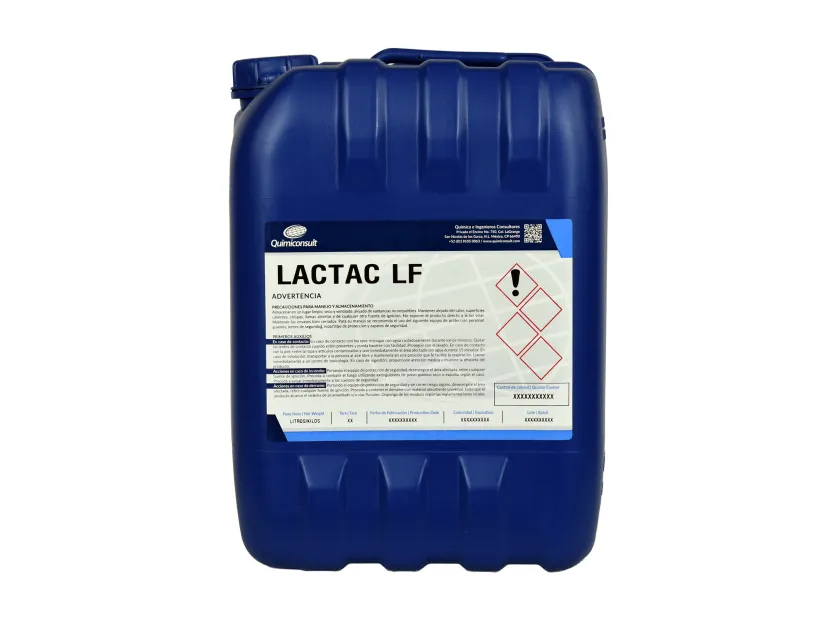
LACTAC LF ACID CIP DETERGENT FOR REMOVAL OF ORGANIC MATTER AND SCALE
View All Prices
| Quantity | Unit Price |
|---|---|
| kg | |
| 1 - 99 | USD 2.40 |
| 100 - 199 | USD 2.30 |
| 200 - 599 | USD 2.20 |
| 600 - 999 | USD 1.98 |
| 1000+ | USD 1.90 |
Need more? Message us and we'll help you source the volume you're after.
Message us on WhatsApp Message usLactac LF Description — Acid CIP Detergent for Removing Scale and Organic Matter
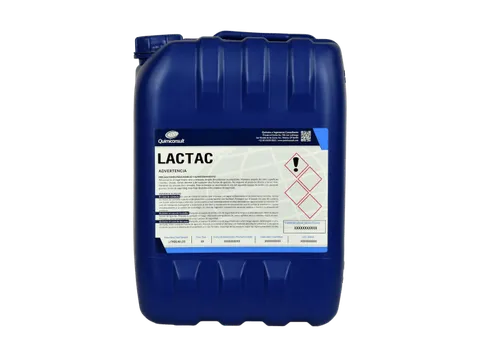
At Quimiconsult we manufacture Lactac LF —also known simply as Lactac in its low-foam version—, a concentrated low-foam acid detergent formulated specifically for CIP (Clean in Place) systems in the food industry. With an acidity of 25.0 to 30.0%, Lactac LF combines the dissolving action of acid on mineral scale with low-foam surfactants that remove organic matter by denaturation-precipitation, keep it in suspension to prevent redeposition, and leave the surface completely clean with a protective layer that temporarily prevents oxidation. It is recommended for removing scale in pasteurizers, coolers, transfer lines, process and storage tanks, and polyethylene and stainless steel equipment, as well as in the meat industry (production equipment, crates and facility surfaces).
Its low-foam profile is a non-negotiable requirement for CIP systems: excess foam in recirculation circuits interferes with the hydrodynamics of the cycle, reduces the effective pressure at spray nozzles and can cause pump cavitation and overpressure. Lactac LF delivers the power of an acid detergent without the operational problems foam creates in automated cleaning systems. It is also highly biodegradable, allowing its use in plants with biological wastewater treatment (activated sludge or stabilization ponds), and it is a stable product that does not release toxic vapors during storage and handling.
As direct manufacturers from our plant in San Nicolás de los Garza, Nuevo León, we control every stage of formulation and production, with analytical verification of the acidity, density and foam level of every lot. Lactac LF complies with SAGARPA/SADER regulations (registration Q-7498-003) and comes with a technical data sheet (FT/TDS) and safety data sheet (HDS/SDS). For those looking for a Mexican-made acid detergent for CIP, low-foam acid degreaser, acid descaler for pasteurizers and heat exchangers, or acid cleaner for the food industry, Lactac LF is the technical answer in the Quimiconsult catalog.
Is detergent acidic or basic? When to use each
A frequent question in the industry is whether detergent is acidic or basic. The answer is that there are detergents of both types, and each tackles a different kind of soil. Alkaline detergents (pH above 10) are effective at dissolving fats and proteins. Against mineral scale —which forms from the precipitation of calcium, magnesium, phosphates and other salts in the process water or in the raw material itself— alkaline detergents are practically ineffective.
That is where an acid detergent such as Lactac LF plays an irreplaceable role: acids dissolve mineral deposits through direct chemical reaction with the carbonates, phosphates and oxalates that form them, converting insoluble salts into soluble salts that the CIP flow carries away and removes. In terms of pH, a detergent is considered acidic when its use solution has a low pH; an acidic-pH soap such as Lactac LF dissolves mineral deposits with short contact times, compatible with standard CIP cycles.
That is why a complete CIP cleaning program alternates alkaline cycles (for organic matter: fat and protein) with acid cycles (for mineral scale), in the sequence: pre-rinse → alkaline cycle → intermediate rinse → acid cycle with Lactac LF → final rinse → sanitization. Trying to replace the acid cycle with more alkaline cycles does not remove scale and leads to its progressive buildup until it affects equipment performance.
Lactac LF technical characteristics
Lactac LF is a slightly amber, acidic, low-foam liquid concentrate, with an acidity of 25.0 to 30.0% and a density of 1.25 to 1.30 g/cc. Its acid capacity dissolves mineral scale and at the same time promotes the removal of fats and proteins by denaturation-precipitation: the acidic medium reduces the adhesion of protein residues, and the low-foam surfactants keep them in suspension, achieving deeper cleaning and preventing redeposition on surfaces that are already clean. After the cycle, it leaves a protective layer that temporarily prevents oxidation of metal surfaces, useful when the time between cleaning and the next production run may be long.
Its high biodegradability makes it suitable for plants with biological wastewater treatment (activated sludge, stabilization ponds), and its stability prevents the release of toxic vapors during storage and handling under normal conditions.
Lactac LF technical specifications
Description:
Low-foam acid CIP detergent
Appearance:
Slightly amber liquid
Acidity:
25.0 – 30.0%
Density:
1.25 – 1.30 g/cc
Foam:
Low (formulated for CIP systems)
Biodegradability:
High
Stability:
High; does not release toxic vapors under normal conditions
Use concentration (CIP):
1 – 5%, for 15 – 20 min
Use concentration (immersion/contact):
2 – 5%, at 70 °C for 10 min
Regulation:
SAGARPA/SADER — registration Q-7498-003
CAS number:
N/A (mixture)
Quimiconsult SKU:
Lactac LF
Every delivery comes with its Technical Data Sheet (FT/TDS) and Safety Data Sheet (HDS/SDS), plus any additional regulatory documentation the customer requires for audits and supplier approval processes.
How does Lactac LF act on scale and process residues?
Lactac LF acts on surfaces through complementary mechanisms that operate during the cleaning cycle:
Dissolution of mineral scale. The acidity of the formulation reacts with the calcium and magnesium carbonates, calcium phosphates and oxalate deposits that form in pasteurizers, plate heat exchangers, pipes and tanks. It converts these insoluble salts into soluble salts that the CIP flow carries away and removes in the purge.
Removal of fats and proteins by denaturation-precipitation. The acidic medium denatures and precipitates residual proteins and fats, reducing their adhesion and promoting their removal by the turbulence of the flow. This is especially useful on protein residues that were not completely removed in the preceding alkaline cycle.
Suspension of residues by low-foam surfactants. The surfactants surround the loosened residues and keep them suspended in the cleaning solution, preventing their redeposition on already-clean areas during recirculation and achieving deeper cleaning.
Temporary protective layer against oxidation. After the acid cycle and rinse, Lactac LF leaves a layer on metal surfaces that temporarily protects them from re-oxidation before the next production cycle.
CIP-compatible low foam. The formulation ensures a foam level compatible with the flow rates and pressures of CIP systems, preventing pump cavitation and the loss of hydraulic efficiency that excess foam causes in closed circuits.
Where Lactac LF fits: the acid cycle of the CIP program
Lactac LF is the acid-cycle detergent for CIP cleaning (closed-loop recirculation). Within the Quimiconsult catalog, the complete program is built like this:
- Pre-rinse with water to flush out coarse soil.
- Alkaline cycle to remove fat and protein: CLK Premium (chlorinated alkaline for CIP, ideal for dairy) or Alkaflow CIP300 (chlorine-free alkaline CIP detergent, e.g. for breweries).
- Intermediate rinse with water.
- Acid cycle to remove mineral scale: Lactac LF (low foam, for recirculating CIP) or Lactac (medium foam, for immersion and out-of-circuit surfaces).
- Final rinse with water.
- Sanitization / disinfection: Quimiconsult's disinfectant solution is the peracetic acid-based Anticel line (Anticel 5% / 15%), a broad-spectrum, no-rinse oxidizing sanitizer; we also offer Sanidet / Quaternary Ammonium for surfaces and facilities.
Important: the alkaline and acid cycles must never be mixed or applied without a complete intermediate rinse. In particular, Lactac LF (acid) must not come into contact with chlorinated alkaline detergents such as CLK Premium, since mixing a chlorinated product with an acid releases toxic chlorine gas.
Industries and equipment where Lactac LF is used
Dairy industry: pasteurizers and plate heat exchangers
The dairy industry is the most demanding environment for an acid CIP detergent: pasteurizers (HTST, UHT and batch) and plate heat exchangers accumulate calcium phosphate and carbonate deposits along with heat-denatured protein (mainly beta-lactoglobulin), which form dairy "fouling". These deposits reduce heat transfer efficiency and create hard-to-reach niches for sanitization. Lactac LF, in the acid cycle of the CIP, dissolves these deposits and restores the equipment's thermal performance.
Meat industry: production equipment, crates and surfaces
In meat plants, protein residues and mineral salts from salting and curing processes build up on production equipment, crates, molds, brine tanks and facility surfaces. Lactac LF acts on these mixed residues, dissolving the mineral fraction and loosening the organic fraction for removal by flow, backed by its SAGARPA/SADER registration for establishments under official inspection.
Brewing and beverage industry: "beerstone" removal
In breweries, the calcium oxalate ("beerstone") that deposits in fermentation and maturation tanks is practically insoluble in alkaline detergents, but dissolves effectively with acids. Thanks to its high acidity and CIP-compatible low foam, Lactac LF is a specific tool for beerstone removal cycles in breweries and fermented beverage plants. (For the alkaline cycle in these plants, when chlorine-free is required, the recommendation is Alkaflow CIP300; the acid cycle is covered by Lactac LF.)
Dairy derivatives and cheesemaking: brines and molding equipment
In cheese plants and dairy derivative plants, molding surfaces, brine tanks and pressing equipment accumulate calcium and protein deposits. Periodic application of Lactac LF, within a CIP program or supervised immersion/contact cleaning, keeps these surfaces hygienic without damaging stainless steel or food-grade polyethylene molds.
Lactac LF directions for use and dosage
In CIP systems: concentration of 1 to 5%, for 15 to 20 minutes of recirculation, depending on the scale load. Applying it at a good flow velocity (turbulence) improves effectiveness on consolidated deposits.
In other equipment (utensils, process tanks, polyethylene molds) by contact or immersion: dilutions of 2 to 5%, at a temperature of 70 °C for 10 minutes. For consolidated deposits, a prior soak improves removal.
Good practices: the acid cycle is carried out after the alkaline cycle and its intermediate rinse, never mixing the two products. Finish with a complete rinse before sanitization or resuming production. Quimiconsult's technical team helps define the concentration, temperature and frequency of the acid cycle according to the product, the equipment and the water hardness.
Lactac LF safety, handling and storage
Lactac LF is a concentrated acid solution that, according to its Safety Data Sheet (HDS/SDS), is a strong oxidizing agent and highly reactive. It must be handled following the recommendations of the current SDS. Although the product is stable under the recommended storage and handling conditions and does not release toxic vapors under normal conditions, it presents a fire hazard if heated, so all ignition sources (sparks, flames), heat and exposure of containers to heat sources must be avoided; do not pressurize, cut or weld containers.
Personal protection: wear safety glasses (and a face shield for severe exposure) and acid-resistant safety gloves, as well as protective clothing, when handling the concentrate.
Incompatibilities: as a strong oxidizing acid, keep separate from concentrated alkalis, reducing agents, combustible or organic materials, and reactive metals. Never mix with alkaline detergents (sudden neutralization generates heat and splashing) or with chlorinated alkaline products such as CLK Premium (mixing a chlorinated product with an acid releases toxic chlorine gas). Store in high-density polyethylene (HDPE) or polypropylene containers; avoid contact of the concentrate with carbon steel, aluminum, zinc and copper.
First aid (general guidance): skin or eye contact, rinse with plenty of water for several minutes (eyes, about 15 minutes) and seek medical attention; ingestion, rinse the mouth, do not induce vomiting and contact a physician; in case of exposure, follow the SDS.
Storage: at room temperature, in the original closed container, in a cool, dry, ventilated place, away from heat and ignition sources, direct sunlight and incompatible materials. Classified and labeled in accordance with the Globally Harmonized System (GHS); the full classification, H statements and precautionary statements must be taken from the current SDS. Dispose of leftover product and containers in accordance with applicable environmental legislation.
Lactac LF material compatibility
Lactac LF is compatible with the standard materials of food CIP systems: stainless steel (304 and 316L), food-grade polyethylene and polypropylene and the usual gasket and seal elastomers (EPDM, silicone). Its use is not recommended in circuits or for storage with components made of aluminum, zinc, copper or uncoated carbon steel, since a low-pH acid can corrode these materials, especially at high temperatures or with prolonged contact times. For non-standard materials or coatings, validate compatibility with a preliminary test and with Quimiconsult's technical team.
Lactac LF compared with other industrial cleaning detergents
Lactac LF (acid, low foam, CIP) vs. Lactac (acid, medium foam, surfaces/immersion): both are descaling acid detergents; Lactac LF is low foam for CIP recirculation in closed circuits, while Lactac (regular) is medium foam for immersion, soaking and spraying of parts and surfaces outside the circuit. Choose according to the cleaning method.
Lactac LF (acid) vs. CLK Premium / Alkaflow CIP300 (alkaline CIP detergents): they are the two sides of the CIP program. The alkalines remove fat and protein; Lactac LF removes the mineral scale that alkalines cannot dissolve. They are used in sequence, always with an intermediate rinse and never mixed (a chlorinated product with an acid releases chlorine gas).
Lactac LF vs. a pure acid (phosphoric or nitric): a pure acid only dissolves minerals; Lactac LF is an acid degreaser that combines scale dissolution with low-foam surfactants that remove and suspend organic matter, preventing redeposition, in addition to its high biodegradability and temporary protective layer against oxidation.
Lactac LF vs. imported acid detergents: it guarantees specified acidity, density and low foam, SAGARPA/SADER registration, high biodegradability, in-house manufacturing with lot-by-lot control, direct technical support and nationwide availability, without the logistics dependence of an imported product.
Frequently asked questions about Lactac LF
Is detergent acidic or basic? When is each one used?
There are acid, alkaline and neutral detergents depending on their use pH. In the food industry, alkaline detergents remove fat and protein; acid detergents such as Lactac LF are the effective ones for dissolving mineral scale (carbonates, phosphates, oxalates, hard-water scale). A professional CIP program alternates both: rinse, alkaline cycle, rinse, acid cycle with Lactac LF, rinse and sanitization. Replacing the acid cycle with more alkaline cycles does not remove scale and lets it build up until it affects the equipment.
What is the difference between an acid detergent and an "acid degreaser"?
"Acid degreaser" describes a product that combines acid action (dissolving mineral scale) with surfactant action (removing organic residues). Lactac LF is technically an acid degreaser: its acidity acts on mineral deposits and its low-foam surfactants remove and suspend organic matter, preventing redeposition. This sets it apart from a pure acid (phosphoric, nitric), which only dissolves minerals and requires an additional step with detergent.
Can Lactac LF be used for CIP cleaning?
Yes, it is its main application. It is formulated with low foam specifically for closed-loop CIP recirculation. It is used at 1 – 5% for 15 – 20 minutes. For out-of-circuit equipment (utensils, tanks, polyethylene molds) it is applied by contact or immersion at 2 – 5%, 70 °C, 10 minutes.
Does Lactac LF remove "beerstone" in breweries?
Yes. Beerstone (calcium oxalate) is practically insoluble in alkalines, but dissolves with acids. Thanks to its high acidity and CIP-compatible low foam, Lactac LF is suitable for beerstone removal cycles in fermentation and maturation tanks.
Is it compatible with stainless steel, EPDM and food-grade plastics?
Yes, with 304 and 316L stainless steel, EPDM, silicone, and food-grade polyethylene and polypropylene. It is not recommended in circuits with aluminum, zinc, copper or uncoated carbon steel, because a low-pH acid can corrode them. For non-standard materials, consult our technical team.
How often is the acid cycle applied in a CIP program?
It depends on the product, the water hardness and how fast scale forms in each piece of equipment. As a reference, in dairy the acid cycle is usually inserted every certain number of days between alkaline cycles; in breweries, beerstone removal is scheduled less frequently depending on the equipment. Our technical team can audit your program and set the optimal frequency.
What registrations or certifications does Lactac LF have?
Lactac LF complies with SAGARPA/SADER regulations (registration Q-7498-003) for use in animal-origin food processing establishments. Request the current documentation (FT/TDS and HDS/SDS) for your audits.
Where to buy Lactac LF in Mexico?
At Quimiconsult we are direct manufacturers, with availability from the Monterrey area, Nuevo León, and shipping throughout Mexico. Contact us at +52 (81) 8105 0063 for a quote, technical data sheet, safety data sheet and advice on your CIP program.
Other names and terms related to Lactac LF
Lactac LF is a Quimiconsult brand. It is identified in short as Lactac or Lactac LF, and in purchase requests, specification sheets and online searches it is commonly referenced through functional descriptions:
Lactac, Lactac LF, acid detergent, CIP acid detergent, detergent acid, acid degreaser, acidic degreaser, acid soap, acidic-pH soap, acid cleaning solution, acid cleaner, acid descaler, low-foam acid detergent, acid detergent for pasteurizers, acid detergent for plate heat exchangers, beerstone removal acid, hard-water scale acid, dairy CIP acid detergent, brewery acid detergent, Lactac LF Quimiconsult, acid detergent Monterrey, industrial acid detergent manufacturer Mexico.
These variations help buyers, maintenance managers, sanitation supervisors and quality managers find Lactac LF within Quimiconsult's own line of low-foam acid detergents for CIP.
Why buy Lactac LF from Quimiconsult?
Quimiconsult is a Mexican company with more than 30 years of experience in specialty chemicals and a direct manufacturer of a complete family of detergents and sanitizers for industrial and food cleaning. When you buy Lactac LF from Quimiconsult you get:
- A low-foam CIP acid detergent with acidity and density specified and verified lot by lot.
- Dual action: dissolution of mineral scale and removal of organic matter by denaturation-precipitation, with a temporary protective layer against oxidation.
- High biodegradability, suitable for plants with biological wastewater treatment.
- SAGARPA/SADER (Q-7498-003) compliance and supporting documentation (FT/TDS and HDS/SDS) for your audits.
- Direct technical support from the manufacturer, with advice on the complete CIP program (alkaline → acid → sanitizing) and protocol validation.
- The program's complete product family (CIP and surface alkalines, acids and sanitizers) from a single Mexican supplier.
- Availability from Monterrey, Nuevo León, with shipping throughout Mexico.
Does your dairy, meat, brewing or food plant need a reliable, Mexican-made acid CIP detergent? Contact us at +52 (81) 8105 0063: we analyze your process, the condition of the scale and your water hardness, and propose a complete CIP program with the products in our catalog.
Related products
Lactac LF is part of Quimiconsult's industrial cleaning and sanitation portfolio. Products that complement its use within a complete program:
- CLK Premium — chlorinated alkaline detergent for the alkaline cycle in CIP, ideal for dairy because of its high protein load.
- Lactac LF — medium-foam descaling acid detergent, for the acid cycle by immersion, soaking and spraying outside the CIP circuit.
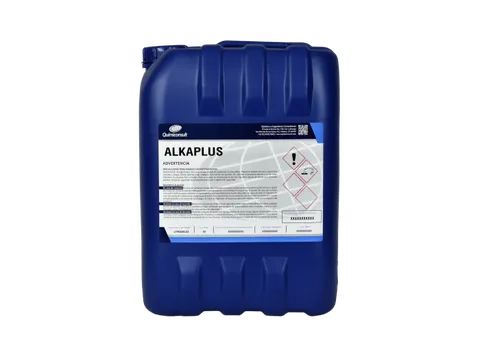
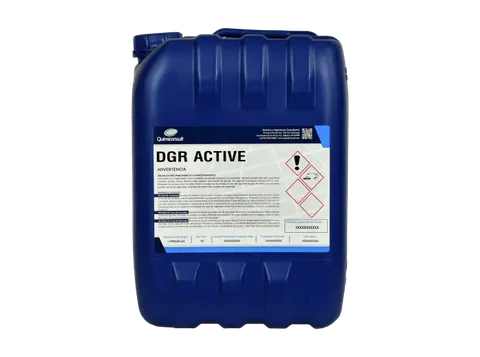
- Alkaplus / DGR Active — chlorine-free self-foaming alkaline detergents for cleaning surfaces and facilities (COP).
- Anticel Peracetic Acid (5% / 15%) — Quimiconsult's disinfectant solution: a broad-spectrum, no-rinse peracetic acid-based oxidizing sanitizer for the final disinfection stage of surfaces and equipment.
- Sanidet / Quaternary Ammonium— sanitizers for plant surfaces and facilities.
- Sequestrants and antiscalants (EDTA, sodium gluconate, PBTC) — to reinforce scale control in high-hardness water.
Related categories: Acid detergents for industrial cleaning · Detergents and agents for CIP cleaning · Supplies for the dairy, meat and beverage industries · Sanitizers and disinfectants
Looking to build a complete CIP cleaning and sanitation program (alkaline → acid → sanitizing) for your plant? Contact us and we will review the options in our catalog for your industry and type of process.
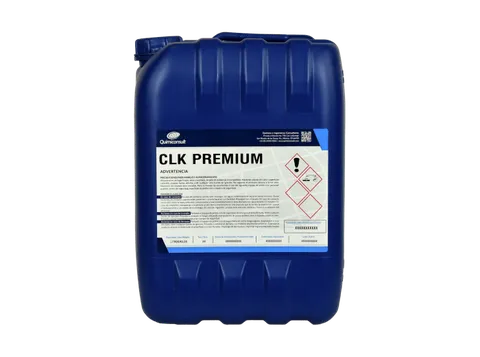
CLK PREMIUM CHLORINATED ALKALINE CIP DETERGENT FOR REMOVAL OF FAT AND PROTEIN