Spanish
 English


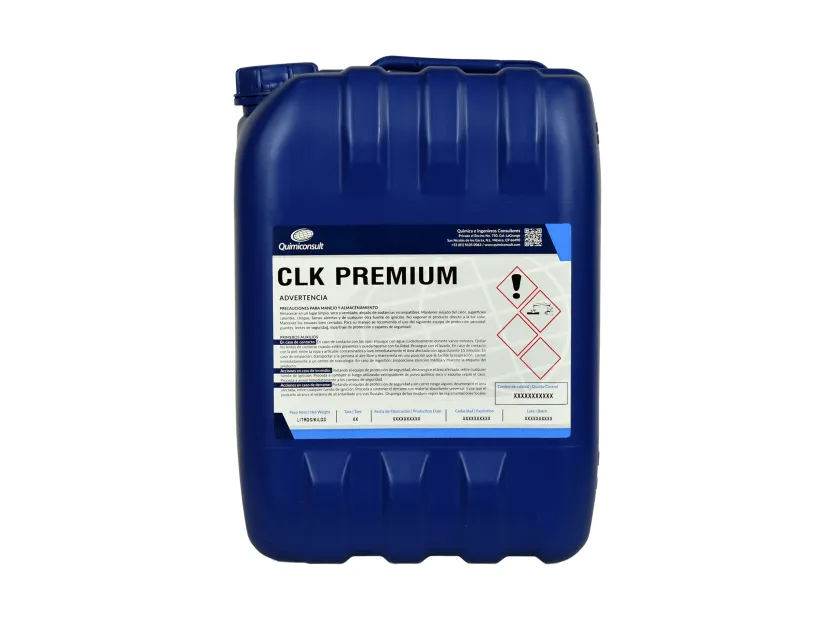
CLK PREMIUM CHLORINATED ALKALINE CIP DETERGENT FOR REMOVAL OF FAT AND PROTEIN
View All Prices
| Quantity | Unit Price |
|---|---|
| kg | |
| 1 - 99 | USD 2.10 |
| 100 - 199 | USD 2.08 |
| 200 - 599 | USD 2.06 |
| 600 - 999 | USD 2.00 |
| 1000+ | USD 1.90 |
CLK Premium Description — Chlorinated Alkaline Detergent for CIP Cleaning in the Food Industry
At Quimiconsult we manufacture CLK Premium, a high-performance chlorinated alkaline detergent formulated especially for CIP (Clean in Place) cleaning by closed-loop recirculation, spraying or immersion, aimed at removing fat and protein from process surfaces in the food, dairy and beverage industries. CLK Premium combines a powerful alkaline base (minimum alkalinity of 20%) with available chlorine (2.0 to 3.0%) and a system of additives, wetting agents and dispersants that enhance its performance, achieving deep cleaning of the organic soil film —saturated fat, oils, denatured protein, surface milkstone and biofilm— and leaving equipment hygienic and ready for the sanitization stage.
CLK Premium is designed as the alkaline detergent of the CIP cycle: its controlled foam profile and wetting-dispersing system make it suitable for recirculation in the closed circuits of pasteurizers, silos, tanks and pipelines, where high-foam detergents cannot be used. The available chlorine in its formulation decisively boosts the removal of protein and organic films: it peptizes and disperses protein residues, helps bleach stains and organic deposits, contributes to odor control and makes it easier to flush away soil during rinsing, a performance that a chlorine-free alkaline detergent cannot match on protein-rich soils such as those in the dairy industry.
As direct manufacturers from our SQF (Safe Quality Food) certified plant in Monterrey, Nuevo León, we control every stage of formulation and production, ensuring lot-to-lot consistency. CLK Premium is certified by NSF International, holds Kosher certification and is registered with SAGARPA (now SADER), and comes with a technical data sheet (TDS), safety data sheet (HDS/SDS) and certificate of analysis for every lot, with direct technical support from the manufacturer and shipping throughout Mexico. For those looking for a Mexican-made chlorinated alkaline detergent for CIP, a CIP cleaner for dairy, a chlorinated alkaline degreaser for pasteurizers, silos and tanks, or an NSF/Kosher chlorinated alkaline agent, CLK Premium is the technical answer in the Quimiconsult catalog.
CLK Premium technical characteristics
CLK Premium is a slightly amber, chlorinated alkaline liquid concentrate, with a density of 1.20 to 1.30 g/cc and a pH of 13.0 to 15.0 in a 1.0% solution. Its minimum alkalinity of 20% and available chlorine content of 2.0 to 3.0% give it a combined action on the organic soils of the food industry: the alkaline base saponifies fats and oils (turning them into water-soluble compounds) and peptizes proteins, while the available chlorine boosts the breakdown and dispersion of the protein film, bleaches organic stains and contributes to odor control. The wetting agents and dispersants in the formulation ensure the detergent penetrates the soil film and keep organic matter in suspension to prevent its redeposition on the already-clean surface, with controlled foam that allows its use in CIP recirculation.
Its high solubility and consistent performance make it possible to prepare homogeneous working solutions and take advantage of the effect of temperature: higher temperatures make fat and protein removal easier, so 65 °C is a suitable application temperature, for 15 to 20 minutes of contact/recirculation.
CLK Premium technical specifications
Description:
Chlorinated alkaline agent / detergent for CIP
Appearance:
Chlorinated alkaline liquid, slightly amber
Alkalinity:
Minimum 20.0%
Available chlorine:
2.0 – 3.0%
pH (1.0% solution):
13.0 – 15.0
Density:
1.20 – 1.30 g/cc
Solubility:
High
Use concentration:
0.5 – 2.0%
Application temperature:
65 °C (recommended)
Contact time:
15 – 20 minutes
Certifications:
NSF, Kosher, SAGARPA (SADER) — manufactured in an SQF plant
Packaging:
20 kg and 50 kg jerrycans; larger sizes on request
Quimiconsult SKU:
INPTF024
Every delivery comes with its Certificate of Analysis (CoA) per lot, Technical Data Sheet (TDS), Safety Data Sheet (HDS/SDS) and additional regulatory documentation as required by the customer for audits and supplier approval processes.
How does CLK Premium work? Alkalinity + available chlorine
CLK Premium works through the synergistic combination of three mechanisms:
Saponification of fats and oils (alkaline base). The high alkalinity (pH 13 – 15, minimum alkalinity 20%) reacts with fats and oils, turning them into water-soluble compounds (saponification), which allows them to be removed and flushed away during rinsing.
Peptization and dispersion of proteins (alkalinity + available chlorine). The alkaline medium peptizes (breaks down and solubilizes) denatured proteins stuck to surfaces, and the available chlorine decisively boosts this effect: it attacks the bonds of the protein film, fragments and disperses it, and bleaches stains and organic films. This is why chlorinated alkaline detergents are the standard for the protein-rich soils of the dairy and beverage industries, where a chlorine-free alkaline leaves residual films and stains.
Wetting, dispersion and anti-redeposition (surfactant system). The wetting agents and dispersants penetrate the soil film, support the chemical action and keep organic and mineral matter in suspension, preventing dirt from settling back onto the clean surface. Its controlled foam allows recirculation in closed CIP circuits.
What is an alkaline detergent used for and why is it combined with chlorine?
An alkaline detergent is used to remove organic matter —mainly fat and protein— from process surfaces, and it works through two mechanisms: it saponifies fats (the alkaline base breaks animal and vegetable triglycerides into water-soluble compounds, eliminating the greasy film) and solubilizes proteins (the high pH denatures and fragments protein deposits from milk, meat, egg and other ingredients, turning them into fragments that the cycle flow carries away). That is why alkaline detergent is the basis of the cleaning cycle in the food industry.
When available chlorine is added to an alkaline detergent —as in CLK Premium— its capabilities expand: chlorine oxidizes the most resistant proteins that alkali alone cannot solubilize (for example, heat-denatured beta-lactoglobulin in pasteurizers or coagulated blood in meat plants), bleaches organic pigments that stain surfaces —which makes visual verification of cleaning easier— and supports microbiological control during the same alkaline cycle. This is the difference between a simple alkaline detergent and a chlorinated alkaline detergent: the latter is the technically superior option for equipment with a high load of denatured protein or stubborn biofilms. (Validated sanitization in the final stage is carried out separately, with a dedicated sanitizer such as the Anticel peracetic acid line.)
CLK Premium is Quimiconsult's premium chlorinated alkaline detergent for this role within the CIP cycle.
CIP vs. non-CIP: where CLK Premium fits in the cleaning program
A key technical decision when selecting an industrial detergent is the application method, which determines the required foam level:
- CIP (Clean in Place) cleaning — closed-loop recirculation: requires controlled-foam / low-foam detergents, because excess foam disrupts the recirculation pump and reduces cycle efficiency. This is where CLK Premium (chlorinated alkaline detergent for CIP) fits and, in the acid cycle, a low-foam acid detergent such as Lactac LF.
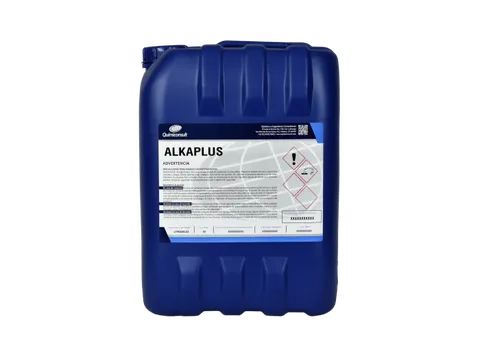
- COP (Clean Out of Place) and open-surface cleaning: vertical surfaces, equipment, ceilings and hard-to-reach areas, where a high, clinging foam that stays in contact with the soil is desired. This is where Alkaplus (chlorine-free self-foaming alkaline detergent) fits, which because of its high foam is not suitable for CIP recirculation.
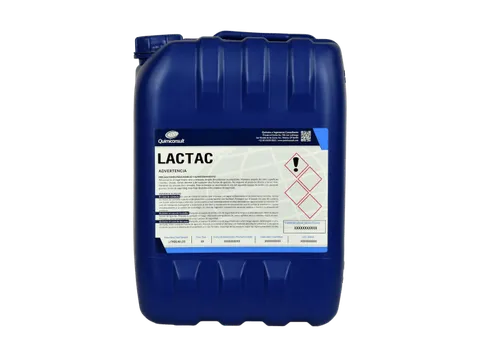
- Descaling by immersion, soaking and spraying: for parts, molds and removable equipment, with medium foam, such as Lactac (descaling acid detergent).
Within CIP cleaning, the second decision is whether the alkaline detergent should contain chlorine or be chlorine-free, which depends on the product being processed and the risk of chlorine interacting with residues:
- CIP with chlorine — CLK Premium: when maximum protein removal and bleaching of the organic film are sought (typically in the dairy industry and on casein-rich soils), the available chlorine decisively boosts cleaning. CLK Premium is the alkaline CIP detergent option when the product needs to contain active chlorine.
- Chlorine-free CIP — Alkaflow CIP300: when the process specifically requires a chlorine-free alkaline CIP detergent to avoid damage or interaction with residues —for example, in the brewing industry, as a precaution with hop and fermentation compounds, where chlorine can affect the process—, the recommendation is Alkaflow CIP300, a chlorine-free low-foam alkaline CIP detergent specifically for these applications where chlorine must be avoided.
CLK Premium is therefore the chlorinated alkaline detergent of the CIP cycle: it covers closed-loop recirculation cleaning —which Alkaplus (high foam, COP) cannot perform— and provides the available chlorine that boosts protein removal. When the process calls for a chlorine-free CIP alkaline, the catalog solution is Alkaflow CIP300.
The complete cleaning and sanitation program
CLK Premium is one piece of a professional cleaning and sanitation program. A typical cycle in the food and dairy industry follows this sequence, and Quimiconsult manufactures and supplies the products for each stage:
- Pre-rinse with water to flush out coarse soil.
- Alkaline cycle: cleaning with CLK Premium (chlorinated alkaline) by CIP recirculation, spraying or immersion, to remove fat and protein.
- Intermediate rinse with water.
- Acid cycle (when there is mineral scale): descaling with an acid detergent such as Lactac (immersion/spraying, medium foam) or Lactac LF (low foam, for recirculating CIP), to remove milkstone, scale and mineral deposits.
- Rinse with water.
- Sanitization / disinfection (final stage): application of a sanitizer manufactured by Quimiconsult to eliminate the residual microbial load and leave the equipment ready for production. For this stage, Quimiconsult offers its flagship disinfectant solution: the peracetic acid-based Anticel line (Anticel 5% / 15%), a broad-spectrum, no-rinse oxidizing sanitizer, ideal for both CIP and process surfaces, effective against bacteria, yeasts, molds and biofilm, which breaks down into harmless residues (acetic acid, water and oxygen). As alternatives depending on the application, we also manufacture STR Sanitizer and STR 100 (acid sanitizers for CIP) and Sanidet / Quaternary Ammonium (sanitizers for surfaces and facilities).
Important: the alkaline and acid cycles must never be mixed or applied without a complete intermediate rinse. In particular, CLK Premium (chlorinated alkaline) must not come into contact with acid products, since mixing a chlorinated product with an acid releases toxic chlorine gas.
CLK Premium applications
CLK Premium is indicated for CIP and surface cleaning in the food, dairy and beverage industries, where removing fat and protein from process circuits and equipment is critical. The concentration and protocol should be validated with Quimiconsult's technical team according to the type of soil, the equipment and the water hardness.
Dairy industry and milk production
This is CLK Premium's leading application: CIP cleaning of pasteurizers (HTST, UHT and batch), milk silos, process and storage tanks, plate heat exchangers, transfer and filling lines, and dairy derivative equipment (cheese, yogurt, cream). Available chlorine is especially valuable in dairy because of the high protein load of the soil: casein and, above all, heat-denatured beta-lactoglobulin in pasteurizers and heat exchangers are deposits that a chlorine-free alkaline does not fully solubilize; chlorine boosts their breakdown and dispersion, leaving surfaces film-free. Chlorine also helps control the psychrotrophic bacterial biofilms that develop in silos and lines at refrigeration temperatures.
Meat industry: processing, cutting surfaces and equipment
In meat processing plants, the most demanding soil for any detergent is the combination of coagulated protein, animal fat and denatured blood residues. The combined alkalinity and chlorine action of CLK Premium is especially effective against hemoglobin and myoglobin, which pigment surfaces and which chlorine-free alkaline detergents do not fully remove: chlorine oxidizes and bleaches these residues, which also makes visual verification of cleaning easier. Its application by spraying and immersion, in addition to CIP, allows it to be used on equipment that is not part of closed circuits —work tables, band saws, conveyors and removable utensils. (In Federal Inspection Type (TIF) establishments, verify the applicable sanitary registration with the product's current documentation.)
Cooling, pasteurization and storage systems in food
Cleaning of cooling, pasteurization and storage systems in the food industry, where fat and protein build up on stainless steel surfaces and reduce the hygiene and thermal efficiency of the equipment.
Silos and stainless steel surfaces
Cleaning of stainless steel surfaces in large-capacity silos and tanks, by CIP recirculation or spraying, to keep product-contact surfaces hygienic.
Transfer and conveying pipelines and tanks
CIP cleaning of transfer and conveying pipelines, process and storage tanks, and process circuits, where recirculating the CLK Premium solution at the right concentration and temperature removes organic soil from the inner walls.
Beverage industry and other food applications
CIP and surface cleaning in the beverage industry (soft drink plants, bottlers, juices) and in food plants in general that require a chlorinated alkaline detergent to remove fat and protein from circuits and equipment. Concentration, temperature and time are adjusted to the type of soil and equipment. Note for breweries: when the process requires a chlorine-free CIP alkaline —as a precaution with hops and fermentation compounds, where chlorine can interfere or cause damage— the recommendation is not CLK Premium but Alkaflow CIP300 (chlorine-free CIP alkaline).
CLK Premium directions for use and dosage
Use concentration: from 0.5% to 2.0%, depending on the degree of soiling and the type of equipment. For light to moderate soils, 0.5 – 1.0% is usually enough; for heavy fat and protein loads, up to 2.0%.
Temperature and time: higher temperatures make fat and protein removal easier; 65 °C is the recommended application temperature, for 15 to 20 minutes of contact or recirculation.
Application methods: closed-loop CIP recirculation (its main method), spraying on surfaces and equipment, and immersion of parts and removable components. After the alkaline cycle, rinse thoroughly with water before continuing with the acid cycle (if applicable) and sanitization.
Good practices: prepare the solution with good-quality water; check the working concentration (by titration of alkalinity and available chlorine) according to the soil load; and validate the protocol (concentration, temperature, time) with post-cleaning microbiological counts. Quimiconsult's technical team supports the testing and protocol adjustment stage. Note on available chlorine: chlorinated detergents lose available chlorine with heat, light and time; store in a cool, closed place protected from light, and rotate inventory.
CLK Premium certifications and backing
- NSF International: CLK Premium is certified by NSF, the world's reference body for evaluating chemical products for the food industry. This certification makes compliance easier during food safety audits under schemes such as FSSC 22000, SQF, BRC and HACCP, by showing that the detergent was evaluated by an internationally recognized third party for use in food plants.
- Kosher: CLK Premium holds current Kosher certification, required by plants serving markets with religious certification requirements and by exporters.
- SAGARPA (SADER): registered with the Mexican agri-food authority for use in regulated food and livestock industry establishments.
- SQF plant: manufactured in an SQF (Safe Quality Food) certified plant, recognized by the Global Food Safety Initiative (GFSI). This combination —a certified product, made in a certified plant— gives your audits and supplier approval processes a double guarantee.
CLK Premium safety, handling and storage
CLK Premium is a corrosive chlorinated alkaline product that must be handled following the recommendations of its current Safety Data Sheet (HDS/SDS). Direct contact can cause burns/severe skin and eye irritation due to its high pH. The use of personal protective equipment (PPE) is recommended: splash-proof goggles (and a face shield for severe exposure), chemical-resistant neoprene gloves, protective clothing and footwear, and respiratory protection if necessary. Wash thoroughly after handling.
Critical incompatibility — do not mix with acids or with chlorinated products in acidic media: CLK Premium reacts with acid products; mixing a chlorinated product with an acid releases toxic chlorine gas. For this reason, it must never be mixed or put in direct contact with acid detergents (such as Lactac), and a complete rinse must always be carried out between the alkaline and acid cycles. Keep separate from acids, reducing agents and incompatible metals.
First aid (general guidance): skin contact, remove contaminated clothing and wash with plenty of water, seek medical attention; eye contact, rinse with water for several minutes, remove contact lenses if easy to do, and seek immediate medical attention; ingestion, rinse the mouth, do not induce vomiting and contact a physician or poison control center; inhalation, move to fresh air and seek medical attention if breathing is difficult.
Storage: keep at room temperature, in the original closed container, in a cool, dry, ventilated place protected from direct sunlight and heat (to preserve the available chlorine), separate from incompatible materials. It complies with NOM-018-STPS-2015 and is classified and labeled in accordance with the Globally Harmonized System (GHS); the full classification, H statements and precautionary statements must be taken from the current SDS. Dispose of leftover product and empty containers in accordance with current environmental legislation.
CLK Premium material compatibility
CLK Premium is compatible with stainless steel and the food-grade plastics of process surfaces, as well as with the industry's standard elastomers —EPDM and silicone— which are the most common materials in the gaskets, seals and valves of CIP equipment. Prolonged exposure to concentrated alkaline solutions or high temperatures can accelerate elastomer wear over time, so it is advisable to observe the indicated use concentrations and temperatures and to inspect seals and gaskets periodically.
Not recommended for use on aluminum, zinc, tin or copper (or their alloys): the strongly alkaline pH corrodes these soft metals. For special materials or coatings in your facility, validate compatibility with a preliminary test and with Quimiconsult's technical team.
CLK Premium compared with other industrial cleaning detergents
CLK Premium (chlorinated alkaline, CIP) vs. Alkaflow CIP300 (chlorine-free alkaline, CIP): both are low-foam alkaline detergents for closed-loop CIP recirculation; the difference is chlorine. CLK Premium provides available chlorine that decisively boosts protein removal and bleaching of the organic film, making it the CIP option when active chlorine is required (typically in dairy and on casein-rich soils). Alkaflow CIP300 is chlorine-free, for processes that specifically require a chlorine-free CIP alkaline —for example, the brewing industry, as a precaution with hops and fermentation compounds, where chlorine can interfere or cause damage. The choice between them depends on the product being processed and whether chlorine should be present or avoided.
CLK Premium / Alkaflow CIP300 (CIP alkalines) vs. Alkaplus (self-foaming alkaline, COP): CLK Premium and Alkaflow CIP300 have controlled foam for closed-loop CIP recirculation; Alkaplus produces a high, clinging foam for cleaning open surfaces (COP) —walls, ceilings and vertical equipment— and, because of its foam level, is not used in CIP recirculation. They are not "paired" products within the same circuit: they serve different cleaning methods (CIP vs. surfaces).
CLK Premium (alkaline) vs. Lactac (acid): CLK Premium is the alkaline-cycle detergent (fat and protein removal); Lactac is the acid-cycle detergent (removal of milkstone, scale and mineral deposits). Both are used in sequence within the cleaning program, always with an intermediate rinse and never mixed (a chlorinated product with an acid releases chlorine gas).
CLK Premium vs. generic imported chlorinated alkaline detergents: CLK Premium guarantees specified alkalinity and available chlorine, an anti-redeposition wetting-dispersing system, NSF and Kosher certification, in-house manufacturing in an SQF plant and SADER registration, with direct technical support and nationwide availability, without the logistics dependence or lead times of an imported product.
Frequently asked questions about CLK Premium
What is CLK Premium and what is it used for?
CLK Premium is a chlorinated alkaline detergent (minimum alkalinity 20%, available chlorine 2.0 – 3.0%), manufactured by Quimiconsult, formulated for CIP cleaning (closed-loop recirculation), spraying and immersion, to remove fat and protein from pasteurizers, silos, tanks, pipelines and equipment in the food, dairy and beverage industries. It is the alkaline-cycle detergent of the cleaning program.
What is an alkaline detergent used for?
An alkaline detergent is used to remove fat and protein from process surfaces: the alkaline base saponifies fats (makes them water-soluble) and solubilizes proteins (breaks down their structures so water can carry them away). It is the basis of the cleaning cycle in the food industry. When it contains available chlorine —like CLK Premium— it adds oxidation of the most resistant proteins, bleaching of organic stains and support for microbiological control during the same cycle.
Why is it chlorinated? What does available chlorine contribute?
Available chlorine (2.0 – 3.0%) boosts protein removal: it peptizes and disperses the protein film, bleaches stains and organic films and helps control odors. That is why chlorinated alkaline detergents are the standard for protein-rich soils, such as those in the dairy industry, where a chlorine-free alkaline leaves residual film and stains.
Can CLK Premium be used for CIP cleaning?
Yes. CLK Premium is formulated specifically for closed-loop CIP recirculation (as well as spraying and immersion), with controlled foam suitable for recirculation pumps. It is the alkaline detergent of the CIP cycle; for the acid cycle in recirculating CIP, a low-foam acid detergent such as Lactac LF is used.
How is CLK Premium different from Alkaplus?
CLK Premium is controlled-foam, chlorinated and for CIP (closed circuits); Alkaplus is high, clinging foam, chlorine-free and for open surfaces (COP). They are not "paired" within the same CIP circuit —Alkaplus, because of its high foam, is not suitable for CIP recirculation—; they serve different cleaning methods: CLK Premium for CIP circuits and equipment, Alkaplus for vertical and hard-to-reach surfaces.
I need an alkaline CIP detergent without chlorine (for example, for a brewery). Which do you recommend?
In that case the recommendation is Alkaflow CIP300, our chlorine-free low-foam alkaline CIP detergent. It is designed for processes that specifically require a chlorine-free alkaline —such as the brewing industry, as a precaution with hops and fermentation compounds, where chlorine can interfere or cause damage. CLK Premium is reserved for when active chlorine is required (for example, in dairy, because of its high protein load).
Can CLK Premium be mixed with an acid detergent such as Lactac?
No, never. Mixing a chlorinated product with an acid releases toxic chlorine gas. The alkaline and acid cycles are applied in sequence, always with a complete rinse between them.
At what concentration and temperature is it used?
From 0.5% to 2.0% depending on the degree of soiling, at a recommended temperature of 65 °C, for 15 to 20 minutes of contact or recirculation.
Is it compatible with the gaskets and materials of my CIP equipment?
Yes with stainless steel and with the food industry's standard elastomers —EPDM and silicone—, the most common materials in gaskets, seals and valves. It is not recommended on aluminum, zinc, tin or copper (or their alloys), because the strongly alkaline pH corrodes these soft metals. Observe the indicated concentrations and temperatures and inspect seals periodically.
How often is it applied in a dairy CIP program?
As a reference, the chlorinated alkaline cycle with CLK Premium is usually applied as the main cleaning at the end of each shift or between product changes; in continuous production, during the scheduled shutdowns of critical equipment (pasteurizers and heat exchangers). Every certain number of days it is alternated with an acid cycle (for example Lactac LF) to remove the mineral scale that the alkaline does not eliminate. The exact frequency depends on the product, the volume and the results of microbiological monitoring; Quimiconsult's technical team helps define it.
What certifications does CLK Premium have?
It is certified by NSF International, holds Kosher certification and SAGARPA (SADER) registration, and is manufactured in an SQF-certified plant in Monterrey, Nuevo León.
Where to buy CLK Premium in Mexico?
At Quimiconsult we are direct manufacturers of CLK Premium, with availability from Monterrey, Nuevo León, and shipping throughout Mexico, in 20 kg and 50 kg jerrycans (larger sizes on request). Contact us at +52 (81) 8105 0063 for advice on the cleaning protocol, the optimal concentration and a quote.
Other names and terms related to CLK Premium
CLK Premium is a Quimiconsult brand. It is identified in short as CLK, CLK 20% (for its minimum alkalinity of 20%) or CLK Premium detergent, and in purchase requests, specification sheets and online searches it is commonly referenced through functional descriptions:
CLK, CLK 20%, CLK Premium detergent, premium detergent, premium detergents, alkaline detergent, what is alkaline detergent used for, chlorinated alkaline detergent, chlorinated alkaline degreaser, chlorinated alkaline soap, chlorinated alkaline cleaning solution, chlorinated alkaline cleaner, CIP chlorinated alkaline agent, CIP detergent, alkaline detergent for CIP, chlorinated alkaline CIP detergent, CIP cleaner for dairy, chlorinated alkaline detergent for pasteurizers, detergent for milk silos, detergent for process tanks and pipelines, alkaline degreaser for the food industry, NSF chlorinated alkaline detergent, kosher chlorinated alkaline detergent, alkaline CIP cleaner, chlorinated detergent for dairy, chlorine-free alkaline CIP detergent (see Alkaflow CIP300), chlorine-free brewery CIP detergent, CLK Premium price, CLK Premium Quimiconsult, chlorinated alkaline detergent Mexico, CIP detergent Monterrey, industrial detergent manufacturer Mexico.
These variations help buyers, maintenance managers, sanitation supervisors and quality managers find CLK Premium within Quimiconsult's own line of chlorinated alkaline detergents for CIP.
Why buy CLK Premium from Quimiconsult?
Quimiconsult is a Mexican company with more than 30 years of experience in specialty chemicals and a direct manufacturer of a complete family of detergents and sanitizers for industrial and food cleaning. When you buy CLK Premium from Quimiconsult you get:
- An NSF International and Kosher certified product, with SADER registration, backing your food safety audits (FSSC 22000, SQF, BRC, HACCP).
- In-house manufacturing in an SQF-certified plant, with full control of the value chain and lot-to-lot consistency.
- A chlorinated alkaline CIP detergent with specified alkalinity and available chlorine and an anti-redeposition wetting-dispersing system.
- Direct technical support from the manufacturer, with advice on designing the complete cleaning and sanitation program (alkaline → acid → sanitizing) and on protocol validation.
- The complete family of cleaning program products (alkaline detergents, acids and sanitizers) from a single Mexican supplier.
- Immediate availability from Monterrey, Nuevo León, with shipping throughout Mexico and complete regulatory documentation (CoA per lot, TDS, SDS).
Does your dairy, beverage or food plant need a reliable, certified, Mexican-made chlorinated alkaline CIP detergent? Contact us at +52 (81) 8105 0063: we analyze your process, the type of soil and your water hardness, and propose a complete cleaning and sanitation protocol with the products in our catalog.
Related products
CLK Premium is part of Quimiconsult's industrial cleaning and sanitation portfolio. Products that complement its use within a complete program:
- Alkaplus — chlorine-free self-foaming alkaline detergent for cleaning open surfaces (COP), walls, ceilings and vertical equipment. Because of its high foam it is not suitable for CIP recirculation; it serves a different cleaning method (surfaces) and is not a product "paired" with CLK Premium within the same circuit.
- Lactac — descaling acid detergent (phosphoric acid) for removing milkstone, scale and mineral deposits by immersion, soaking and spraying (acid cycle of the program).
- Lactac LF — low-foam descaling acid detergent for the acid cycle in recirculating CIP cleaning.
- Anticel Peracetic Acid (5% / 15%) — Quimiconsult's disinfectant solution: a broad-spectrum, no-rinse peracetic acid-based oxidizing sanitizer for the final disinfection stage in both CIP and process surfaces; effective against bacteria, yeasts, molds and biofilm.
- STR Sanitizer / STR 100 — acid sanitizers for CIP, for the final disinfection stage of food and beverage equipment.
- Sanidet / Quaternary Ammonium — sanitizers for plant surfaces and facilities.
- EDTA, Sodium Gluconate and PBTC — sequestrants and antiscalants to reinforce cleaning and scale control in high-hardness water.
- Silad B700 and the antifoam line — for foam control in water-based processes and systems.
Related categories: Alkaline detergents for industrial cleaning · Detergents and agents for CIP cleaning · Supplies for cleaning and sanitation in the food industry · Sanitizers and disinfectants
Looking to build a complete cleaning and sanitation program (alkaline → acid → sanitizing) for your plant? Contact us and we will review the options in our catalog for your industry and type of process (CIP or open surfaces).
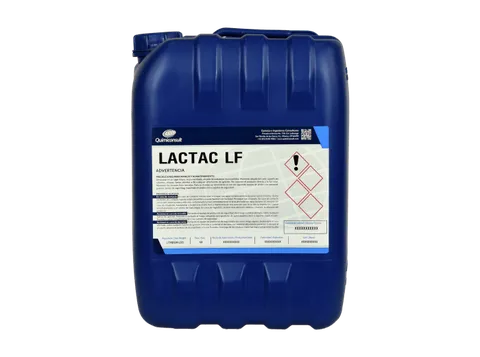
LACTAC LF ACID CIP DETERGENT FOR REMOVAL OF ORGANIC MATTER AND SCALE