Spanish
 English


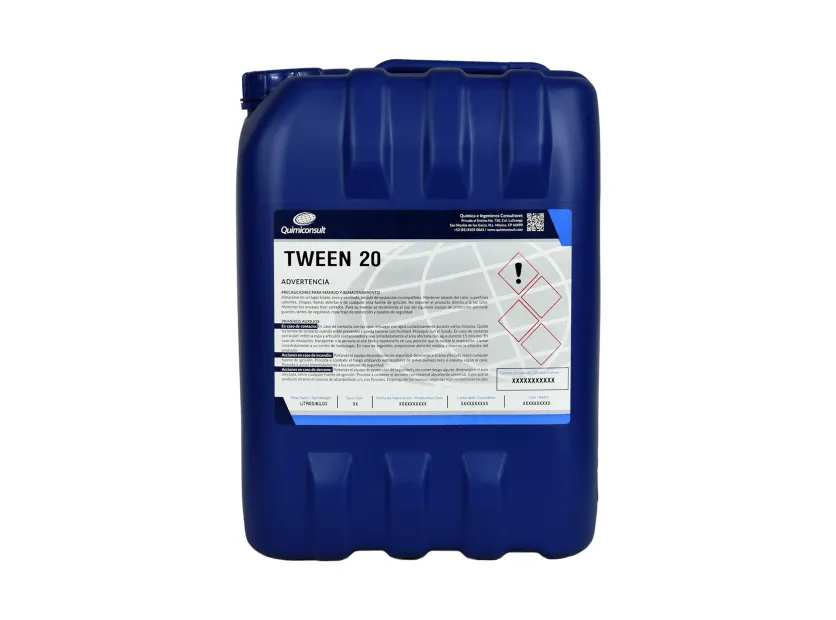
POLYSORBATE 20 NON-IONIC EMULSIFIER
View All Prices
| Quantity | Unit Price |
|---|---|
| kg | |
| 1 - 99 | USD 3.07 |
| 100 - 199 | USD 3.03 |
| 200 - 499 | USD 2.99 |
| 500 - 999 | USD 2.95 |
| 1000 - 4999 | USD 2.91 |
| 5000 - 9999 | USD 2.87 |
| 10000 - 17999 | USD 2.84 |
| 18000+ | USD 2.80 |
Polysorbate 20 Description — Tween 20, the Highest-HLB Nonionic Solubilizer in Its Family
At Quimiconsult we offer Polysorbate 20, also known as Tween 20, polisorbato 20 (its Spanish name), polyoxyethylene (20) sorbitan monolaurate, PEG-20 sorbitan monolaurate or by its INCI name Polysorbate 20, a multifunctional nonionic surfactant widely used in the cosmetic, pharmaceutical, food, cleaning, agrochemical, textile, paint and animal care industries for its unique combination of properties: the highest HLB value in the polysorbate family (between 16 and 17), excellent ability to solubilize oils, flavors and fragrances in aqueous media, stability over a wide pH range (acidic and alkaline), no reactivity with ionic agents, complete water miscibility, broad chemical compatibility and a safe industrial handling profile.
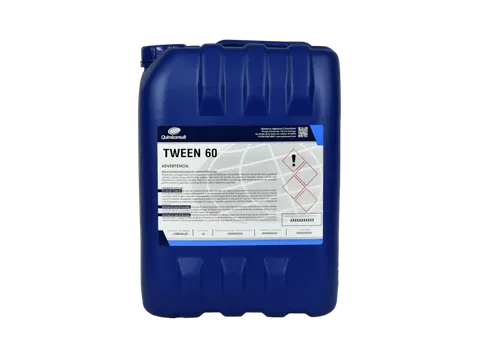
It is a yellow liquid at room temperature, practically odorless, soluble or dispersible in water, with a hydroxyl number of 100, a pH of 6.0 to 6.5 (5% aqueous solution), maximum moisture of 3.0% and maximum Gardner color of 3.0, parameters that ensure consistent quality and predictable formulation performance. Unlike polysorbate 60 (semi-solid) or polysorbate 80 (viscous liquid), polysorbate 20 is the most fluid and most hydrophilic member of the group, which greatly simplifies its handling, dosing and incorporation in both cold and temperature-controlled processes.
Polysorbate 20 belongs to the chemical family of polyethoxylated sorbitan esters (polysorbates), obtained by reacting sorbitol with ethylene oxide and a fatty acid. In the case of polysorbate 20, the fatty acid is lauric acid (C12 chain) —the shortest chain in the commercial family—, which gives it its unique profile: it is an amphiphilic molecule with a hydrophilic end (the polyethoxylated chain, rich in hydroxyl groups) and a lipophilic end (the lauric chain). This architecture maximizes its affinity for water and its ability to form micelles, making it one of the most hydrophilic nonionic emulsifiers in common use and the best solubilizer in the family for essential oils and fragrances.
The CAS number of polysorbate 20 is 9005-64-5, and in the European Union it is identified as food additive E432. In cosmetics it is recognized by its INCI name Polysorbate 20, and in industry it is commonly referred to by its historic trade name Tween 20. Polysorbate 20 is listed in the main pharmacopoeias (USP/NF, Ph. Eur.) in the corresponding grades and is widely recognized in international technical literature, regulations and raw material specifications for multiple sectors.
At Quimiconsult, located in San Nicolás de los Garza, Nuevo León, we distribute polysorbate 20 nationwide, with formulation technical support, certificates of analysis per batch, and an up-to-date technical data sheet (TDS) and safety data sheet (HDS/SDS), serving cosmetic formulators, pharmaceutical and diagnostic laboratories, food and beverage manufacturers, cleaning product formulators, agrochemical plants, veterinary product manufacturers, textile plants, paint and coatings manufacturers, and R&D departments throughout Mexico.
Polysorbate 20 Technical Specifications and Physicochemical Properties
The polysorbate 20 we sell meets a consistent batch-to-batch quality profile, verifiable through a Certificate of Analysis (CoA). The certified parameters according to the technical data sheet are as follows:
- Appearance @ 25 °C: Yellow liquid
- Hydroxyl number: 100
- Moisture (max.): 3.0 %
- Color, Gardner (max.): 3.0
- pH (5 % aqueous): 6.0 – 6.5
- Ionic nature: Nonionic
- Solubility: Soluble / dispersible in water
- pH stability: Wide (acidic and alkaline media)
- Ionic reactivity: Does not react with ionic agents
Additional reference data:
- CAS: 9005-64-5
- INCI: Polysorbate 20
- Food additive (EU): E432
- HLB: ~16 – 17
- Fatty chain: Lauric acid (C12)
Product benefits: hydrophilic agent soluble or dispersible in water, dispersant, wetting agent and stability over a wide pH range.
Main uses: emulsifier, solubilizer and softener.
The complete technical data sheet (TDS) and safety data sheet (HDS/SDS), as well as certificates of analysis per batch, are available to registered customers and are delivered with every order.
Synonyms, Chemical Names and Search Terms Related to Polysorbate 20
In the cosmetic, pharmaceutical, food, cleaning, agrochemical and manufacturing markets, polysorbate 20 is known by multiple chemical names, trade names and nomenclatures depending on the region and application. The most widely used include: polysorbate 20, polysorbate-20, polisorbato 20, Tween 20, Tween-20, polyoxyethylene sorbitan monolaurate, polyoxyethylene (20) sorbitan monolaurate, PEG-20 sorbitan monolaurate, ethoxylated sorbitan ester, E432, lauric nonionic surfactant and, on finished product labels, usually as "Polysorbate 20" according to the applicable regulatory format.
Likewise, in purchasing, sourcing, formulation and product development it is common to find searches such as: polysorbate 20 price, buy polysorbate 20, polysorbate 20 Mexico, bulk polysorbate 20, what is polysorbate 20 used for, where to buy polysorbate 20, cosmetic polysorbate 20, food grade polysorbate 20, pharmaceutical grade polysorbate 20, polysorbate 20 technical data sheet, polysorbate 20 safety data sheet, Tween 20 price, Tween 20 Mexico, what is Tween 20 used for, polysorbate 20 vs polysorbate 80, difference between polysorbate 20 60 80, polysorbate 20 emulsifier, polysorbate 20 solubilizer, polysorbate 20 laboratory, polysorbate 20 ELISA, polysorbate 20 supplier Monterrey and nonionic emulsifier supplier Mexico. These variations are especially relevant for cosmetic formulators, laboratory chemists, food technologists, pharmaceutical and veterinary formulators, plant engineers and industrial buyers.
How Does Polysorbate 20 Work in Formulation? — Functional Mechanisms
Unlike single-function ingredients, polysorbate 20 delivers its value through several simultaneous mechanisms that make it the nonionic surfactant of choice when gentle solubilization and emulsification of lipophilic phases in water are required:
Solubilization through micelle formation: thanks to its high HLB (16–17), polysorbate 20 forms micelles in aqueous media at low concentrations, encapsulating lipophilic molecules (essential oils, fragrances, fat-soluble vitamins, oily actives) inside them and allowing them to be dispersed in water as clear or slightly opalescent solutions, without intense agitation or heating. This is its most valued mechanism in liquid formulations where clarity is a quality attribute.
Emulsification of oil-in-water (O/W) systems: the molecule orients itself at the oil/water interface —hydrophilic head toward the water, lauric tail toward the oil— reducing interfacial tension and stabilizing oil-phase droplets dispersed in the continuous aqueous phase. Because of its short chain it is especially effective with light oil phases (fluid oils, light silicones, low-molecular-weight esters). It is commonly combined with a low-HLB emulsifier (e.g. a sorbitan ester) to adjust the system's required HLB.
Wetting and surface tension reduction: it reduces the surface tension of water, improving wetting of difficult surfaces (plant cuticle, fibers, hydrophobic substrates) and promoting even distribution of the product.
Dispersion and suspension: it keeps solid particles (pigments, active ingredients, fillers) stably suspended, preventing settling and agglomeration.
Stabilization of foams and proteins/biomolecules: it contributes to controlled foams without the irritation of some anionic surfactants, and —key in pharmaceutical and laboratory applications— prevents protein aggregation and adsorption to surfaces.
Universal ionic compatibility: being nonionic, it does not react with ionic agents and is compatible with anionic, cationic, nonionic and amphoteric surfactants, making it a very versatile co-surfactant.
Polysorbate 20 Applications by Industry
One of the great advantages of polysorbate 20 is its cross-industry reach: the same ingredient solves formulation problems in very different sectors.
Personal Care & Cosmetics
Cosmetics is one of the most established applications of polysorbate 20. Its extensively evaluated safety profile, its compatibility with virtually all actives and its ease of use have made it a standard in modern formulation. It appears in the INCI lists of thousands of products:
- Toners and facial waters: solubilizes botanical extracts and lipophilic actives in clear aqueous bases, without cloudiness or phase separation.
- Micellar waters and makeup removers: forms micelles that encapsulate oily dirt and makeup so they can be removed with water, without rubbing.
- Serums and light fluids: incorporates active oils, oil-based retinol and vitamin E into aqueous formulations without compromising the light texture.
- Facial and body cleansers: a co-surfactant that provides post-wash softness and reduces the irritation potential of primary surfactants.
- Light sunscreens and mists: stabilizes fluid emulsions of highly dispersible UV filters.
- Perfumery and flavors: solubilizes fragrances in hydroalcoholic and aqueous bases.
Pharmaceutical & Wellness
Polysorbate 20 is a recognized pharmaceutical excipient (listed in USP/NF and Ph. Eur. in the corresponding grades):
- Solubilization of poorly water-soluble active ingredients, improving their bioavailability.
- Stabilizer for proteins, antibodies and biologics, preventing aggregation and adsorption of the active to container walls.
- Wetting and dispersing agent in oral and topical suspensions.
- Vehicle in dermatological formulations, drops, syrups and solutions.
In laboratories, biotechnology and diagnostics it is used as a mild detergent in wash buffers (PBS-/TBS-polysorbate) for ELISA, Western blot and immunoassays, where it reduces nonspecific binding and background noise; it stabilizes enzymes and reagents in diagnostic kits; it gently permeabilizes membranes and assists in protein purification processes.
Food & Beverages
Listed as food additive E432 in the European Union (with maximum limits by category), regulated by COFEPRIS in Mexico and recognized as GRAS by the FDA for certain applications within established limits. It is used to solubilize flavors and fat-soluble vitamins, as an emulsifier in low-fat systems and as a wetting agent in certain processes.
Industrial Cleaning and Institutional & Household Cleaning
In detergents, disinfectants and surface cleaners, polysorbate 20 acts as a wetting agent and co-emulsifier that improves penetration of the active surfactant into greasy soil, reduces surface tension on hard-to-wet materials and provides better appearance and performance. Its compatibility with anionic, nonionic, cationic and amphoteric surfactants makes it a very versatile auxiliary; at low concentrations it also reduces the irritation potential of harsher surfactant systems.
Agrochemicals
In foliar-applied crop protection products, polysorbate 20 is used as an adjuvant, wetter, co-emulsifier and dispersant. By reducing surface tension it improves leaf coverage and penetration of the active ingredient through the plant cuticle, increasing the product's biological efficacy.
Animal Health & Nutrition
In veterinary and animal hygiene products it facilitates solubilization of actives in aqueous bases and improves distribution over skin and coat. It is used in shampoos, topical sprays, sealants/antiseptics and dermatological formulations for veterinary use.
Paints & Coatings
As a pigment dispersant, substrate wetting agent and co-emulsifier in waterborne systems, it improves dispersion stability and application uniformity.
Textiles
Wetting agent, leveling agent and dyeing/finishing auxiliary: improves uniform penetration of dyes and finishing agents into the fiber; useful in low-viscosity sizing agents and softeners.
Other industries
- Plastics & Rubber: antistatic auxiliary and co-emulsifier in emulsion polymerization systems.
- Pulp & Paper: wetting agent and processing aid.
- Metalworking / Soluble lubricants: co-emulsifier in water-soluble cutting fluids.
- Water Treatment: auxiliary dispersant in specific formulations.
- Glass & Crystal: wetting agent in cleaning formulations.
Polysorbate 20 vs Polysorbate 60 vs Polysorbate 80 — Which One to Choose?
All three belong to the same family of ethoxylated sorbitan esters, but they differ in their fatty chain, their HLB and, consequently, their optimal application:
Polysorbate 20 (Tween 20)
- Fatty chain: Lauric C12
- State at 25 °C: Yellow, fluid liquid
- Approximate HLB: 16 – 17
- CAS: 9005-64-5
- EU additive: E432
- Best for: Solubilizing essential oils and fragrances; light O/W emulsions; laboratory use
Polysorbate 60
- Fatty chain: Stearic C18 (saturated)
- State at 25 °C: Semi-solid / paste
- Approximate HLB: 14 – 15
- CAS: 9005-67-8
- EU additive: E435
- Best for: Emulsifying oil phases of higher consistency (creams)
Polysorbate 80
- Fatty chain: Oleic C18 (unsaturated)
- State at 25 °C: Viscous liquid
- Approximate HLB: 15
- CAS: 9005-65-6
- EU additive: E433
- Best for: Emulsifying medium/heavy oil phases; widely used in food and pharma
Choose Polysorbate 20 when you need the highest HLB in the group, maximum ability to solubilize essential oils and fragrances in water with clarity, light O/W emulsions, or a liquid, easy-to-handle nonionic surfactant for laboratory work, liquid cosmetics and gentle cleaning.
Choose Polysorbate 60 when you need to emulsify oil phases of higher consistency (creams, lotions with body), where its stearic chain adds stability to the emulsion.
Choose Polysorbate 80 when you need to emulsify medium to heavy oil phases or are working in food and pharmaceutical applications where polysorbate 80 is the historical standard.
It is common practice to combine a polysorbate (high HLB) with a sorbitan ester (low HLB) to reach the exact required HLB of the oil phase and obtain finer, more stable emulsions.
Recommendations for Use, Dosage and Incorporation
Polysorbate 20 is a low-viscosity liquid, which makes direct incorporation by pumping, volumetric dosing or weighing easy. Typical concentrations in the final formulation by application:
- Solubilization of fragrances and essential oils: 0.5 % – 2.0 % (typical ratio of 3:1 to 5:1 relative to the oil to be solubilized).
- Light O/W emulsions: 1.0 % – 4.0 % (alone or combined with a low-HLB co-emulsifier).
- Co-surfactant in facial/body cleansing: 0.1 % – 2.0 %.
- Laboratory wash buffers (ELISA, Western blot): 0.05 % – 0.1 %.
- Foliar agrochemical adjuvant: according to product design and label.
- Liquid cosmetics (toners, micellar waters, mists): 0.5 % – 3.0 %.
How to incorporate: add it to the aqueous phase, or premix it with the oil/fragrance phase before adding to water (the usual method for maximum clarity in solubilization). Most applications require no heating; for hot-processed systems it can be incorporated at 40–70 °C. Standard moderate agitation is sufficient.
Performance verification: carry out accelerated stability tests (temperature cycling, centrifugation, clarity/viscosity validation) on the finished product before scaling up to production. The exact value must be determined in each formulation's specific system.
Polysorbate 20 Compatibilities and Incompatibilities
It is compatible with water and aqueous solutions; alcohols and glycols (ethanol, propylene glycol, glycerin, PEG); anionic, nonionic, cationic and amphoteric surfactants; water-soluble polymers (PVP, cellulosics, gums); salts, weak acids and bases within the stability range; essential oils and fragrances; and most cosmetic actives and standard preservatives. It is stable over a wide pH range and does not react with ionic agents.
Use caution with:
- Strong oxidizing agents (peroxides, peracetic acid, hypochlorites at high concentration): can oxidize the polyethoxylated chain.
- Electrolytes at very high concentration: can alter the cloud point and solubility.
- Sustained extreme pH at high temperature: can promote slow hydrolysis of the ester bond.
- Preservation: like all polysorbates, it can be a substrate for microbial contamination in dilute aqueous solution; use an appropriate preservative system.
Storage, Packaging and Shelf Life
Polysorbate 20 is offered in packaging sizes suited to different consumption scales:
- 20 kg jugs for development laboratories and small-scale production.
- 200 kg drums for medium production and formulators with regular supply.
- 1,000 kg IBCs for high-consumption industrial production.
- Continuous supply with the option of fixed volume pricing for established manufacturing programs.
- Laboratory samples available for evaluation.
Storage: in the original closed container, in a cool, dry, well-ventilated place (ideally 15–30 °C), away from heat sources, direct sunlight, strong oxidizers and excessive moisture. Seal the container between uses. Typical shelf life: 24 months from the date of manufacture under proper conditions. For batches stored for extended periods, check color, pH and appearance before use in critical applications.
Safety, Handling and Regulatory Considerations
Polysorbate 20 has a low toxicological profile and a long history of safe use in cosmetic, food and pharmaceutical applications within regulated concentrations. It is not classified as a carcinogen by any reference regulatory agency (IARC, FDA, EFSA, SCCS). Concerns circulating online are usually based on studies at doses far above those of commercial use or on models that cannot be extrapolated to consumers under normal conditions.
Typical GHS classifications indicate minimal hazards under normal handling conditions (possible mild eye/skin irritation from prolonged direct contact). Recommended personal protective equipment includes safety goggles, chemical-resistant gloves (nitrile), work clothing and adequate ventilation; a mask if mists or aerosols are generated. Spills are slippery: collect with inert absorbents and clean with water and detergent.
The grade described on this page is for general/industrial use. For applications requiring food grade (E432 / FCC) or pharmaceutical grade (USP/NF, Ph. Eur.), ask about availability of the specific grade, as industrial grade is not a substitute for regulated grades. The product's safety data sheet (HDS/SDS) details toxicological parameters, occupational exposure limits and precautionary measures.
Certifications and Regulatory Compliance
Each batch of polysorbate 20 comes with a Certificate of Analysis (CoA) documenting the critical parameters (appearance, hydroxyl number, moisture, Gardner color, pH). Technical, quality and purchasing departments can request the complete documentation: technical data sheet (TDS), safety data sheet (HDS/SDS), CoA per batch and specific technical statements for inclusion in supplier approval files and operating records.
Why Buy Polysorbate 20 from Quimiconsult
Quimiconsult is not a raw material distributor: we are a Mexican manufacturer with more than 30 years of experience in chemical formulation, with our own R&D laboratory and a technical team that visits customer facilities directly. When you buy polysorbate 20 from us you get:
- Batch-to-batch verified quality: every lot is analyzed in-house before dispatch.
- Formulation advice included: guidance on concentration, compatibilities and combinations with other emulsifiers, at no additional cost.
- Custom formulation development: complete emulsifier systems, validated in our laboratory.
- Field team at your plant: we evaluate your emulsification process and identify opportunities for improvement.
- Domestic supply without reliance on imports: production and sourcing in Mexico, with short response times.
Frequently Asked Questions about Polysorbate 20
What is polysorbate 20 and what is it used for?
Polysorbate 20 (Tween 20) is a nonionic surfactant from the ethoxylated sorbitan ester family, with a C12 lauric chain and the highest HLB in its group (16–17). It is used as a solubilizer for essential oils, flavors, fragrances and fat-soluble vitamins in water; as an emulsifier for light oil-in-water systems; and as a wetting and dispersing agent. It is used in cosmetics, pharmaceuticals, laboratories, food, cleaning, agrochemicals, veterinary products, paints and textiles.
Are polysorbate 20 and Tween 20 the same thing?
Yes. "Tween 20" is the best-known trade name for polysorbate 20 (INCI: Polysorbate 20; CAS 9005-64-5). They are exactly the same ingredient.
How does it differ from polysorbate 60 and 80?
Polysorbate 20 has the shortest fatty chain (C12, lauric), which gives it the highest HLB and makes it the best solubilizer for essential oils and fragrances. Polysorbate 60 (saturated C18) is better at emulsifying oil phases with body; polysorbate 80 (unsaturated C18) emulsifies medium/heavy phases and is the most used in food and pharma.
Is polysorbate 20 water-soluble?
Yes, it is soluble or dispersible in water and, because of its high HLB, it forms clear or slightly opalescent solutions at low concentrations. It is also miscible with alcohols and glycols.
What is polysorbate 20 used for in the laboratory?
As a mild detergent in wash buffers (PBS-/TBS-polysorbate) for ELISA and Western blot, where it reduces nonspecific binding and background noise; also to stabilize proteins and reagents in diagnostic kits.
Is polysorbate 20 bad, toxic or carcinogenic?
It is not classified as a carcinogen by any reference regulatory agency (IARC, FDA, EFSA, SCCS). For cosmetic, food and pharmaceutical use at regulated concentrations, its safety profile is extensively documented.
Is polysorbate 20 safe for all skin types?
It has an extensive history of use in cosmetics for all skin types, including sensitive skin. As with any ingredient, individual sensitivity may occur; formulations should stay within established ranges and pass the finished product safety assessment.
Is polysorbate 20 plant-derived?
The lauric acid portion is usually derived from plant sources such as coconut or palm oil. The specific status depends on the supplier and grade; we can provide the corresponding documentation.
What concentration of polysorbate 20 should I use?
It depends on the function: 0.5 %–2.0 % to solubilize fragrances, 1.0 %–4.0 % for light emulsions, 0.1 %–2.0 % as a cleaning co-surfactant and 0.05 %–0.1 % in laboratory buffers. It is best to confirm with stability tests in each system.
Can polysorbate 20 be used in food?
Yes, within regulated limits. It is listed as E432 in the EU, regulated by COFEPRIS in Mexico and recognized as GRAS by the FDA for certain applications. Food use requires the appropriate grade.
What is the difference between industrial grade and USP or food grade?
General-use/industrial grade meets specifications appropriate for cosmetics, cleaning, agrochemicals, textiles and related applications. USP/NF (pharmaceutical) and food grade (E432/FCC) meet monographs with stricter controls on purity, impurities and microbiology, required for regulated applications. Industrial grade does not replace regulated grades; ask about availability.
What are the pH and appearance of polysorbate 20?
It is a yellow liquid at room temperature, with a pH of 6.0 to 6.5 in 5 % aqueous solution, hydroxyl number 100, moisture max. 3.0 % and Gardner color max. 3.0. It is stable over a wide pH range.
Where to buy polysorbate 20 in Mexico and at what price?
At Quimiconsult we distribute polysorbate 20 from our warehouse in San Nicolás de los Garza, Nuevo León, with nationwide coverage. Packaging ranges from laboratory samples to 20 kg jugs, 200 kg drums and 1,000 kg IBCs, with TDS, SDS and CoA per batch. The price depends on volume, packaging and specification. Request a quote stating volume, application sector and specifications.
Request a Polysorbate 20 Sample or Quote
If you are looking for polysorbate 20 (Tween 20) with guaranteed quality, real technical support and the backing of a Mexican manufacturer with more than 30 years of experience, Quimiconsult is your natural supplier. We can send you samples for evaluation, support you in developing your formula or quote the volume you need with delivery from our facilities in Mexico. Write to us through our contact page and a formulation specialist will reply within 24 business hours. Our own laboratory, an on-site technical team and more than three decades serving the Mexican chemical industry.