 Spanish
 English


Peracetic acid for the food industry and agriculture
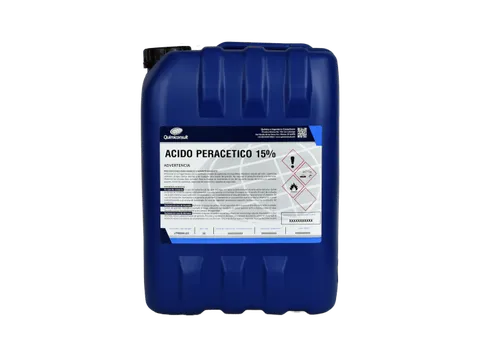
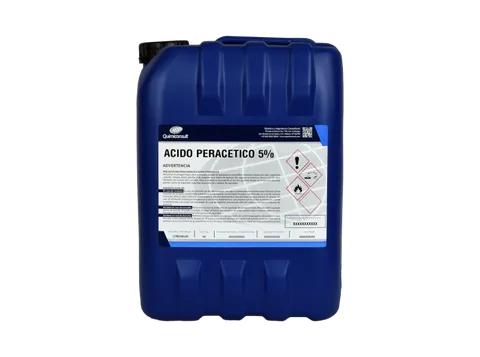
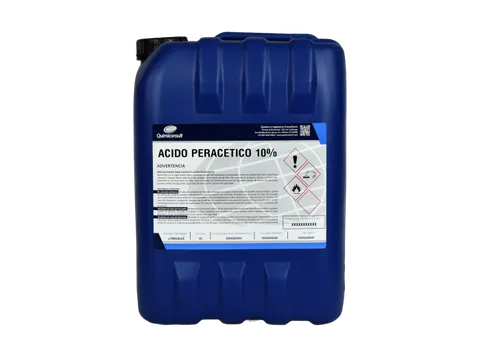
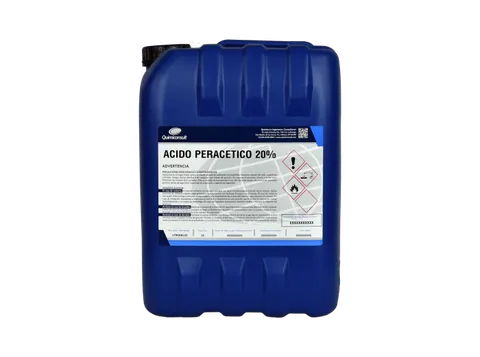
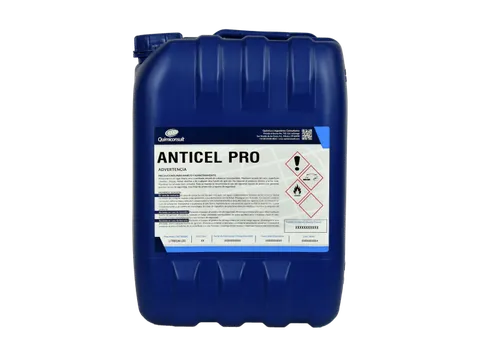
A broad-spectrum oxidizing disinfectant that breaks down into water, oxygen and acetic acid, so it leaves no toxic residue. We make the Anticel line at 5, 10, 15 and 20%, plus Anticel Food for direct food contact, with stock in Monterrey and shipping across Mexico.
At a glance
- Formula
- CH₃CO₃H · CAS 79-21-0
- Concentrations
- 5, 10, 15 and 20%
- Packaging
- 20 kg jerrycan · 200 kg drum · 200 g sample
- Certifications
- Kosher · NSF · OMRI
- Documents
- Data sheet, SDS and certificates
What is peracetic acid?
Peracetic acid (CH₃CO₃H), also called peroxyacetic acid or PAA, is made by reacting acetic acid with hydrogen peroxide. Commercial solutions hold all three in equilibrium: peracetic acid, hydrogen peroxide and acetic acid. It works by oxidizing the membrane and cell wall of microorganisms, so it kills Gram-positive and Gram-negative bacteria, molds, yeasts, viruses and spores within seconds.
Unlike chlorine disinfectants, it forms no halogenated by-products and breaks down into oxygen, water and acetic acid. Within the concentrations the FDA allows (21 CFR) it is used as a no-rinse sanitizer. It works in cold or warm water, in hard water, and needs no pH adjustment.
Uses of peracetic acid
Application | Use concentration* | Reference |
|---|---|---|
Food-contact surfaces and equipment, no rinse | 100–200 ppm | 21 CFR 178.1010 |
Disinfection followed by a rinse (shock treatment against molds, Listeria) | 220–400 ppm | — |
Final sanitizing in CIP systems for pipes and tanks | per CIP program | — |
Fruit and vegetable wash water | 60–80 ppm | 21 CFR 173.315 |
Beef and other carcasses, by spray | 90–220 ppm | 21 CFR 173.370 |
Organic production | per label | NOP (OMRI) |
*Peracetic acid concentration in the use solution. See each product's technical data sheet.
It is also used in livestock and poultry, greenhouses and agribusiness, breweries and bottlers, and process water treatment.
Which concentration should I choose?
Product | Peracetic acid | Recommended for |
|---|---|---|
5% + min. 26% hydrogen peroxide | Industrial disinfection with a double oxidizing action; better penetration of biofilm and organic matter | |
min. 10% | A balance of strength, handling and cost; food industry and livestock | |
min. 15% | General use in food plants: CIP, equipment, surfaces, fruit and vegetables | |
min. 20% | Large operations and water treatment: more use solution per kilo | |
15%, self-regulating acidity | Direct contact with meat and poultry; reduces discoloration of bruised carcass areas |
All come in a 20 kg jerrycan and a 200 kg drum, with a 200 g sample. The Anticel line holds Kosher, NSF and OMRI certifications; Anticel Food: OMRI and NSF.
How do you dilute peracetic acid?
To make a use solution, divide the target concentration in ppm by the product's concentration in ppm (1% = 10,000 ppm). Example: for 200 ppm with Anticel 15% (150,000 ppm): 200 ÷ 150,000 = 1.33 g of product per liter of water.
Product | For 100 ppm | For 200 ppm |
|---|---|---|
Anticel 5% | 2.0 g/L | 4.0 g/L |
Anticel 10% | 1.0 g/L | 2.0 g/L |
Anticel 15% / Food 15% | 0.67 g/L | 1.33 g/L |
Anticel 20% | 0.5 g/L | 1.0 g/L |
Prepare the solution the same day, always add the product to the water (never the other way round) and check the concentration with peracetic acid test strips.
Peracetic acid or chlorine?
Peracetic acid | Sodium hypochlorite (chlorine) | |
|---|---|---|
Residues | Water, oxygen and acetic acid | Can form trihalomethanes and other chlorinated by-products |
Rinse | Not required within FDA limits | Depends on the concentration |
Organic matter and biofilm | Stays effective; penetrates biofilm | Used up quickly by organic matter |
pH and temperature | Effective across a wide pH range, cold or warm water | Loses effectiveness at high pH |
Odor | Vinegar odor | Chlorine odor |
If your process already uses chlorine, we also offer Dioxel, an odorless chlorinated biocide.
Safety and storage
Concentrated peracetic acid is corrosive and oxidizing. Handle it with gloves, goggles and respiratory protection; store it in its original container with a vented cap, in a cool, shaded place, away from combustible materials, reactive metals and reducing agents, and never mix it with other chemicals. Every product comes with a downloadable technical data sheet and safety data sheet (SDS).
Frequently asked questions
What is peracetic acid used for?
To disinfect and sanitize equipment, surfaces and CIP systems in food and beverage plants, wash fruit and vegetables, decontaminate carcasses in slaughterhouses, and disinfect in livestock, agriculture and water treatment.
What concentration should I use on food equipment?
For food-contact surfaces and equipment without a rinse, use 100 to 200 ppm of peracetic acid in the use solution (21 CFR 178.1010). With Anticel 15% that is 0.67–1.33 g of product per liter of water.
Does peracetic acid need rinsing?
No, when used within the concentrations the FDA allows for food-contact surfaces, because it breaks down into water, oxygen and acetic acid. At higher concentrations (220–400 ppm) a rinse is recommended.
Which is better, peracetic acid or chlorine?
Peracetic acid leaves no chlorinated residue, stays effective with organic matter and biofilm, and works across a wide pH range; chlorine is cheaper but loses effectiveness at high pH and can form by-products. Many plants use chlorine for general cleaning and peracetic acid for the final sanitizing step.
What is the formula of peracetic acid?
CH₃CO₃H (C₂H₄O₃). CAS number 79-21-0. Commercial solutions also contain hydrogen peroxide and acetic acid.
Where can I buy peracetic acid in Mexico?
Quimiconsult makes the Anticel line at 5, 10, 15 and 20% and Anticel Food. You can buy online in a 20 kg jerrycan or a 200 kg drum, with volume pricing and shipping across Mexico from Monterrey.
Related
products
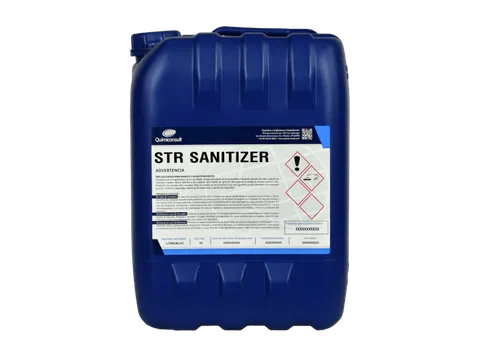
SANIFLOW ACID CIP DESCALER AND SANITIZER FOR FOOD AND BEVERAGE EQUIPMENT
sku INPTF021
Price:
/kg
USD 2.06
Have a question?
A specialist answers your questions about concentrations, dosing, packaging or volume pricing.
