Spanish
 English


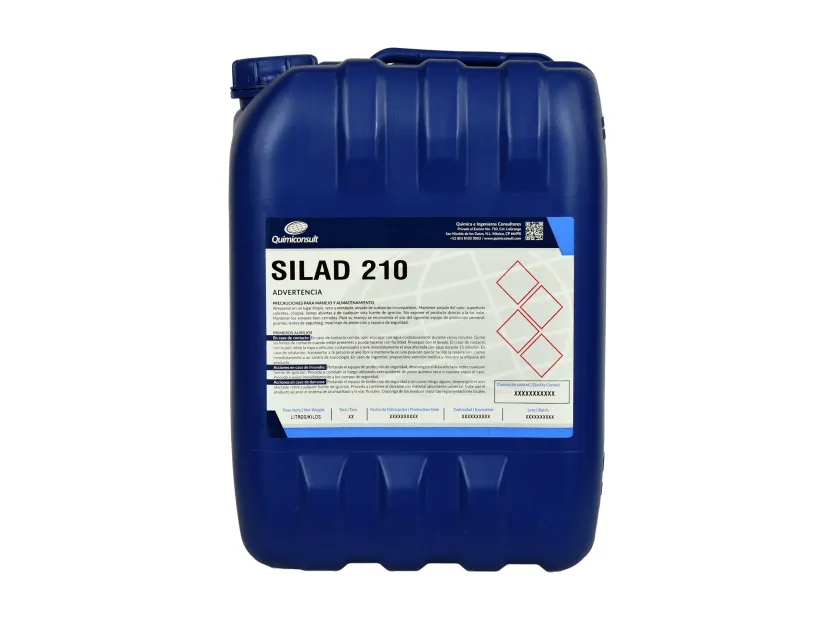
SILAD 210 DEFOAMING AGENT IN SILICONE EMULSION 10%
View All Prices
| Quantity | Unit Price |
|---|---|
| kg | |
| 1 - 99 | USD 2.86 |
| 100 - 199 | USD 2.82 |
| 200 - 499 | USD 2.78 |
| 500 - 999 | USD 2.74 |
| 1000 - 4999 | USD 2.70 |
| 5000 - 9999 | USD 2.66 |
| 10000 - 17999 | USD 2.62 |
| 18000+ | USD 2.58 |
Silad 210 Description — Foam Control Agent for Industrial Applications in Aqueous Systems
At Quimiconsult we offer Silad 210, an industrial antifoam formulated as a low-viscosity, water-based silicone emulsion, designed for effective foam control in a wide variety of industrial processes that use water-based systems: agrochemical formulations, industrial cleaning solutions, chemical manufacturing processes, the pulp and paper industry, textile processing, water-based paint and coating formulations, industrial water treatment, cutting fluids and metalworking processes, where foam formation reduces efficiency, tank capacity and operational quality. It is a homogeneous, stable, easy-to-handle and cost-effective foam control agent that excels in applications with nonionic and anionic surfactants, delivering superior performance under neutral, slightly alkaline or acidic pH conditions and effectively withstanding a wide range of process pH.
It comes as a homogeneous creamy white emulsion, with a viscosity of 1,000 to 3,000 cP at 25 °C, a 1% solution pH in the range of 3.50 to 4.50, water as the suitable diluent and a nonionic emulsifier (key to its compatibility with industrial surfactant systems). Supplying it as an aqueous emulsion, rather than pure silicone, makes it easy to incorporate evenly into the foaming system, improves the distribution of the active in the aqueous medium and allows precise dosing with standard metering pumps at typical starting concentrations of 50 to 500 ppm.
Silad 210 belongs to the category of polydimethylsiloxane (PDMS) antifoams emulsified in water with a nonionic emulsifier, one of the most established and effective technologies for foam control in industrial aqueous systems. Compared with organic antifoams based on vegetable oils, fatty acids or esters, silicone antifoams offer decisive advantages for industrial processes: greater potency per unit of mass, longer-lasting antifoam action over time, thermal stability suited to conventional industrial processes, broad compatibility with the surfactants used in industrial formulations and cleaning, and a safe handling profile under good industrial handling practices.
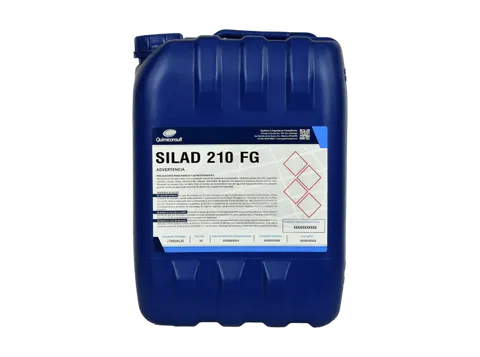
Important — choosing the right grade: Silad 210 is an industrial grade antifoam, formulated for industrial applications where there is no direct or indirect contact with food products intended for human or animal consumption. For applications involving food contact (food plants, meat processing, beverages, juices, preserves, washing of food products, supplements, CIP in food plants), the Silad 210 FG (Food Grade) version must be used: a kosher food grade product manufactured in a plant certified under the SQF scheme.
At Quimiconsult, located in San Nicolás de los Garza, Nuevo León, we distribute Silad 210 with nationwide coverage, application technical support, certificates of analysis for every lot, and up-to-date technical data sheets (TDS) and safety data sheets (HDS/SDS), serving agrochemical formulation plants, industrial cleaning solution manufacturers, paper mills, textile mills, water-based paint and coating formulators, chemical process plants, metalworking industries, industrial water treatment plants and production and development departments throughout Mexico.
Silad 210 Technical Specifications
Silad 210 meets a consistent lot-to-lot quality profile, verifiable through a Certificate of Analysis (CoA):
- Appearance: homogeneous creamy white emulsion.
- Viscosity at 25 °C: 1,000 to 3,000 cP.
- Suitable diluent: water (in any proportion).
- Emulsifier type: nonionic (key to compatibility with the anionic and nonionic systems typical of industrial processes).
- pH (1% solution): 3.50 to 4.50 (slightly acidic).
Beyond these parameters, Silad 210 has functional properties that determine its value in industrial applications:
- High antifoam efficiency at very low dosage (typically 50 to 500 ppm).
- Long-lasting antifoam action: silicone antifoams remain active for extended periods, compared with organic antifoams that are consumed more quickly.
- Compatibility with nonionic and anionic surfactants, widely used in industrial formulations and non-food CIP.
- Stability over a wide pH range: reliable performance under acidic, neutral and slightly alkaline conditions.
- Thermal stability suited to conventional industrial processes.
- Fully dilutable in water for preparing dosing solutions.
- Suitable for continuous dosing with standard metering pumps.
- Long-term storage stability under proper conditions; easy recovery in case of partial separation due to exposure to extreme temperatures.
Synonyms and Related Search Terms
In the industrial market, silicone emulsion antifoams are known by many names: industrial antifoam, industrial silicone antifoam, silicone antifoam emulsion, antifoam silicone emulsion, PDMS antifoam, industrial foam controller, foam control agent, foam control additive, industrial defoaming agent, antifoam for agrochemicals, antifoam for industrial CIP, industrial defoamer or water-based antifoam. In regulatory labeling and technical specifications, the main active is typically polydimethylsiloxane (PDMS) emulsified in water with nonionic emulsifiers.
Frequent searches include Silad 210 price, buy Silad 210, industrial antifoam Mexico, antifoam for agrochemicals Mexico, industrial antifoam supplier Monterrey, antifoam for water-based paints, industrial CIP antifoam, pulp and paper antifoam, textile antifoam, industrial water treatment antifoam, PDMS antifoam supplier, buy silicone antifoam emulsion, industrial antifoam dosage, silicone antifoam Mexico or low-viscosity antifoam. These variations are relevant to production, formulation and quality departments, process engineers, plant managers, industrial buyers and R&D departments.
The Silad Family at Quimiconsult — Industrial Grade and Food Grade
Quimiconsult offers two versions of Silad antifoam to cover every application according to the required regulatory grade:
- Silad 210 (industrial grade) — the product described on this page: silicone emulsion antifoam intended for non-food industrial applications. Ideal for agrochemical formulations, industrial chemical processes, the paper industry, textiles, paints and coatings, industrial water treatment, cutting fluids and industrial cleaning solutions without food contact. A more economical option than food grade when the end application does not require food certification.
- Silad 210 FG (Food Grade): silicone emulsion antifoam, food grade, kosher, manufactured in a plant certified under the SQF (Safe Quality Food) scheme recognized by GFSI. Intended for all applications with direct or indirect food contact: food plants, meat and poultry processing, beverages, juices, preserves, jams, dietary supplement manufacturing, condiments, washing of food products and CIP in food plants.
Key selection criterion: if your process involves any contact with food products, you must use Silad 210 FG. If the process is strictly industrial with no food contact, you can use standard Silad 210 to optimize cost. The price difference between the two versions is marginal compared with the regulatory risk of using industrial grade in food applications. When in doubt, using the FG version is always recommended to ensure regulatory compliance.
How Does Silad 210 Work?
Silicone emulsion antifoams such as Silad 210 work through a highly efficient, durable and selective physical mechanism that ruptures foam films.
The fine polydimethylsiloxane (PDMS) droplets released after the emulsion disperses migrate to the air-liquid interface of the foam bubbles, drawn by the low surface tension of silicone (~20 mN/m vs ~30-40 mN/m for foaming surfactant solutions). By inserting itself into the bubble's surfactant film (lamella), the silicone locally ruptures the film that kept the bubble stable. The lamella thins rapidly due to capillary forces until it collapses mechanically, releasing the trapped gas.
Because the silicone is not chemically consumed during this process, it remains available to suppress new foam formation in cascade for extended periods after the initial dose, which explains the longer-lasting effect and lower dosage of Silad 210 compared with organic antifoams. The nonionic emulsifier in Silad 210 avoids unfavorable interactions with the anionic surfactants common in industrial formulations, maintaining effectiveness in the presence of process detergents and surfactants, and the polydimethylsiloxane chain does not undergo significant hydrolysis under the acidic to slightly alkaline pH conditions typical of industrial processes.
Industrial Applications of Silad 210
Agrochemical Formulations
Silad 210 is widely used in agrochemical formulation as a manufacturing process antifoam (foam control during mixing, filling and packaging of emulsifiable concentrates, suspensions, wettable powders and solutions) and as a final-formulation antifoam incorporated into the agrochemical product to prevent excessive foaming when the product is diluted in the farmer's spray tank. Its compatibility with the nonionic and anionic surfactants typical of agrochemical formulations (such as nonylphenol ethoxylates, alcohol ethoxylates and sulfonates) makes it a standard component in this sector.
Component of Industrial Cleaning Solutions
In industrial detergent formulations, non-food CIP cleaning solutions and specialty cleaners, Silad 210 controls the foam generated by surfactants and residues during cleaning operations:
- Industrial alkaline detergents for cleaning industrial equipment and floors.
- Acid detergents for removing mineral scale.
- Industrial maintenance cleaners for warehouses, equipment and surfaces.
- Non-food industrial CIP solutions for cleaning equipment in the chemical, paper, textile and manufacturing industries.
- Industrial automotive cleaners for fleets and workshops.
- Washing solutions for mechanical parts and metal components.
Pulp and Paper Industry
In the paper industry, Silad 210 controls foam at multiple process stages where fibers, starches, surfactants and additives generate persistent foam:
- Mechanical and chemical pulping processes.
- Pulp bleaching operations.
- Process water recirculation systems (white water).
- Paper machines: headbox, forming and pressing.
- Paper coating processes.
- Deinking operations in paper recycling.
- Paper mill effluent treatment.
Textile Industry
In textile processing, Silad 210 is used as an antifoam in:
- Dyeing and finishing baths where auxiliary surfactants and dyes generate foam that affects process uniformity.
- Preparatory washing (scouring) processes for raw fibers.
- Bleaching and mercerizing operations under alkaline conditions.
- Textile printing systems and fixation processes.
- Treatment of textile effluents and process wastewater.
Water-Based Paints, Coatings and Inks Industry
In water-based formulations where emulsifying surfactants, dispersants and coalescents generate foam during mixing, grinding and packaging:
- Latex paints (acrylic, vinyl, styrene-acrylic) for architectural and industrial use.
- Water-based protective and decorative coatings.
- Water-based industrial and printing inks.
- Surface coating systems.
- Water-based adhesives during manufacturing.
Industrial Chemical Processes and Manufacturing
Silad 210 is used as a process antifoam in many chemical sectors:
- Emulsion polymerization for manufacturing latex and aqueous polymers.
- Liquid-liquid extraction and phase separation processes.
- Industrial chemical reactors where intensive agitation generates foam.
- Evaporation and concentration processes for industrial solutions.
- Manufacture of specialty chemicals, inks and adhesives.
- Water-soluble cutting and machining fluids where foam control is required during operation.
Industrial Water Treatment
In industrial water treatment plants (not intended for human consumption), Silad 210 controls foam in aerobic bioreactors, aeration tanks, flotation systems, clarifiers and treatment units where surfactants, industrial proteins and oils generate foam that affects system operation.
Silad 210 Features and Competitive Advantages
- Cost-effective: an economically optimized option compared with food grade when the application does not require FG certification.
- High antifoam efficiency at very low dosage (50-500 ppm).
- Long-lasting antifoam action, greater than traditional organic antifoams.
- Compatibility with nonionic and anionic surfactants, the most widely used in industrial formulations and CIP.
- Effective over a wide pH range (acidic, neutral, slightly alkaline).
- Fully dilutable in water for preparing dosing solutions.
- Continuous dosing with standard metering pumps.
- Long-term storage stability under proper conditions.
- Food grade version available (Silad 210 FG) for food-contact applications, keeping the Silad antifoam family with a single supplier.
Recommendations for Use, Dosage and Incorporation
Pre-mixing: the emulsion should be mixed gently before use to ensure uniformity. In drums that have been standing for a long time, stir gently or recirculate before dosing.
Method of application: Silad 210 can be used as a concentrate (direct dosing) or diluted in water or process liquid (the recommended form for maximum cost-effectiveness and better distribution): mix 1 part Silad 210 with 3 to 10 parts of the selected diluent, stirring gently until a uniform mixture is obtained. Keep the dilution under continuous gentle agitation during intermediate storage to ensure uniformity.
Point of addition: to maximize cost-effectiveness, the antifoam should be pre-diluted and added continuously at a stage before foam forms (proactive, not reactive dosing). This practice prevents foam from forming rather than eliminating it once formed.
Suggested starting concentrations: 50 to 500 ppm of Silad 210 in the foaming system. Start with the lowest dose in the range (50-100 ppm) and adjust upward progressively until the desired foam control is achieved, optimizing dosage and cost. The exact concentration depends on the foaming intensity of the process, the type of surfactants present, temperature, pH and residence time.
Dosing equipment: standard diaphragm, peristaltic or piston metering pumps are suitable. For continuous dosing in process lines, flow-controlled injection systems help maintain a constant concentration.
Silad 210 Compatibility
Silad 210 is compatible with water and aqueous solutions in any proportion, nonionic and anionic surfactants at typical process concentrations, dilute organic and inorganic acids, moderate bases, organic and inorganic salts, auxiliary formulation surfactants, standard industrial additives, water-soluble polymers and most industrial process ingredients.
It requires special precautions with: cationic surfactants at high concentration (they can alter the stability of the nonionic emulsion — check the specific case), extreme temperatures during prolonged storage (excessive heat or freezing can cause reversible separation of the emulsion), strong oxidizing agents at high concentration (concentrated peroxide, highly concentrated hypochlorites), and very intense prolonged shear that may affect emulsion stability.
Storage, Handling and Shelf Life
To ensure product quality, the container must be tightly closed when not in use. Store at controlled room temperature (ideally 15-30 °C) and avoid prolonged exposure to extreme temperatures of heat (>40 °C sustained) or freezing, which can cause separation of the emulsion.
In case of separation due to exposure to extreme temperatures: if frozen, first thaw at room temperature; gently stir the contents to recombine the phases; use as usual. Reversible separation does not compromise product performance once homogenized.
The product's shelf life under proper storage conditions is typically 12 to 18 months from the date of manufacture, depending on the supplier's specification and the lot. The official expiration date is shown on the original container and on the lot's Certificate of Analysis.
Safety, Handling and Regulatory Considerations
Silad 210 is an industrial grade silicone emulsion with a well-characterized handling profile, recognized as a substance with a low hazard profile under normal industrial use conditions. Emulsified polydimethylsiloxane (PDMS) antifoams have a long history of safe use in industrial applications under good handling practices.
Recommended PPE: chemical safety goggles, industrial gloves (nitrile or equivalent), appropriate work clothing and work in areas with adequate ventilation.
Spill handling: Silad 210 spills are slippery and present a fall hazard. Contain with inert absorbents (vermiculite, sand, absorbent pads), collect and dispose of according to current waste legislation. Wash the area with water and detergent to remove residues.
Important regulatory consideration: Silad 210 is an industrial grade antifoam, not suitable for food contact. For applications with direct or indirect food contact (food plants, beverages, meat products, supplements, washing of food products, food CIP), Silad 210 FG must be used (food grade, kosher, manufactured in an SQF plant).
Every lot of Silad 210 comes with a Certificate of Analysis (CoA), technical data sheet (TDS) and safety data sheet (HDS/SDS) available for inclusion in operational records.
Frequently Asked Questions about Silad 210
What is Silad 210 and what is it used for?
Silad 210 is an industrial grade antifoam formulated as a water-based low-viscosity silicone emulsion. It is used to control foam formation during industrial processing operations: agrochemical formulations, industrial cleaning solutions, the pulp and paper industry, textile processing, water-based paint and coating formulations, industrial chemical processes, metalworking cutting fluids, and industrial water treatment (not intended for human consumption).
What is the difference between Silad 210 and Silad 210 FG?
The fundamental difference lies in the regulatory grade and intended use. Silad 210 (this product) is industrial grade, designed for industrial applications without food contact. Silad 210 FG is food grade, kosher, manufactured in a plant certified under the SQF scheme, and intended for applications with direct or indirect food contact. The antifoam efficiency profile is similar for both, but only the FG grade includes the traceability and certifications specific to food safety. If your process involves food contact, Silad 210 FG must be used.
At what concentration is Silad 210 used?
The suggested starting concentration is 50 to 500 ppm of Silad 210 in the foaming system. It is recommended to start with the lowest dose in the range (50-100 ppm) and adjust upward progressively until the desired foam control is achieved. The exact concentration depends on the foaming intensity of the process, the type of surfactants present, temperature, pH and residence time.
How is Silad 210 diluted and applied?
Silad 210 can be used as a concentrate (direct dosing) or diluted in water or process liquid (the recommended form for maximum cost-effectiveness). Dilution is done by mixing 1 part antifoam with 3 to 10 parts diluent, stirring gently. Keeping the dilution under continuous gentle agitation during intermediate storage is recommended. For maximum effectiveness, dose it continuously at a stage before foam forms (proactive rather than reactive dosing).
Does Silad 210 work with detergents and CIP cleaners?
Yes, Silad 210 is compatible with nonionic and anionic surfactants, the most common in industrial detergent formulations and non-food CIP solutions. It works over a wide pH range (acidic, neutral, slightly alkaline), suitable for both acid and alkaline industrial CIP. Important: for CIP in food plants, Silad 210 FG must be used.
In what pH range does Silad 210 work?
Silad 210 is effective over a wide pH range, with superior performance under acidic, neutral and slightly alkaline conditions. The polydimethylsiloxane chain does not undergo significant hydrolysis under normal industrial process conditions.
What happens if Silad 210 separates during storage?
Separation can occur if the product is exposed to prolonged extreme temperatures (excessive heat or freezing). In case of separation: if frozen, thaw at room temperature; gently stir the contents to recombine the phases; use as usual. Reversible separation does not compromise performance once homogenized.
How long does Silad 210 last in storage?
In a tightly closed container stored at controlled room temperature (15-30 °C), Silad 210 has a typical shelf life of 12 to 18 months from the date of manufacture, depending on the lot specification. The official expiration date is shown on the original container and on the lot's CoA.
Where to buy Silad 210 in Mexico and at what price?
At Quimiconsult we distribute Silad 210 with availability from our warehouse in San Nicolás de los Garza, Nuevo León, serving industrial customers throughout Mexico. We offer drums and bulk deliveries on request, with complete technical documentation (TDS, SDS, CoA per lot) and application technical support. We also distribute Silad 210 FG (food grade) for food-contact applications. The price depends on volume, packaging and purchase frequency. Request a personalized quote at +52 (81) 8105 0063.
Request Your Silad 210 Quote
Does your agrochemical formulation plant, industrial cleaning solution manufacturing operation, paper mill, textile mill, water-based paint and coating formulation business, chemical process plant, metalworking operation, industrial water treatment plant or any industry that needs an efficient, cost-effective industrial antifoam need to incorporate Silad 210 into its processes? We also offer Silad 210 FG (food grade, kosher, manufactured in an SQF plant) for food-contact applications. Contact us and we will analyze your specific application, recommend the right dosage and the optimal point of addition, advise you on which version (industrial or FG) fits your application, and deliver a comprehensive solution that includes complete technical documentation, application advice and timely delivery anywhere in Mexico.
Related Products
- Silad 210 FG (Food Grade) — food grade, kosher silicone emulsion antifoam, manufactured in an SQF plant for food-contact applications
- Industrial organic antifoams — ester- and alcohol-based alternatives for specific applications (subject to availability)
- Nonionic surfactants (NF 10 M, NF 4, NF 30, NF 70) — for agrochemical formulations and industrial cleaning
- Polyethylene glycols (PEG 200, 300, 400, 600) — industrial formulation aids
Related categories:
- Category: Industrial Antifoams and Foam Control Agents
- Category: Agrochemical Formulation Aids
- Category: Supplies for Industrial Cleaning Solutions
- Category: Supplies for the Pulp and Paper Industry
- Category: Textile Processing Aids
- Category: Additives for Water-Based Paints and Coatings
- Category: Supplies for Industrial Chemical Processes

SILAD X700 SILICONE-BASED INDUSTRIAL DEFOAMER FOR NON-AQUEOUS SYSTEMS