Spanish
 English


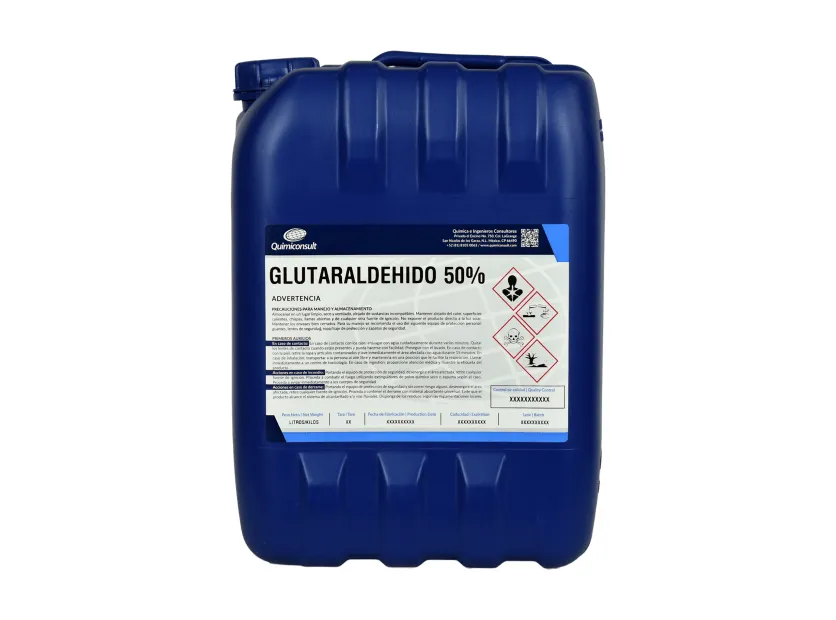
GLUTARALDEHYDE 50% INDUSTRIAL DISINFECTANT
View All Prices
| Quantity | Unit Price |
|---|---|
| kg | |
| 1 - 99 | USD 2.88 |
| 100 - 199 | USD 2.82 |
| 200 - 499 | USD 2.78 |
| 500 - 999 | USD 2.74 |
| 1000 - 4999 | USD 2.69 |
| 5000 - 9999 | USD 2.65 |
| 10000 - 17999 | USD 2.61 |
| 18000+ | USD 2.58 |
We'll send you a single e-mail as soon as it's back in stock. No spam.
Glutaraldehyde 50% Description — High-Efficacy Industrial Biocide in Acidic and Alkaline Media
At Quimiconsult we offer Glutaraldehyde 50%, a colorless to slightly yellowish liquid with a strong, pungent odor, completely soluble in water and recognized worldwide as one of the most effective broad-spectrum biocides available to industry. It is a short-chain dialdehyde — chemically identified as pentanedial — whose biocidal activity derives from its unique ability to react with amines and amino acids in the cell walls and structural proteins of microorganisms, causing their irreversible inactivation through protein denaturation and nucleic acid cross-linking.
Unlike many conventional disinfectants, glutaraldehyde retains its biocidal activity in both acidic and alkaline media, making it effective across a wide variety of process conditions and industrial matrices. Its spectrum of action includes gram-positive and gram-negative bacteria, viruses, fungi, bacterial spores and mycobacteria, including highly resistant microorganisms that are not eliminated by less potent biocides such as hypochlorites or quaternary ammonium compounds. This efficacy against spores sets it apart as one of the few agents with confirmed sterilizing capability, not merely disinfecting.
Its 50% formulation lets users prepare working solutions at the exact concentration each application requires, optimizing the cost per liter of active solution and reducing the storage volume needed. It is compatible with foaming formulations and spray application systems.
Available in Monterrey, with shipping throughout Mexico. Packaged in 20 L jerrycans, 50 L and 200 L drums, and 1,000 L totes for industrial operations of any scale.
Glutaraldehyde 50% Technical Specifications and Physicochemical Properties
The Glutaraldehyde 50% we carry at Quimiconsult meets specifications verified by a certificate of analysis for every batch, ensuring consistent active concentration and biocidal performance with every delivery.
Chemically it is identified as Pentanedial or 1,5-Pentanedial, with molecular formula C₅H₈O₂ and CAS number 111-30-8. It belongs to the dialdehyde family, characterized by two aldehyde groups at the ends of a five-carbon chain, a structure that gives it exceptional reactivity with proteins and the ability to form irreversible molecular cross-links in the cellular structures of microorganisms.
Its minimum active glutaraldehyde content is 50.0%, verified by chemical analysis, which ensures the biocidal potency required for industrial and medical applications where active concentration determines treatment efficacy. The specific gravity at 20°C ranges from 1.12 to 1.14, an essential figure for accurately calculating volumes and doses in automatic dosing systems. The pH at 25°C is between 3.0 and 5.0, a slightly acidic range that contributes to the compound's stability in aqueous solution; in this state, glutaraldehyde is present mainly in its active monomeric form. The Pt-Co color ranges from 0 to 100, giving an appearance from colorless to slightly yellowish without affecting product activity. The maximum methanol content is 0.50%, a relevant purity parameter for applications in regulated industries where residual solvents are audited.
In terms of its mechanism of action, glutaraldehyde's biocidal efficacy is based on the reaction of its two aldehyde groups with the free amino groups (–NH₂) of amino acids such as lysine and arginine and with the N-terminus of microbial membrane proteins and enzymes. This cross-linking reaction is irreversible and prevents structural and enzymatic proteins from functioning normally, resulting in the death of the microorganism. Its ability to penetrate bacterial spores and destroy their internal contents distinguishes it from conventional disinfectants that act only on vegetative microorganisms.
Glutaraldehyde 50% Applications — Uses by Industry
Glutaraldehyde 50% is one of the most versatile biocides available to industry, with applications ranging from sterilizing medical instruments to microbiological control in industrial water systems. Its main applications by industry are detailed below:
Disinfection and Sterilization of Medical and Surgical Equipment
Glutaraldehyde's best-known application worldwide is the cold sterilization of heat-sensitive medical and surgical instruments, that is, those that cannot undergo heat sterilization (autoclaving) without damage or deformation. This equipment includes flexible endoscopes, laparoscopes, bronchoscopes, colonoscopes, fiber-optic instruments, reusable catheters, cannulas, anesthesia tubing, prostheses and other critical or semi-critical medical devices under the Spaulding classification.
2% glutaraldehyde working solutions (prepared from the 50% formulation) are the reference standard for this use in hospitals, clinics, laboratories and endoscopy centers, where they are applied by immersion with contact times of 20–45 minutes for high-level disinfection and 6–10 hours for full sterilization. Its efficacy against Mycobacterium tuberculosis, Clostridium difficile (in vegetative form), enveloped and non-enveloped viruses (including HIV, HBV and HCV) and fungi makes it the agent of choice for instruments that come into contact with mucous membranes or sterile tissue.
CIP/COP Cleaning and Sanitation in the Food and Beverage Industry
In food and beverage processing plants, glutaraldehyde is used as a biocide in CIP (Clean in Place) systems to disinfect piping circuits, storage tanks, heat exchangers, homogenizers, fillers and process equipment where microbiological control is critical to the safety of the finished product. Its efficacy against bacterial biofilms — including those formed by Pseudomonas, Listeria and Bacillus — makes it especially valuable in systems where other biocides have shown limited efficacy against sessile microorganisms.
On bottling, packaging and aseptic filling lines, dilute glutaraldehyde solution is applied by immersion or spraying to sanitize food-contact surfaces, change parts, conveyor belts and auxiliary equipment between production shifts or product changeovers. Its compatibility with foaming formulations makes it easier to apply on vertical surfaces and hard-to-reach equipment.
Industrial Water Treatment and Cooling Towers
In industrial water treatment systems, glutaraldehyde is widely used as a non-oxidizing biocide to control microbiological growth in cooling towers, process water systems, closed cooling loops, fire water systems and cooling water in petrochemical, steel and power generation plants. Its efficacy against aerobic and anaerobic bacteria, including the sulfate-reducing bacteria (SRB) responsible for biocorrosion in water systems, makes it an essential complement to water treatment programs in continuous-process industries.
Unlike oxidizing biocides (chlorine, bromine, peroxide), glutaraldehyde is not consumed by reacting with organic matter dissolved in the water, which makes it more effective in systems with a high organic load. It is typically applied as shock doses (high concentrations for short periods) and maintenance doses (lower concentrations, continuously or periodically), with dosing adjusted based on microbiological analysis of the water.
Pharmaceutical Industry — Disinfection and Tissue Fixation
In the pharmaceutical and biotechnology industries, glutaraldehyde is used as a disinfecting agent for process equipment in classified areas, fermenters, bioreactors, ultrafiltration systems and biologics manufacturing equipment where conventional oxidizing agents are not compatible with the process materials or the products being manufactured.
In histology, pathology and biomedical research laboratories, 2.5–4% glutaraldehyde is the reference tissue fixative for electron microscopy, as it preserves cellular ultrastructure more faithfully than formaldehyde, maintaining the morphology of organelles, membranes and subcellular structures for high-resolution analysis. It is also used in sample preparation for immunohistochemistry, cryomicroscopy and other advanced pathology diagnostic procedures.
Oil and Gas Industry — Microbiological Control in Reservoirs
In the oil and gas industry, glutaraldehyde is one of the most widely used biocides for controlling bacteria in water injection systems, reservoirs and pipelines. Sulfate-reducing bacteria (SRB) and acid-producing bacteria (APB) in production systems generate hydrogen sulfide (H₂S) and cause biocorrosion in pipes, valves and surface equipment, posing safety, environmental and asset-integrity risks. Applied as shock doses through injection systems, glutaraldehyde effectively eliminates these bacterial populations without the corrosion problems associated with oxidizing biocides such as hypochlorite.
Livestock, Veterinary and Biosecurity
In livestock facilities, slaughterhouses and poultry and cattle processing plants, glutaraldehyde in dilute formulations is used for the environmental disinfection of facilities, equipment, animal transport vehicles and quarantine areas. Its efficacy against avian influenza, foot-and-mouth disease and Newcastle disease viruses and other pathogens with an economic impact on animal production makes it a key component of biosecurity programs on modern farms and in certified processing plants.
To discover other products related to disinfection and microbiological control, we invite you to visit our Biocides, Disinfection & Sanitation, CIP & COP Cleaning, Industrial Cleaning, Food & Beverage and Pharmaceutical & Wellness pages.
Glutaraldehyde 50% Packaging and Availability
Glutaraldehyde 50% is available in multiple package sizes to match each customer's volumes and process requirements, from quality control laboratories to industrial plants with continuous dosing systems.
For laboratories, formulation trials and small-scale operations, we offer 20 kg jerrycans, ideal for preparing 2% working solutions for medical equipment disinfection, biocidal efficacy testing and the start-up of sanitation protocols. For medium-sized processing plants, clinics and hospitals with weekly or biweekly consumption, we have 50 kg drums, which make handling and storage easier without requiring specialized transfer equipment. Industrial food, beverage and water treatment plants with CIP systems and continuous consumption are served with 200 kg drums, the standard format in industrial operations with automatic dosing. For large industrial users, water treatment service companies, regional distributors and petrochemical or oil plants, we offer 1,000 kg totes, which maximize operational efficiency and minimize the unit cost of the active biocide.
All containers are made of materials compatible with aldehyde solutions and meet safety requirements for the storage and transport of irritant and toxic chemicals. The product is kept permanently in stock in Monterrey, Nuevo León, with shipping throughout Mexico, accompanied by complete quality and safety documentation.
Safe Storage and Handling of Glutaraldehyde 50%
Storage Conditions
Glutaraldehyde 50% should be stored in its original, tightly closed container, protected from direct sunlight and heat sources. It should be kept in a cool, dry place with active mechanical ventilation, since glutaraldehyde vapors can cause severe irritation of the respiratory tract, eyes and skin even at very low airborne concentrations. The recommended storage temperature is between 5°C and 30°C; above this range, polymerization of the compound can accelerate, reducing its active biocidal activity.
It must be kept away from strong oxidizing agents, which can react with the aldehyde groups, and stored separately from strong bases, which can trigger polymerization of glutaraldehyde in solution. The storage area must have a spill containment system and access restricted to personnel trained in handling hazardous chemicals.
Required Personal Protective Equipment (PPE)
Handling glutaraldehyde 50% requires full protective equipment given its classification as a toxic, irritant and sensitizing substance. For eye and face protection, splash-proof safety goggles and a full face shield are mandatory, since the product can cause serious eye damage and severe irritation on contact with the eyes. For hand and body protection, wear nitrile or neoprene gloves of adequate thickness (minimum 0.3 mm), a chemical-resistant apron, protective suit and closed-toe shoes; glutaraldehyde can cause skin sensitization and contact dermatitis with repeated exposure, even at low concentrations. For respiratory protection, a respirator with an organic vapor cartridge is mandatory in confined spaces, poorly ventilated areas or during transfer and solution preparation; glutaraldehyde vapors can cause respiratory sensitization, occupational asthma and bronchospasm with chronic exposure, so adequate ventilation is a critical, not optional, control measure.
Other Names, Synonyms and Search Terms
Glutaraldehído is the orthographically correct Spanish spelling of the compound, used in scientific literature, regulatory filings with COFEPRIS, safety data sheets and academic publications.
Glutaral is the abbreviated name used in the chemical and pharmaceutical industries for the same compound, especially in laboratory chemical catalogs, substance databases and technical documentation from manufacturers of hospital disinfection products. It also appears in some clinical literature and in health registrations of biocidal products approved for medical use.
Pentanedial is the systematic IUPAC name of glutaraldehyde, corresponding to CAS number 111-30-8. This name appears in international chemical substance databases such as PubChem, ChemSpider and ECHA, and in regulatory documentation where precise chemical identification of the compound is required. It is also the name used in the substance record within the European REACH system for biocidal products.
Glutaryl dialdehyde or glutaraldialdehyde are academic and pharmaceutical names used to highlight the compound's chemical structure — two aldehyde groups at the ends of a five-carbon chain — in scientific publications, mechanism-of-action studies and review articles on sterilizing agents in medical and hospital settings.
Glutaraldehyde disinfectant or disinfectant glutaraldehyde are the expressions most often used by purchasing managers at hospitals, clinics, food processing plants and sanitation service companies to identify this compound in its main role as a high-level antimicrobial agent. These are the names searched for on institutional purchasing platforms, medical supply tenders and industrial sanitation bids.
Glutaraldehyde suppliers Mexico is the most frequent search term among industrial buyers, hospital administrators and purchasing managers in Mexico who need to find local distributors with available stock, complete regulatory documentation and specialized technical support for critical biocidal applications.