Spanish
 English


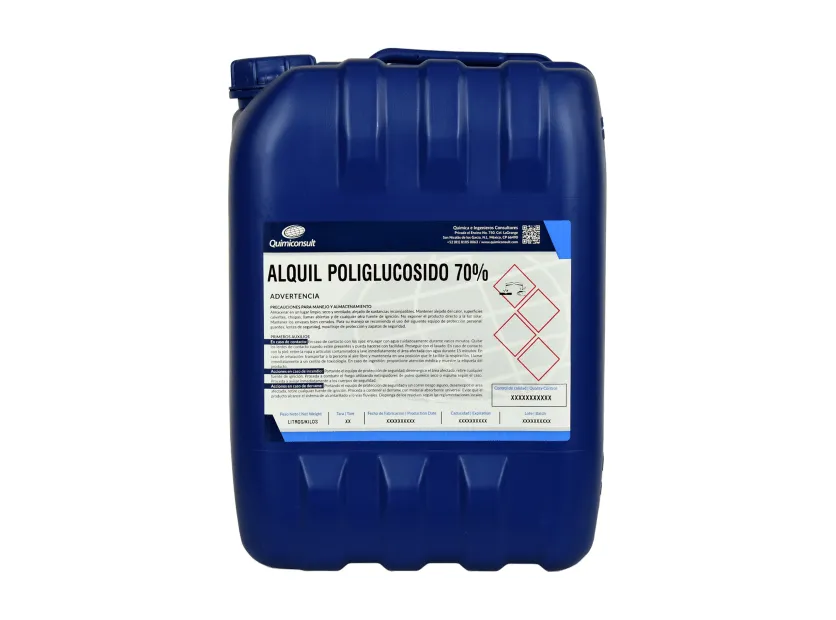
ALKYL POLYGLUCOSIDE 70% BIODEGRADABLE SURFACTANT
View All Prices
| Quantity | Unit Price |
|---|---|
| kg | |
| 1 - 99 | USD 4.02 |
| 100 - 199 | USD 3.96 |
| 200 - 499 | USD 3.90 |
| 500 - 999 | USD 3.85 |
| 1000 - 4999 | USD 3.79 |
| 5000 - 9999 | USD 3.74 |
| 10000 - 17999 | USD 3.69 |
| 18000+ | USD 3.64 |
Product description: Alkyl Polyglucoside 70%, a biodegradable nonionic surfactant from renewable sources
At Quimiconsult we offer Alkyl Polyglucoside 70% (APG), a high-performance nonionic surfactant derived from 100% renewable raw materials: plant-based fatty alcohols (coconut or palm) and glucose obtained from corn or potato starch. This combination of natural sources makes it one of the most sustainable surfactants available to industry, without compromising the technical efficiency demanded by professional cleaning, personal care, agrochemical and water treatment formulations.
What exactly is an alkyl polyglucoside? It is a compound made up of an alkyl chain (the hydrophobic part, derived from the fatty alcohol) bonded to one or more glucose units (the hydrophilic part, derived from sugar). This molecular structure is what gives it its nonionic surfactant character: unlike anionic surfactants such as sodium lauryl sulfate (SLS) or sodium alkyl sulfate, APG carries no electrical charge in solution, giving it exceptionally broad formulation compatibility with other surfactants (nonionic as well as anionic and amphoteric), preservatives, fragrances, enzymes, active ingredients and electrolytes.
With an active content between 68% and 72%, Alkyl Polyglucoside 70% is a viscous, light yellow to brown liquid, with a pH between 6.0 and 9.0 in a 10% solution, free fatty alcohol below 1.0% and a freezing point of -4°C. It is highly soluble in concentrated alkaline solutions and has low toxicity and good biodegradability, qualities that make it the alternative of choice for formulators looking to move from petroleum-derived surfactants to green raw materials without sacrificing performance.
Alkyl Polyglucoside 70% is distributed from Monterrey, Nuevo León, with shipping throughout Mexico, technical formulation advice and documentation for use in food and personal care products.
Why are formulators switching to APG? The global trend toward green surfactants
The cleaning, personal care and agrochemical industries are undergoing a structural shift driven by three converging forces: stricter environmental regulation (in Mexico and in export markets), end-consumer demand for "eco-friendly" and "sulfate-free" products, and pressure from retail chains and certification bodies for ingredients with better toxicological and biodegradability profiles.
In this context, alkyl polyglucoside is the most mature technical answer to these three simultaneous demands. Unlike ethoxylated surfactants (such as alkyl polyglycol ether or nonylphenol ethoxylates), whose production involves ethylene oxide — a compound classified as a carcinogen that can generate by-products such as 1,4-dioxane — APGs are synthesized through a direct glucosidation reaction between the fatty alcohol and glucose, with no toxic intermediates or problematic residues.
For a formulator evaluating a raw material change, the practical advantages are tangible. APG keeps its surfactant activity across an extremely wide pH range (from pH 2 to pH 13), making it compatible with both acidic and alkaline formulations, a flexibility that conventional anionic surfactants do not offer, since many of them lose efficiency or precipitate at very low pH or in hard water. In addition, APG improves formulation stability because it does not interact negatively with divalent cations (calcium and magnesium), which are precisely what cause water "hardness" and the loss of foam and detergency in anionic surfactants.
A surfactant price analysis also favors APG when the total cost of the formulation is evaluated rather than the cost per kilogram of the ingredient in isolation. Thanks to its ability to act as a boosting co-surfactant, increasing the efficiency of the primary anionic surfactant, many formulations reduce their total surfactant load by 15% to 25% when APG is added, which offsets or exceeds the difference in unit cost.
Functional properties: What alkyl polyglucoside does in a formulation
The performance of APG 70% in a formulation rests on five functional properties that work synergistically:
Superior wetting. Reducing the surface tension of water is the most basic function of any surfactant, but APG does it particularly efficiently at low concentrations. This means the cleaning solution "wets" the surface faster, penetrates pores and textures more easily and makes contact with soil in less time. In agricultural applications, this property is critical to ensure that agrochemicals spread evenly over the leaf surface instead of forming droplets that run off without being absorbed.
Enhanced detergency. APG effectively disperses fats, mineral oils, waxes and particulate soil. Its detergency mechanism combines micellar solubilization (APG molecules surround the grease particle and draw it into the micelle) with electrosteric stabilization (the glucose chains create a barrier that prevents loosened soil from redepositing on the clean surface). This dual action is why many formulators report that adding APG as a co-surfactant significantly improves the perceived cleaning of the final product.
Stable, creamy foam. APG produces abundant, stable foam with a creamy texture that consumers associate with high-quality products, especially in categories such as liquid hand soap, shampoo, shower gel and hand dishwashing detergent. Unlike the foam produced by sodium laureth sulfate (SLES), which tends to be voluminous but short-lived, APG foam is more persistent and feels richer to the touch. When APG is combined with SLES or betaines, the synergistic effect produces better foam than either component generates on its own.
Emulsification and dispersion. In formulations containing oil phases (essential oils, fragrances, oil-soluble actives, solvents), APG acts as an emulsifier that stabilizes the water-oil interface, preventing phase separation during storage. This property is especially valued in industrial cleaning formulations where mineral oils, animal fats or hydrophobic compounds must be kept in suspension.
Dermatological mildness. APG is known for its exceptional skin compatibility. Unlike anionic surfactants such as SLS, which can strip lipids from the stratum corneum and cause irritation with repeated use, APG has a significantly lower skin and eye irritation index. This property makes it a first-choice ingredient for sensitive personal care formulations, baby products, intimate soaps and dermatological lines.
Alkyl polyglucoside applications: Sectors and formulations where APG makes a difference
Institutional detergents and cleaners. APG 70% is used in formulations of multi-purpose liquid detergents, floor cleaners, mild degreasers, hand and automatic dishwashing detergents and bathroom cleaners. In the institutional and household segment, where the trend toward "eco" and "biodegradable" products is growing rapidly, APG lets manufacturers offer products with sustainability claims backed by the renewable nature of the ingredient. Within Quimiconsult’s Institutional & Household Cleaning solutions, APG is one of the most recommended raw materials for stable, mild and biodegradable formulations.
Personal care and cosmetics. Shampoos, shower gels, liquid soaps, shaving foams, makeup removers, baby products and dermatological lines use APG as a primary surfactant or co-surfactant. The APG + cocamidopropyl betaine combination is one of the most popular bases in sulfate-free formulations, a segment growing at double digits annually in Mexico and Latin America, driven by demand from consumers with sensitive skin, color-treated hair or a preference for natural-origin ingredients.
Agrochemicals and crop protection. As an agricultural adjuvant, APG improves the spreading and adhesion of herbicides, insecticides, fungicides and foliar fertilizers on the leaf surface. Its ability to reduce surface tension ensures uniform coverage of the crop protection product, maximizing its biological efficacy and reducing the amount of product needed per hectare. Unlike adjuvants based on nonylphenol ethoxylate (which are being progressively restricted by environmental regulations in export markets), APG offers a significantly more favorable toxicological and ecotoxicological profile.
Industrial cleaning and degreasing. In manufacturing plants, mechanical workshops, the automotive industry and maintenance operations, APG is used in aqueous degreaser formulations that replace chlorinated solvents and petroleum-based products. Its ability to emulsify mineral oils and industrial greases, combined with its biodegradability and low toxicity, helps companies meet corporate sustainability programs and wastewater discharge regulations.
Water treatment. In flotation processes, flocculant dispersion and foam control in industrial water treatment plants, APG reduces surface tension and improves the homogeneous dispersion of chemical reagents. Its biodegradability is an added advantage in systems where the treated effluent must meet strict environmental parameters.
Food and beverage industry. APG is used in cleaner and sanitizer formulations approved for indirect food contact, such as CIP equipment washing detergents, surface cleaners in food plants and cleaning agents for returnable containers. Its low toxicity and the absence of problematic residues make it compatible with food safety requirements.
Textile and leather industry. In washing, degreasing and finishing processes for fabrics and hides, APG acts as a wetting agent and emulsifier that facilitates the uniform penetration of dyes, softeners and finishes without damaging natural or synthetic fibers.
APG as a co-surfactant: The synergistic effect that optimizes formulations and reduces costs
One of the smartest uses of Alkyl Polyglucoside 70% is not as the primary surfactant, but as a co-surfactant that boosts the performance of other surfactants in the formulation. This strategic use lets formulators achieve better results with a lower total load of active ingredients.
When APG is combined with anionic surfactants such as SLES (sodium laureth sulfate) or LAS (linear alkylbenzene sulfonate), a synergistic effect occurs in which the blend produces more foam, better detergency and less skin irritation than either component alone at the same total concentration. This phenomenon, well documented in the technical surfactant literature, is due to the formation of mixed micelles with a lower critical micelle concentration (CMC) than the individual components, which means less total surfactant is needed to reach the same level of activity.
In practice, this translates into formulations that can reduce their SLES or LAS load by 15% to 25% by partially replacing it with APG, while maintaining or improving the perceived performance of the final product. When the surfactant price factor of the complete formulation is evaluated, not just the cost per kilogram of the ingredient, this synergy often results in an equal or lower formulation cost, with the added benefit of a milder, more biodegradable product with better sustainability credentials.
The most widely used combinations in the industry include APG + SLES for dishwashing liquids and shampoos, APG + cocamidopropyl betaine for sulfate-free lines and sensitive-skin products, APG + LAS for liquid laundry and multi-purpose detergents, and APG + alkyl polyglycol ether for industrial degreasers and technical emulsions.
Advantages of APG over conventional surfactants: Why switch
100% renewable vs. petrochemical origin. Unlike alkylbenzene sulfonate (LAS), sodium alkyl sulfonate and other petroleum-derived surfactants, APG is produced exclusively from coconut/palm oil and plant starch. For brands looking to position products with "natural origin" or "bio-based" claims, APG is one of the few surfactants that withstands technical scrutiny of these claims.
Rapid, complete biodegradability. APG meets the criteria for ready biodegradability under OECD 301, degrading more than 60% in 28 days. This sets it apart from ethoxylated surfactants and branched-chain alkylbenzene sulfonate, which biodegrade more slowly and can generate persistent metabolites in aquatic environments.
Hard water tolerance. While anionic surfactants lose efficiency and foaming in the presence of calcium and magnesium (hard water), APG keeps its performance intact regardless of water hardness. In Mexico, where water hardness varies enormously by region — from soft water in tropical areas to extremely hard water in the north and the Bajío — this tolerance is a significant operational advantage.
Stability across a wide pH range. APG is functional from pH 2 to pH 13, making it compatible with acidic formulations (bathroom cleaners, descalers), neutral formulations (liquid soaps, shampoos) and alkaline formulations (degreasers, CIP detergents). Conventional anionic surfactants often lose stability or precipitate at extreme pH.
Dermatologically mild. With a significantly lower skin and eye irritation index than SLS and SLES, APG makes it possible to formulate personal and household cleaning products that are gentler on the user’s skin without compromising the perception of cleanliness.
No problematic by-products. Unlike ethoxylated surfactants, which can contain traces of 1,4-dioxane and residual ethylene oxide, the APG production process does not involve these intermediates, eliminating the risk of contamination with by-products classified as carcinogens.
Alkyl Polyglucoside 70% technical specifications
The product is a viscous, light yellow to brown liquid. Its active content is between 68.0% and 72.0%, with a pH in 10% solution between 6.0 and 9.0. The free fatty alcohol content is below 1.0%, indicating a high degree of reaction and product purity. Its freezing point is -4°C, allowing it to be stored and transported without special freeze protection in most of Mexico.
APG is highly soluble in concentrated alkaline solutions, which makes it easy to add directly to alkaline-based formulations without pre-dilution steps. In neutral aqueous formulations, the product disperses easily with moderate agitation.
Storage and handling
Store in the original, tightly closed container in a cool, dry place with adequate ventilation. Protect from direct sunlight and extreme temperatures. Avoid contact with strong oxidizing agents. Since the product has a freezing point of -4°C, in regions with very low winter temperatures it is recommended to store it in temperate areas or check the product’s flowability before dosing.
APG is a low-toxicity product, but as with any industrial chemical raw material, it is recommended to handle it with gloves, safety glasses and appropriate work clothing, following standard industrial chemical handling practices.
Frequently asked questions about Alkyl Polyglucoside 70%
What is a nonionic surfactant and why does it matter for my formulation? A nonionic surfactant is a surface-active agent that carries no electrical charge when dissolved in water. This gives it exceptional compatibility with virtually every other ingredient in a formulation: other surfactants (anionic, cationic, amphoteric), preservatives, fragrances, enzymes, electrolytes and active ingredients. In practice, this means fewer stability problems, fewer incompatibilities and greater formulation flexibility.
Can APG replace sodium lauryl sulfate (SLS) or SLES? Yes, partially or completely depending on the application. In personal care products, many brands have moved to APG + betaine formulations as a sulfate-free base. In detergents and cleaners, APG is often used as a co-surfactant that allows the SLES or LAS load to be reduced by 15% to 25% without losing performance. Full replacement is viable in premium, eco-friendly or dermatological lines; partial replacement is the most common route to optimize cost and performance at the same time.
Is sodium alkyl sulfate organic or inorganic? Sodium alkyl sulfate (SLS) is an organic compound because its molecular structure contains carbon chains derived from fatty alcohols. However, the term "organic" in the colloquial sense of "natural" or "eco-friendly" does not necessarily apply, since SLS can be produced from either coconut oil or petrochemical sources, and its sulfation process involves sulfuric acid. APG, on the other hand, is produced entirely from plant raw materials through a glucosidation reaction that involves no toxic intermediates.
Does APG work as an agricultural adjuvant? Yes. APG is widely used as an adjuvant to improve the spreading and adhesion of agrochemicals on the leaf surface. Its ability to reduce surface tension maximizes coverage of the crop protection product and reduces the amount needed per hectare. In addition, its ecotoxicological profile is significantly more favorable than that of nonylphenol ethoxylate-based adjuvants, which are being restricted in export markets.
Is APG compatible with CIP solutions in the food industry? Yes. Thanks to its stability in concentrated alkaline solutions and its low toxicity, APG is used in CIP detergent formulations in the food, dairy and beverage industries. Its biodegradability makes it easier to comply with wastewater discharge regulations.
What is the price of Alkyl Polyglucoside 70%? The price varies with purchase volume and commercial terms. When the surfactant price factor of the complete formulation is evaluated, taking into account APG’s synergistic effect as a co-surfactant that allows the total surfactant load to be reduced, the formulation cost often turns out to be competitive with or lower than that of conventional formulations based exclusively on anionic surfactants. Contact us for a personalized quote.
Other names and synonyms for alkyl polyglucoside
Alkyl polyglucoside / alkylpolyglucoside / polyglucoside alkyl (alquilpoliglucósido / alquil poliglucósido / poliglucósido de alquilo): interchangeable names used in technical data sheets, purchase specifications and formulation documentation in Spanish. All refer to the same type of nonionic surfactant derived from glucose and fatty alcohols.
APG (alkyl polyglucoside): an acronym derived from the English name, widely used in the global surfactant, personal care, agrochemical and specialty chemical industries. It is the most common term in international technical literature, formulation sheets and communications between suppliers.
Nonionic surfactant / non-ionic surfactant / nonionic tenside (surfactante no iónico / tensoactivo no iónico): the general category to which APG belongs. These terms are common in searches by formulators exploring alternatives within this family of surfactants.
Biodegradable surfactant / biodegradable tenside / green surfactant / natural-origin surfactant: descriptors that position APG within the sustainable raw materials segment. Formulators and buyers for eco-friendly brands use these terms to identify ingredients that support their sustainability claims.
Sodium alkyl sulfate / sodium lauryl sulfate / SLES / SLS: although these are anionic surfactants and not synonyms of APG, they often appear in comparative searches where the formulator is evaluating replacing these ingredients fully or partially with alkyl polyglucoside. If you reached this page looking for a milder, more biodegradable alternative to SLS or SLES, APG 70% is the most established option on the market.
Alkyl polyglycol ether / alkylbenzene / sodium alkyl sulfonate / alkyl benzoate / sodium alkyl ethoxysulfate / ethoxylated sodium alkyl sulfate: these are surfactants of a different chemical nature that are often compared with APG in formulation and raw material evaluation processes. APG differs from all of them in its 100% renewable origin, the absence of ethoxylation in its production process and its lower toxicological profile.