Spanish
 English


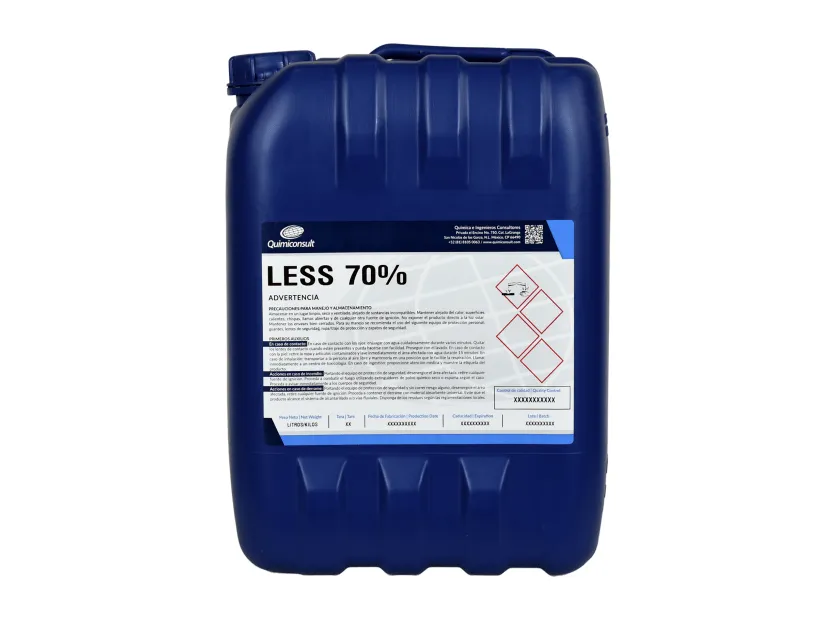
SODIUM LAURETH SULFATE 70% ANIONIC PASTE
View All Prices
| Quantity | Unit Price |
|---|---|
| kg | |
| 1 - 99 | USD 2.42 |
| 100 - 199 | USD 2.38 |
| 200 - 499 | USD 2.35 |
| 500 - 999 | USD 2.32 |
| 1000 - 4999 | USD 2.29 |
| 5000 - 9999 | USD 2.26 |
| 10000 - 17999 | USD 2.24 |
| 18000+ | USD 2.21 |
Sodium Lauryl Ether Sulfate 70% Product Description
At Quimiconsult we offer Sodium Lauryl Ether Sulfate (LESS) 70%, also known as Sodium Laureth Sulfate / SLES 70%, an ethoxylated anionic surfactant supplied as a viscous paste or semi-solid gel, white to slightly yellow in color, with a characteristic odor and a minimum active matter content of 70%. With CAS number 68585-34-2, this surfactant is the concentrated version of LESS, designed for formulators and industries that need greater dosing flexibility, lower shipping cost per active unit and the ability to adjust the final concentration directly in the plant according to the needs of each formulation.
LESS 70% is the most widely used anionic surfactant in the world for formulating personal care products and cleaning systems. Its popularity stems from a combination of properties that few surfactants manage to bring together in a single ingredient: high foaming capacity with abundant, fine and stable foam; excellent detergency for removing grease, oils and dirt; good skin and hair compatibility thanks to its ethoxylated structure, which makes it milder than non-ethoxylated sulfates; and broad compatibility with other anionic, amphoteric, cationic and nonionic surfactants, making it possible to design formulation systems balanced in detergency, foam, viscosity and sensory feel.
Unlike LESS 28%, which is supplied as a ready-to-formulate aqueous solution, LESS 70% is a concentrate that requires controlled dilution or incorporation during the manufacturing process. This higher concentration offers significant advantages for industrial operations: it lowers freight costs by shipping less water, allows more active matter to be stored in the same space, gives the formulator full control over the final product concentration and makes it easier to prepare concentrated bases that can later be diluted according to the application.
For anyone looking for what sodium lauryl ether sulfate 70% is used for, or needing a high-performance concentrated surfactant for their production lines, Quimiconsult provides quality supply, technical support in selecting the right system and guidance on incorporating the product into your formulation processes.
Sodium Lauryl Ether Sulfate 70% is available in Monterrey, Nuevo León, with shipping throughout Mexico, ensuring reliable supply for industrial-scale production processes and new formulation development.
Sodium Lauryl Ether Sulfate 70% Details and Properties
The Sodium Lauryl Ether Sulfate (LESS) 70% we distribute at Quimiconsult offers a minimum of 70% active matter, more than double the concentration of LESS 28%, which translates into greater efficiency per kilogram of product purchased. It has a pH between 7.0 and 9.0, unsulfated alcohols of 1.50% or less, sodium chloride of 0.50% or less and a maximum color of 20 APHA in 5% solution, parameters that ensure high purity, good appearance in the finished product and excellent reproducibility in manufacturing processes.
It comes as a white to slightly yellow viscous paste or gel that can be made more fluid by moderate heating (40-50°C) to make handling, pumping and dosing in the plant easier. This pasty consistency at room temperature is inherent to the high active matter concentration and is not a product defect. Many industrial operations keep LESS 70% in tanks with controlled heating or use pumping systems designed to handle high-viscosity products.
At Quimiconsult we supply LESS 70% in 170 kg drums and 1000 kg totes, packed under conditions that preserve its quality and make it easy to handle in the plant. Our package sizes are designed to serve both large-scale production operations and mid-volume formulation plants looking to optimize their raw material costs.
Physicochemical and Functional Properties of LESS 70%
The molecular structure of Sodium Lauryl Ether Sulfate consists of a C12-C14 fatty alcohol (predominantly lauric) that has been ethoxylated with an average of 2 to 3 moles of ethylene oxide and then sulfated and neutralized with sodium hydroxide. This ethoxylated structure is the key that sets LESS (SLES) apart from LAS or SLS (sodium lauryl sulfate) and is responsible for its greater dermatological mildness, better solubility, lower potential for skin and eye irritation, and greater tolerance to water hardness.
The foaming capacity of LESS 70% is one of its most valued properties. It generates abundant foam with a fine, creamy texture and excellent stability, even in the presence of dirt, grease and oils that normally collapse the foam of other surfactants. This property is essential in personal care products such as shampoos and shower gels, where foam not only contributes to cleaning but is a decisive factor in the consumer's perception of quality and effectiveness.
Its detergency comes from its ability to effectively reduce the surface tension of water, which promotes surface wetting, penetration into dirt, and the lifting and emulsification of grease and oils. This mechanism of action is what allows LESS 70% to work as the primary cleaning agent in formulations ranging from gentle shampoos to heavy-duty industrial detergents.
A particularly useful property of LESS 70% in formulation development is its excellent response to viscosity adjustment through the addition of electrolytes, especially sodium chloride (salt). This rheological response lets the formulator control the consistency of the finished product economically and predictably, obtaining anything from free-flowing liquids to thick gels simply by adding controlled amounts of salt. This salt curve is a fundamental tool in developing shampoos, liquid soaps and detergents, and is one of the reasons LESS remains the preferred surfactant over newer alternatives.
LESS 70% also acts as a wetting, dispersing and solubilizing agent, facilitating the homogeneous incorporation of fragrances, colorants, natural extracts, preservatives and other active ingredients into the formulation. Its compatibility with amphoteric surfactants such as cocamidopropyl betaine makes it possible to develop synergistic systems in which the combination of both surfactants produces more foam, higher viscosity, lower irritation and better sensory feel than either one alone.
Sodium Lauryl Ether Sulfate 70% Applications and Industrial Uses
Sodium Lauryl Ether Sulfate 70% is a raw material used across multiple industries that require a high-performance primary surfactant. Its high concentration makes it especially attractive to formulation plants looking to optimize costs, reduce inventories and gain greater control over the active concentration in their finished products.
In the cosmetics and personal care industry, LESS 70% is the base surfactant in shampoo formulations for all hair types, providing the cleansing, foam and sensory feel consumers expect. It is incorporated at typical concentrations of 8 to 15% active matter in the finished product, usually combined with cocamidopropyl betaine as a secondary surfactant to improve mildness, increase system tolerance and boost foam. It is also used in shower gels, liquid hand soaps, facial cleansers, scrubs, intimate hygiene products and shaving foams, where its foaming capacity and compatibility with cosmetic actives make it possible to develop functional products with a pleasant sensory profile.
In anti-dandruff, anti-hair-loss and color-treated hair shampoos, LESS 70% serves as a vehicle for the active ingredients, ensuring they are distributed evenly during washing and remain in contact with the scalp long enough to work. The foam acts as a transport medium that facilitates deposition of the actives on hair and skin.
In dentifrice and toothpaste formulations, LESS is used as a foaming agent that helps distribute the toothpaste in the mouth and provides the feeling of cleanliness during brushing. Its low toxicity and acceptance as an ingredient in oral hygiene products support this use.
In the home care and household cleaning industry, LESS 70% is used to formulate liquid dishwashing detergents, where its high degreasing and foaming capacity lets users perceive the product's effectiveness immediately. It is also incorporated into all-purpose cleaners, delicate laundry detergents, floor cleaners, car wash products and industrial detergents for a variety of uses. In these applications, LESS 70% can be used alone or in combination with other surfactants such as alkyl polyglucosides (APG), ethoxylated alcohols or sulfonates to optimize the system according to detergency, foam, cost and environmental profile requirements.
In the institutional and industrial cleaning industry, LESS 70% is incorporated into high-concentration formulations for cleaning facilities, restaurants, hotels, hospitals, food plants and other environments that require effective removal of grease and dirt with good foam generation. Its use in manual foamers and automatic dosing systems is common in these applications.
In the oil and drilling industry, LESS is used as a foaming agent in foamed drilling fluids, as a surfactant in well stimulation operations and as a component in cleaning formulations for oilfield equipment where removing hydrocarbons and greasy residues is an operational requirement.
In the textile industry, LESS 70% is used as a wetting and washing agent in scouring, bleaching and dyeing of fabrics and fibers, where its ability to reduce surface tension promotes uniform penetration of treatment baths and improves the efficiency of wet processes.
In the construction industry, LESS is used as a foaming agent in the production of cellular concrete and foam blocks, where generating a stable, uniform foam is critical to achieving the desired density and mechanical properties in the final product.
In agrochemical formulations, LESS can be incorporated as a wetting, emulsifying and dispersing agent in herbicide, insecticide and fungicide formulations, promoting uniform distribution of the active ingredient on leaf surfaces and improving absorption.
To complement your formulation systems, explore our Quimiconsult categories for Detergents, Cleaners, Personal Care and Cosmetics and Humectants.
LESS 70% vs LESS 28%: Which to Choose for Your Formulation
One of the most important decisions when selecting Sodium Lauryl Ether Sulfate as a raw material is whether to work with the 70% or the 28% version. Both products contain the same active surfactant (Sodium Laureth Sulfate), but their difference in concentration brings different advantages and considerations for each type of operation.
LESS 28% comes as a free-flowing liquid that is easy to pump, dose and mix at room temperature without heating. It is the ideal choice for small and medium-sized formulation plants without heated tanks, for operations where ease of handling is a priority, for formulators who prefer to work with a pre-diluted product that goes straight into the mixer, and for production volumes where the freight cost of the water contained in the product does not significantly affect the cost structure.
LESS 70% comes as a viscous paste that requires moderate heating (40-50°C) for handling. It is the preferred choice for medium and large formulation plants that want to optimize cost per kilogram of active matter, have heated tanks and pumping systems for viscous products, need to reduce warehouse space by concentrating more active matter per container, handle volumes where the difference in freight cost is significant, and require full control over dilution and final concentration in their formulations.
In terms of performance in the final formulation, both products deliver the same results when dosed at the same active matter concentration. Foam, detergency, viscosity, sensory feel and finished product stability are identical if the amount of active SLES in the formulation is the same, regardless of whether you started from 28% or 70%.
The choice therefore depends on operational and economic factors: if your plant can handle a pasty product with heating, LESS 70% offers a better cost per kilo of active matter. If your operation requires a fluid, ready-to-incorporate product, LESS 28% simplifies the process.
At Quimiconsult we offer both versions, and our technical team can guide you in choosing according to your plant conditions, production volumes and type of formulations.
SLES vs SLS: Differences Between Sodium Lauryl Ether Sulfate and Sodium Lauryl Sulfate
Another common comparison in the industry is between SLES (Sodium Laureth Sulfate / Sodium Lauryl Ether Sulfate) and SLS (Sodium Lauryl Sulfate). Although they belong to the same family of fatty alcohol sulfates and share many functional properties, the difference in their molecular structure has significant practical implications for formulation.
SLS (Sodium Lauryl Sulfate) is the direct sulfate of lauryl alcohol, without ethoxylation. It has very high detergency and degreasing power, generates good foam and is more economical than SLES. However, its lack of ethoxylation makes it harsher on skin and hair, with greater potential for skin and eye irritation. For this reason, SLS is mainly used in cleaning applications where dermatological mildness is not a priority: floor detergents, industrial cleaners, toothpastes (where contact time is brief) and as an emulsifier in polymerization processes.
SLES (Sodium Lauryl Ether Sulfate) incorporates ethylene oxide chains (typically 2 to 3 moles) between the fatty alcohol and the sulfate group. This ethoxylation is responsible for its greater dermatological mildness, lower irritation potential, better water solubility, greater tolerance to water hardness (calcium and magnesium), better response to the salt curve for viscosity adjustment and greater compatibility with complex formulation systems. These advantages are what make it the standard primary surfactant in shampoos, shower gels and liquid body soaps, where prolonged skin contact demands a superior mildness profile.
The general rule in the industry is: for personal care products in direct, prolonged contact with skin and hair, SLES is the preferred option. For cleaning applications where detergent strength matters more than mildness, SLS can be a more economical alternative. In many modern formulations, the two are combined or partially replaced with milder surfactants such as cocamidopropyl betaine, alkyl polyglucosides or taurates to achieve the desired balance of cleansing, foam and skin tolerance.
Storage and Handling of Sodium Lauryl Ether Sulfate 70%
Proper storage of LESS 70% requires specific considerations stemming from its high concentration and pasty consistency. It should be stored in tightly closed containers, protected from direct sunlight and extreme heat sources, in a cool, dry, well-ventilated area. The ideal storage temperature is between 20 and 35°C; temperatures below 15°C can cause partial solidification or crystallization that makes handling difficult, while prolonged temperatures above 50°C can affect product stability.
To make handling and dosing LESS 70% in the plant easier, many operations keep the product in tanks with controlled heating at 40-50°C, which reduces its viscosity to manageable levels for pumping and transfer. If the product has partially solidified due to exposure to low temperatures, it can recover its normal consistency through gradual heating and gentle stirring without affecting its functional properties.
Protective gloves, safety glasses and suitable work clothing should be worn during handling, as concentrated LESS 70% can cause eye and skin irritation. In case of eye contact, rinse immediately with plenty of water for at least 15 minutes and seek medical attention. Containers should be kept properly sealed when not in use to prevent contamination, water evaporation and variations in concentration.
Contact of LESS 70% with strong acids and concentrated bases should be avoided, as they can cause hydrolysis of the sulfate group and degradation of the surfactant, affecting its performance in the formulation. It is also advisable to avoid contamination with oxidizing materials.
LESS 70% is not classified as dangerous goods for transport, which simplifies its logistics and distribution nationwide.
Frequently Asked Questions About Sodium Lauryl Ether Sulfate 70%
What is sodium lauryl ether sulfate and what is it used for?
Sodium lauryl ether sulfate (LESS or SLES) is an ethoxylated anionic surfactant derived from lauryl alcohol that works as a cleansing, foaming, emulsifying and wetting agent. It is the main base in formulations of shampoos, shower gels, liquid soaps, dishwashing detergents, all-purpose cleaners, toothpastes and industrial cleaning products. The 70% version is a concentrate that lets the formulator adjust the final concentration in the plant, optimizing costs and formulation flexibility.
Is SLES safe for use in cosmetics?
SLES is approved and widely used as a cosmetic ingredient worldwide. Bodies such as the CIR (Cosmetic Ingredient Review) have assessed its safety and consider it safe at the concentrations typically used in rinse-off products (shampoos, shower gels). Its ethoxylated structure makes it milder than SLS (non-ethoxylated sodium lauryl sulfate), reducing the potential for skin and eye irritation. In modern formulations it is usually combined with amphoteric surfactants such as cocamidopropyl betaine to further improve the system's tolerance on skin and hair.
How is LESS 70% diluted for formulating?
To incorporate LESS 70% into a formulation, first heat it to 40-50°C to reduce its viscosity and make it easier to handle. Add it to the formulation water under moderate stirring, avoiding excessive agitation that creates unnecessary foam at this stage. The amount to add is calculated based on the desired active matter concentration in the final product. For example, to obtain 10% SLES active matter in the finished product, approximately 14.3 grams of LESS 70% are needed per 100 grams of product. It is important to add the LESS to the water and not the other way around, to avoid forming concentrated gels that are hard to disperse.
How is the viscosity of a LESS formulation adjusted?
The viscosity of LESS-based formulations is adjusted mainly by adding sodium chloride (salt) in what is known as the "salt curve." As salt is added gradually, the system's viscosity increases until it reaches a maximum, after which it begins to decrease. The optimal salt concentration varies by formulation (LESS concentration, presence of co-surfactants, pH, fragrance) and must be determined experimentally for each product. Typically, you start with additions of 0.5 to 1% salt and measure viscosity progressively until the desired consistency is reached. Going past the peak of the salt curve results in irreversible thinning of the system.
What is the difference between LESS 70% and LESS 28%?
Both products contain the same active surfactant (Sodium Laureth Sulfate) and produce the same results in the final formulation when dosed at the same active matter concentration. The difference lies in concentration and physical form: LESS 28% is a free-flowing liquid ready to use at room temperature, while LESS 70% is a concentrated paste that requires heating for handling. LESS 70% offers a better cost per kilo of active, lower freight cost and less storage space, but requires equipment for heating and pumping.
Where can I buy sodium lauryl ether sulfate 70% in Mexico?
At Quimiconsult we offer LESS 70% with certificates of analysis, technical support and shipping throughout Mexico. We are located in Monterrey, Nuevo León, and our package sizes include 170 kg drums and 1000 kg totes. We also offer LESS 28% for operations that prefer to work with a fluid product. Our team can guide you in choosing the most suitable package according to your plant conditions and production volume.
Other Names and Synonyms for Sodium Lauryl Ether Sulfate 70%
Sodium lauryl ether sulfate 70% is known internationally by various technical, commercial and INCI names that all refer to the same ethoxylated anionic surfactant in its concentrated form.
Sodium Laureth Sulfate is the INCI (International Nomenclature of Cosmetic Ingredients) name used globally on cosmetic product labels, technical data sheets, formulations and regulatory documentation. Its abbreviation SLES is the most recognized in the industry and is the one that appears on most purchase specifications and formulation sheets.
SLES 70% or AES 70% are the trade designations that indicate the product's active matter content in its concentrated form, distinguishing it from SLES 28%.
Sodium lauryl ether sulfate, sodium lauryl ether sulphate and sodium alkyl ether sulfate are alternative English names that describe the surfactant's nature as an ethoxylated fatty alcohol sulfate.
Laureth-2 sulfate or laureth-3 sulfate are names that specify the average number of moles of ethylene oxide in the chain, with 2 to 3 EO being the most widely used commercial standard.
Sodium ethoxylated lauryl alcohol sulfate (lauril alcohol etoxilado sulfato de sodio) is the descriptive name that refers directly to the manufacturing process: ethoxylation of lauryl alcohol followed by sulfation and neutralization with sodium hydroxide.
In purchasing and procurement it is common to see searches such as SLES 70 price, buy sodium lauryl ether sulfate 70, LESS 70 raw material, concentrated SLES Mexico, concentrated shampoo surfactant, 70% ethoxylated sulfate, concentrated liquid detergent base or 70% foaming anionic surfactant, which use variations in the product description, concentration or application to find options available on the market. There is also frequent confusion with related compounds such as sodium lauryl sulfate (SLS), ammonium lauryl sulfate (ALS) or sodium pareth sulfate, which belong to the same family of anionic surfactants but differ in structure, dermatological mildness and formulation performance. These variations help you, as purchasing, formulation and product development managers, identify LESS 70% within the market for surfactants and raw materials for the cosmetics, home care and industrial sectors.