Spanish
 English


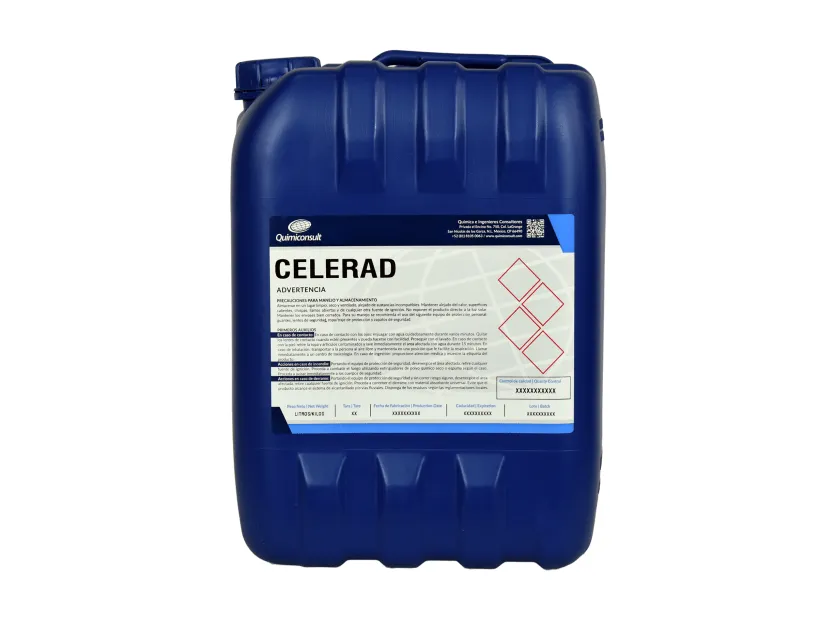
CELERAD TRISILOXANE-BASED SUPER SPREADER ADJUVANT 100%
View All Prices
| Quantity | Unit Price |
|---|---|
| kg | |
| 1 - 99 | USD 7.89 |
| 100 - 199 | USD 7.75 |
| 200 - 499 | USD 7.63 |
| 500 - 999 | USD 7.50 |
| 1000 - 4999 | USD 7.38 |
| 5000 - 9999 | USD 7.27 |
| 10000 - 17999 | USD 7.16 |
| 18000+ | USD 7.05 |
Need more? Message us and we'll help you source the volume you're after.
Message us on WhatsApp Message usCelerad Description — 100% Trisiloxane-Based Super-Wetting Adjuvant (Nonionic) for Maximum Agricultural Efficiency
At Quimiconsult we manufacture Celerad, a 100% concentrated, nonionic, trisiloxane-based super-wetting adjuvant designed to maximize the efficiency of agricultural applications and agrochemical formulation. Celerad is a very high-performance super spreader thanks to its trisiloxane technology: it drastically reduces the surface tension of aqueous and non-aqueous solutions, spreads and wets very effectively on hydrophobic surfaces — waxy or hairy — that would otherwise repel the spray solution, and promotes homogeneous dispersion of the actives in the tank, improving coverage, absorption and utilization of pesticides and foliar fertilizers. It comes as a clear, slightly yellow liquid, with no diluents or inert fillers that would reduce its active strength. As a direct manufacturer with our own R&D laboratory and more than 30 years of experience in specialty chemicals, we guarantee lot-to-lot consistency, with availability from our plant in Monterrey, Nuevo León, and shipping throughout Mexico. Unlike a distributor, we can adjust the formulation to your crop or your water quality, and our technical team validates dosage and performance for each application.
Celerad works both as a tank-mix adjuvant in crop protection and foliar nutrition programs — improving wetting, coverage and penetration of the active ingredient — and as a raw material for agrochemical formulators and toll manufacturers, who incorporate it into emulsifiable concentrate (EC), suspension concentrate (SC) or water-dispersible granule (WG) blends to give them a high-performance wetting and dispersing system.
For anyone looking for what an adjuvant is, types of agricultural adjuvants, a super-wetting adjuvant, a trisiloxane-based silicone surfactant, a super spreader for agrochemicals, a wetting, dispersing and penetrating agent for the spray tank, an alternative to BASF Break-Thru® or 100% trisiloxane for agricultural use, Celerad is the technical answer from the Quimiconsult catalog, backed by in-house manufacturing, complete technical documentation (CoA, TDS, SDS compliant with NOM-018-STPS-2015 / GHS) and advice on dosing and validating the product in each application.
What Is an Adjuvant? Meaning and Types of Agricultural Adjuvants
An adjuvant is any substance added to the spray tank — or to an agrochemical formulation — to improve the efficacy, coverage, penetration or stability of a crop protection product, without itself being a pesticidal active ingredient. Adjuvants make the pesticide or fertilizer "work better," getting the most out of the active ingredient applied.
Commercially, ten major types of agricultural adjuvants are recognized:
- Surfactants (wetting agents) — this is where Celerad belongs.
- Emulsifiers.
- Stickers.
- Penetrants.
- Anti-evaporants.
- Drift control agents.
- Antifoams.
- Sequestrants / water conditioners.
- Acidifiers / pH buffers.
- Descaling equipment cleaners.
Within surfactants, Celerad belongs to the highest-performing subgroup: trisiloxane-based organosilicones, also known as silicone surfactants, ethoxylated trisiloxane, polyether-polysiloxane copolymer or super spreaders, which far outperform conventional surfactants in their ability to reduce surface tension. It is the type of adjuvant mainly sought by agronomists, agrochemical formulators and farm input distributors when wetting and coverage are critical.
What Is a Trisiloxane Super-Wetter and Why Does It Outperform a Regular Wetting Agent?
Celerad's trisiloxane belongs to the family of organosilicone surfactants, capable of reducing the surface tension of water to around 20-22 dynes/cm, well below the 30-35 dynes/cm achieved by conventional surfactants (ethoxylated alcohols, ethoxylated nonylphenols) and far below the ~72 dynes/cm of plain water. That difference is precisely what sets a super-wetter apart from a regular wetting agent: the extreme reduction in surface tension makes it possible to wet waxy, hairy or hard-to-cover surfaces that would otherwise repel the spray droplet, and causes almost instantaneous spreading of the droplet over the foliage. That is why trisiloxanes are called "super spreaders."
Celerad, the Mexican-Made Alternative to BASF Break-Thru®
Celerad is a Mexican-made alternative to benchmark super-wetting adjuvants such as BASF Break-Thru®. Both belong to the same technology family — trisiloxane-based organosilicone surfactants / polyether-polysiloxane copolymers — and serve the same function: drastically reducing the surface tension of the spray water to achieve superior wetting and coverage on hard-to-wet crops, while also improving the dispersion and penetration of pesticides and foliar fertilizers. For formulators, distributors and growers who already know the performance of a trisiloxane super-wetter, Celerad offers that same technology with domestic manufacturing in Monterrey, timely delivery throughout Mexico, lot-by-lot documentation (CoA, TDS, SDS) and the option to adjust the formulation to your crop or water quality. As with any change of adjuvant, we recommend validating performance in the specific application with a preliminary trial.
Break-Thru® is a registered trademark of BASF, mentioned here solely for reference and technical comparison purposes. The comparison is expressed only as a functional similarity between products in the same category and does not imply equivalent performance; results may vary depending on the crop, mixing water and application conditions, and should therefore be verified in the field through your own trials before any substitution decision. Celerad LC is not affiliated with, sponsored by or endorsed by BASF.
Celerad Technical Specifications and Physicochemical Properties
The Celerad we manufacture meets a consistent lot-to-lot quality profile, verifiable through a Certificate of Analysis (CoA):
Nature:
Super-wetting adjuvant — trisiloxane-based (polyether-polysiloxane copolymer)
Active:
100% concentrated (no diluents or inert fillers)
Appearance:
Clear liquid
Color:
Slightly yellow
Ionic nature:
Nonionic
pH (1% solution) at 25 °C:
5.0 – 7.0
Density (g/cm³) at 25 °C:
0.90 – 1.10
Surface tension reduction:
Down to ~20-22 dynes/cm in dilute solution (characteristic of trisiloxane super-wetters)
Solubility:
Miscible in water and most organic solvents
Incorporation rate in formulation:
0.5 – 1.0% of the total formulation (optimal performance in formulations at pH 6.0 – 8.0)
Its key properties are its super-wetting capacity (wetting waxy or hairy surfaces), fast dispersion and spreading over foliage, promotion of rapid absorption and better coverage, and its nonionic character, which makes it broadly compatible with aqueous and non-aqueous formulations. It is stable at room temperature; like all trisiloxanes, it is incompatible with strong oxidizers and concentrated mineral acids, which can degrade its silicone structure, and it performs best when the mixing water is kept in a near-neutral pH range.
How Does Celerad Work? Trisiloxane Mechanism of Action
Stage 1 — Breaking surface tension. Trisiloxane molecules orient themselves at the water-air interface, reducing cohesion between water molecules and bringing surface tension down from ~72 to ~20-22 dynes/cm, a level conventional surfactants cannot reach.
Stage 2 — Flattening and spreading of the droplet on the foliage. A droplet treated with Celerad does not roll off or stay spherical on the waxy cuticle: it flattens and spreads (super spreading), multiplying the effective coverage area per unit volume applied and reducing untreated areas.
Stage 3 — Cuticular absorption and stomatal penetration. Under suitable humidity conditions, the extreme reduction in surface tension allows the solution to penetrate even through leaf stomata (stomatal infiltration, a mechanism characteristic of trisiloxanes), promoting faster absorption of the active ingredient and reducing the risk of wash-off loss after early rainfall.
Celerad Applications in Crop Protection Programs, Foliar Nutrition and Formulation
Celerad's versatility makes it a cross-cutting tool in agricultural management and agrochemical formulation. We always recommend following the label of the main agrochemical and validating the dose with a preliminary trial.
Systemic Herbicides
With systemic herbicides such as glyphosate or glufosinate, Celerad improves foliar absorption by promoting intimate contact between the herbicide and the weed's cuticle, especially on narrow-leaf grasses where conventional adjuvants fail to achieve uniform wetting.
Foliar Insecticides and Fungicides
Celerad improves distribution of the active ingredient over the entire leaf surface, including the underside of the leaf, reducing untreated areas that can become hotspots for reinfestation or reinfection and promoting homogeneous coverage of the sprayed pesticide.
Plant Nutrition and Foliar Fertilization
In foliar fertilization and biostimulant application, Celerad improves the distribution and utilization of nutrients, reducing runoff losses — something especially valuable in high-value horticultural crops — and promoting more efficient absorption.
Crops with Waxy or Hairy Cuticles and Row Crops
Crops such as onion, cabbage, citrus, sugarcane, potato, corn, soybean and various cereals have cuticles that are hard to wet. Celerad's super-wetting capacity breaks through this physical barrier more effectively than stickers or traditional wetting agents, achieving uniform coverage where other adjuvants fail.
Aerial and Post-Harvest Applications
Thanks to its spreading and coverage capacity, Celerad is useful in aerial applications, where uniform coverage with reduced water volumes is critical, and in post-harvest treatments, always following the directions of the main product and validating the dose.
Formulators and Toll Manufacturers
Crop protection formulators use Celerad as a raw material in emulsifiable concentrate (EC), suspension concentrate (SC) or water-dispersible granule (WG) blends to give the formulation a high-performance wetting and dispersing system. Our R&D laboratory can advise on the optimal dosage according to the type of formulation and target crop.
Celerad Dosage and Use Recommendations
Celerad has two use contexts with very different doses. It is important not to confuse them: an overdose of a trisiloxane super-wetter can increase the risk of phytotoxicity and drift.
1) Incorporation into agrochemical formulations (use as a raw material): approximately 0.5 – 1.0% of the total formulation, with optimal performance in formulations at pH 6.0 – 8.0. Celerad can be added at any stage of the process; preliminary trials are recommended to ensure optimal performance.
2) Use as a tank-mix adjuvant in the field: trisiloxane super-wetters are used at low doses, typically on the order of 0.025 to 0.1% v/v (approximately 25 to 100 mL per 100 L of water), depending on the crop, cuticle toughness and type of application. Always follow the dose indicated on the label of the main agrochemical and validate the dose with a preliminary trial; avoid overdosing, which can cause phytotoxicity. Add Celerad at the end of mix preparation, with the tank at 2/3 – 3/4 of its capacity and under gentle, continuous agitation.
Suggested tank-mix mixing instructions: fill the tank with water to 2/3 – 3/4 of its capacity; add the pesticide or fertilizer according to the product label and keep agitating; finally, add Celerad and continue filling the tank while maintaining gentle agitation. In hard water or water with a pH outside the recommended range, it is advisable to first condition the water with a pH buffer / sequestrant before adding Celerad, to preserve the stability of the main agrochemical.
Celerad Compared with Other Types of Adjuvants
Celerad vs. conventional surfactants: ethoxylated alcohol or nonylphenol surfactants reduce surface tension to 30-35 dynes/cm, enough for smooth foliage. Celerad reaches ~20-22 dynes/cm, the level needed on crops with waxy or hairy cuticles, or when the goal is to reduce spray volume without losing coverage.
Celerad vs. traditional stickers: stickers (resins, latex) fix the agrochemical to the leaf to resist rain wash-off, but do not improve initial wetting. Celerad acts at the earlier stage, improving dispersion and coverage; the two are complementary when both persistence and coverage are needed.
Celerad vs. agricultural oils: oils dissolve cuticular wax but usually require higher doses and carry a greater risk of phytotoxicity. Celerad achieves comparable coverage and penetration at lower doses and lower risk, always respecting the dose of the main product.
Celerad Compatibility with Other Agrochemicals
Because of its nonionic nature, Celerad is compatible with most commonly used agrochemicals: systemic herbicides, insecticides, fungicides, liquid foliar fertilizers and EC, SC and WP formulations. It is incompatible with strong oxidizers and concentrated mineral acids, which can degrade its silicone structure. Always perform a jar test before preparing a large-volume tank when combining it with a new agrochemical or when water quality is variable, to rule out precipitates or loss of efficacy.
Celerad Packaging, Storage and Shelf Life
Packaging: Celerad is available in 20 L pails, jugs or carboys (larger-scale growers), 200 L drums (distributors and formulators) and 1,000 L bulk / IBC (large consumers, quoted by agreement), as well as samples for technical evaluation.
Storage: keep in the original closed container, in a cool, dry, well-ventilated place, protected from direct sunlight, heat sources and extreme temperatures (ideally between 5 and 35 °C), and avoid freezing. Keep away from incompatible substances.
Shelf life: typically 24 months from the date of manufacture, in a sealed container and under the storage conditions indicated. The official expiration date is shown on the container and on the Certificate of Analysis (CoA) for the corresponding lot.
Celerad Safety, Handling and Regulation
Celerad should be handled following the recommendations in its current Safety Data Sheet (SDS). As general good handling practice, the use of personal protective equipment (PPE) is recommended: safety glasses, nitrile or neoprene gloves and long-sleeved clothing; respiratory protection is not required in normal outdoor use. Trisiloxane super-wetters can cause eye irritation, so eye protection is especially important.
First aid (general guidance): in case of eye contact, rinse with clean water for at least 15 minutes and seek ophthalmological care; in case of skin contact, wash with plenty of soap and water; in case of inhalation, move to a ventilated area; in case of ingestion, do not induce vomiting and seek medical attention.
Container handling: empty containers must be triple-rinsed before disposal, in accordance with local environmental regulations.
GHS classification, hazard statements (H phrases) and precautionary statements: this section is only a general handling guide. The full classification under the Globally Harmonized System (GHS), hazard statements, precautionary statements, first aid and labeling in accordance with NOM-018-STPS-2015 must be taken from the product's current Safety Data Sheet (SDS), which is provided with every shipment. Always consult the updated SDS before use.
Every Celerad delivery comes with its lot Certificate of Analysis (CoA), Technical Data Sheet (TDS) and Safety Data Sheet (SDS).
Frequently Asked Questions About Celerad
What is Celerad and what is it used for?
Celerad is a 100% concentrated, nonionic, trisiloxane-based super-wetting adjuvant manufactured by Quimiconsult. It is used to drastically reduce the surface tension of spray water, wet waxy or hairy surfaces, improve coverage, absorption and penetration of herbicides, insecticides, fungicides and foliar fertilizers, and facilitate dispersion of the actives in the tank. It is used as a tank-mix adjuvant in the field and as a raw material in agrochemical formulation.
What is a super-wetter and how does it differ from a regular wetting agent?
A super-wetter (super spreader) reduces surface tension to a much lower level (~20-22 dynes/cm) than a conventional wetting agent (30-35 dynes/cm), allowing it to wet and spread over waxy or hairy surfaces that a regular wetting agent cannot cover. Because of its trisiloxane base, Celerad belongs to this higher-performance category.
Is Celerad an alternative to BASF Break-Thru®?
Yes. Celerad is a super-wetting adjuvant from the same technology family as BASF Break-Thru® — trisiloxane-based organosilicones / polyether-polysiloxane copolymers — and performs the same super-wetting, dispersing and penetrating function in agricultural applications. It is offered with domestic manufacturing in Monterrey, lot-by-lot documentation and technical field and formulation support. Break-Thru® is a registered trademark of BASF, cited for reference purposes only; we recommend validating performance in your specific application with a preliminary trial.
Does Celerad replace the surfactant already included in my herbicide or fungicide?
Not necessarily. When the product label already includes its own surfactant, Celerad can be used as a complement to boost coverage under difficult conditions (waxy cuticle, high temperature, water-repellent foliage), always checking compatibility and following the directions on the main product's label.
Is Celerad compatible with all agrochemicals?
It is compatible with most of them thanks to its nonionic nature (systemic herbicides, insecticides, fungicides, foliar fertilizers, EC, SC and WP formulations). It is incompatible with strong oxidizers and concentrated mineral acids. A jar test is recommended before large-volume mixes with new products or water of variable quality.
At what dose is Celerad used?
It depends on the use. As a raw material incorporated into an agrochemical formulation, approximately 0.5 – 1.0% of the total formulation. As a tank-mix adjuvant in the field, at low doses on the order of 0.025 – 0.1% v/v (approx. 25 – 100 mL per 100 L of water), always following the label of the main agrochemical and validating with a preliminary trial. Avoid overdosing, which can cause phytotoxicity.
How is Celerad added to the spray tank?
Fill the tank with water to 2/3 – 3/4 of its capacity, add the pesticide or fertilizer according to its label while maintaining agitation, and add Celerad last, continuing to fill under gentle agitation. In hard water or water with extreme pH, first condition the water with a pH buffer / sequestrant.
Does it work on waxy-leaf crops such as onion, citrus or sugarcane?
Yes. It is precisely on crops with waxy or hairy cuticles — onion, cabbage, citrus, sugarcane, cereals, among others — that a trisiloxane super-wetter makes the biggest difference compared with conventional wetting agents and stickers.
Is it possible to develop a custom Celerad formulation?
Yes. Our R&D laboratory in Monterrey can adjust the formulation according to the crop, the agrochemical it will be combined with or the customer's water quality. Contact us to assess technical and commercial feasibility.
How much does Celerad cost and how do I get a quote?
The price varies by package size and order volume. Contact us at +52 (81) 8105 0063 or through our contact page for a quote tailored to your consumption.
Where can I buy Celerad in Mexico?
Celerad is available from stock at Quimiconsult in Monterrey, Nuevo León, with shipping throughout Mexico, in 20 L pails, 200 L drums and 1,000 L bulk/IBC, as well as samples for technical evaluation. We are the direct manufacturer, with complete technical documentation (CoA per lot, TDS, SDS) and technical support.
Other Names and Search Terms Related to Celerad
Celerad is a Quimiconsult brand. The product type and its function are known by various technical, commercial and search names:
adjuvant, adjuvants, what are adjuvants, adjuvant meaning, types of adjuvants, types of agricultural adjuvants, agricultural adjuvant, farm adjuvant, super-wetting adjuvant, super-wetter, 100% trisiloxane-based super-wetter, trisiloxane, 100% trisiloxane, ethoxylated trisiloxane, silicone surfactant, organosilicone, polyether-polysiloxane copolymer, super spreader, spreader, agricultural wetting agent, silicone wetting agent, agricultural dispersant, agricultural penetrant, nonionic adjuvant, surface tension reducer, herbicide adjuvant, glyphosate adjuvant, fungicide adjuvant, insecticide adjuvant, foliar fertilizer adjuvant, adjuvant for aerial applications, adjuvant for waxy-leaf crops, adjuvant for onion, adjuvant for citrus, adjuvant for sugarcane, adjuvant for potato, corn and soybean, Celerad, Celerad adjuvant, Celerad super-wetter, Celerad 100% trisiloxane, Celerad price, buy Celerad, Break-Thru alternative, alternative to Break-Thru, Break-Thru equivalent adjuvant, Break-Thru substitute, Break-Thru type adjuvant, super-wetting adjuvant Mexico, adjuvant manufacturer Mexico, adjuvant supplier Monterrey (coadyuvante, coadyuvante superhumectante, coadyuvante agrícola).
These variations help agronomists, agrochemical formulators, farm input distributors, field technicians and growers find Celerad within Quimiconsult's line of adjuvants and formulation aids.
Why Buy Celerad from Quimiconsult?
Quimiconsult is a Mexican company with more than 30 years of experience in specialty chemicals and inputs for the agrochemical industry in Mexico. When you buy Celerad from Quimiconsult you get:
- An in-house manufactured product, with an R&D laboratory, internal quality control and lot-to-lot consistency.
- A 100% concentrated trisiloxane-based super-wetting adjuvant, with no diluents or fillers: more active per liter and lower cost per hectare.
- Extreme surface tension reduction (~20-22 dynes/cm) for superior coverage on difficult crops and lower spray volumes.
- Nonionic nature, broadly compatible with anionic, cationic and nonionic formulations.
- A Mexican manufacturer in Monterrey: timely delivery throughout the country, with no exchange-rate risk.
- Our own R&D laboratory to adjust the formulation to your crop or water quality, and a technical team that validates dosage and performance.
- Complete technical documentation (CoA per lot, TDS, SDS compliant with NOM-018-STPS-2015 / GHS).
Request Your Celerad Quote or Sample
Does your farming business, crop protection application operation, foliar nutrition program, farm input distributorship or agrochemical formulation plant need a maximum-performance trisiloxane-based super-wetting adjuvant? Contact us and we will gladly recommend the right dose for your crop, your type of application (tank-mix or incorporation into a formulation) and your water quality, provide complete technical documentation and a CoA per lot, and coordinate delivery throughout Mexico. Our R&D laboratory can develop a variant tailored to your crop, the agrochemical it will be combined with or your application system. We manufacture in Mexico with domestic production, our own inventory and short lead times, and we serve the entire country — including Monterrey, Mexico City, Guadalajara, the Bajío, the agricultural northwest and the southeast. Call us at +52 (81) 8105 0063 or visit us at Privada El Encino No. 750, Col. LaGrange, San Nicolás de los Garza, N.L., CP 66490.
Related Products
- pH buffers / water conditioners for agrochemicals — to correct the pH and hardness of the mixing water before adding Celerad.
- Dispersants for agrochemical formulation — to keep active particles in suspension in SC and WG.
- Thickeners / rheology modifiers for agrochemicals — for viscosity adjustment in liquid formulations.
- Emulsifiers for agrochemical formulation — for developing emulsifiable concentrates (EC).
- Silad® Aqua Max and the antifoam line — for foam control in the manufacture of agrochemical dispersions.
Related categories: Formulation aids for agrochemicals · pH buffers and water conditioners · Dispersants and emulsifiers for agrochemicals.
Not sure which adjuvant is right for your application or formulation? Contact us and we will help you select the right product, dose and point of incorporation according to your crop, your agrochemical and your water quality.