Spanish
 English


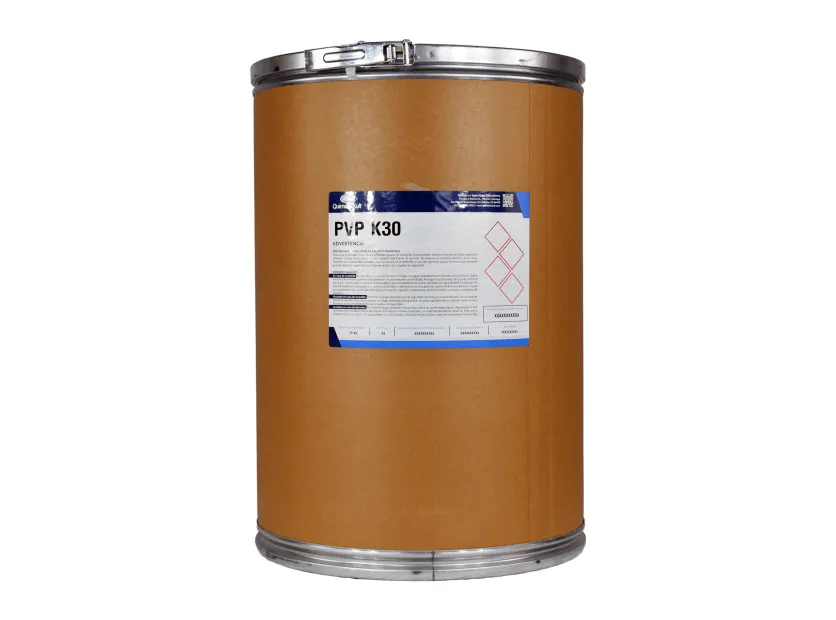
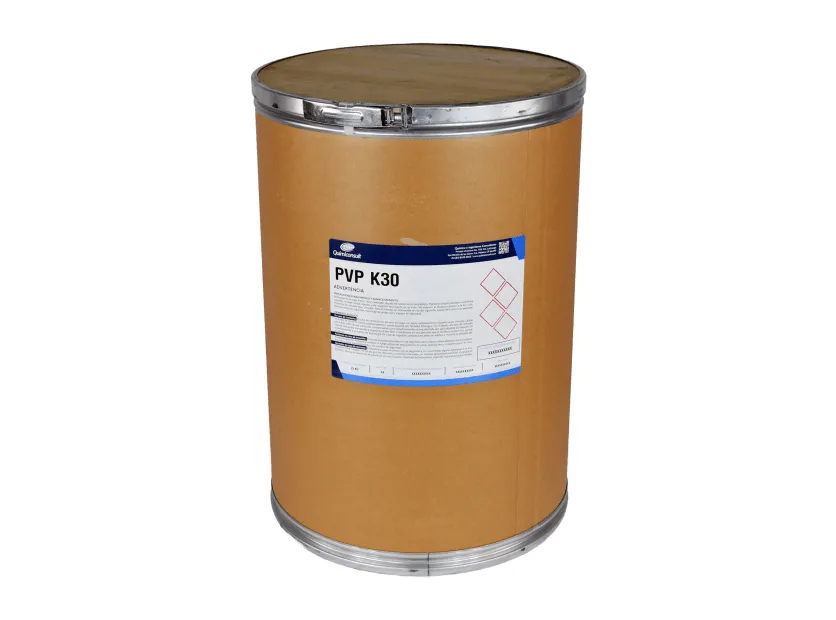
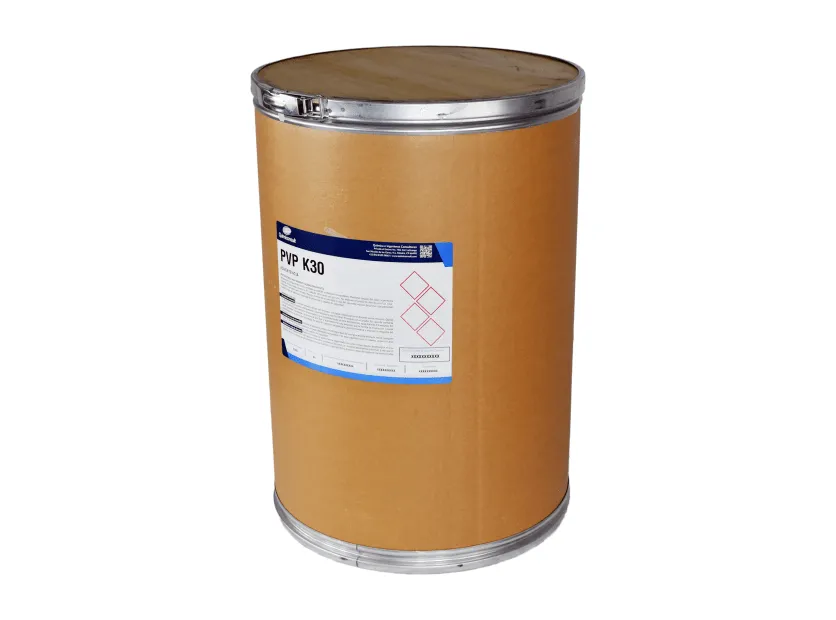
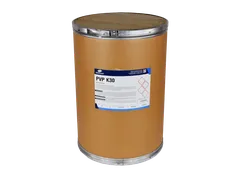
PVP K30 USP/NF 26 GRADE FILM-FORMING POLYMER
View All Prices
| Quantity | Unit Price |
|---|---|
| kg | |
| 1 - 99 | USD 5.03 |
| 100 - 199 | USD 4.95 |
| 200 - 499 | USD 4.86 |
| 500 - 999 | USD 4.78 |
| 1000 - 4999 | USD 4.71 |
| 5000 - 9999 | USD 4.63 |
| 10000 - 17999 | USD 4.56 |
| 18000+ | USD 4.49 |
Description of PVP K30, a film former
At Quimiconsult we offer USP/NF 26 grade PVP K30, also known as polyvinylpyrrolidone K30 or povidone K30. It is an amorphous, hygroscopic, linear, nonionic synthetic polymer, supplied as a white granular powder with a K value between 27.0 and 32.4. Its CAS number is 9003-39-8 and its systematic chemical name is 2-pyrrolidinone, 1-ethenyl-, homopolymer.
PVP K30 is highly soluble in water and in a wide variety of organic solvents, including alcohols, glycols, organic acids and chlorinated compounds, making it one of the most versatile polymers available for industrial formulation. This exceptional solubility, combined with its nonionic nature, makes PVP K30 compatible with virtually any formulation system without altering the pH, reacting with other active ingredients or creating incompatibilities that limit its use.
The most distinctive property of PVP K30 is its ability to form clear, glossy, flexible and tough films with adhesive, cohesive and dispersing properties. These films form when the polymer is dissolved in water or organic solvents and the medium then evaporates, leaving a continuous, uniform layer on the surface where it was applied. This film-forming ability is why PVP K30 is an essential ingredient in industries as diverse as pharmaceuticals, cosmetics, adhesives, coatings, ceramics, textiles and water treatment.
In addition to its role as a film former, PVP K30 is physiologically inert, meaning it does not cause adverse reactions when it comes into contact with biological tissue. This physiological inertness, backed by its USP/NF grade, is what allows its safe use in oral, topical and even parenteral pharmaceutical formulations, as well as in cosmetic products applied directly to the skin and hair.
For those wondering what PVP K30 is used for, it is a multifunctional polymer that acts as a binder, film former, dispersing agent, emulsion stabilizer, suspending agent and rheology modifier, adapting to the specific needs of each formulation and industry sector.
USP/NF 26 grade PVP K30 is available in Monterrey, Nuevo León, with shipping throughout Mexico.
PVP K30 details and properties
Quimiconsult's PVP K30 meets the specifications set by the United States Pharmacopeia (USP) and the National Formulary (NF), 26th edition, ensuring a level of purity and quality control suitable for the most demanding applications in the pharmaceutical, cosmetic and industrial sectors. Our product's technical specifications include a K value of 27.0 to 32.4, pH in 5% solution of 3.0 to 7.0, maximum moisture of 5.0%, maximum residue on ignition of 0.10%, nitrogen content of 11.50 to 12.80%, maximum free vinylpyrrolidone of 0.20% and a maximum aldehyde limit of 0.05%.
The K value is the most important parameter for classifying the different PVP grades, since it is directly related to the polymer's molecular weight. PVP K30 has an approximate average molecular weight of 40,000 to 60,000 daltons, placing it in the middle range of the polyvinylpyrrolidone family. This molecular weight gives it an optimal balance between film-forming ability, solution viscosity, binding power and ease of dissolution, which is why PVP K30 is the most widely used grade in the pharmaceutical and cosmetics industries worldwide.
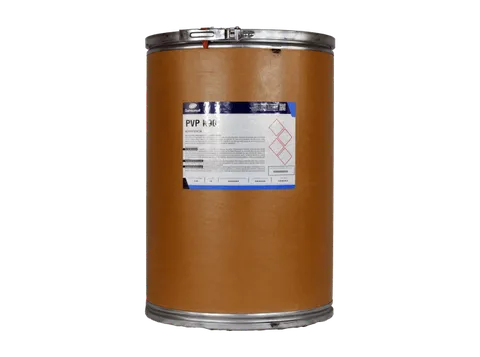
Our packaging includes 25 kg pails, ideal for industrial manufacturing operations that require consistent volumes and traceable lots.
Physicochemical and functional properties of PVP K30
The hygroscopic nature of PVP K30 matters in two ways. On the one hand, it helps it dissolve quickly in water and aqueous systems, since the polymer attracts water molecules and hydrates easily. On the other hand, it calls for precautions during storage to prevent the product from absorbing ambient moisture and caking, which could make dosing and weighing difficult in formulation processes.
As a linear, nonionic polymer, PVP K30 is compatible with an exceptionally wide range of ingredients, including salts, acids, bases, surfactants, natural and synthetic polymers, active pharmaceutical ingredients and pigments. This universal compatibility is a significant competitive advantage over other polymers that have compatibility limitations due to their ionic charge or chemical reactivity.
The films PVP K30 forms are clear, glossy, flexible and abrasion resistant. These films can be formed both with water as the solvent and with the most common organic plasticizers, allowing the mechanical properties of the film to be adjusted to the requirements of each application. In formulations that require more flexibility, plasticizers such as glycerin or propylene glycol can be added to modify the characteristics of the film.
PVP K30 also exhibits complexing properties, that is, the ability to form molecular complexes with a variety of compounds, including iodine (to form povidone-iodine, a widely used antiseptic), dyes, polyphenols and certain active pharmaceutical ingredients. This complexing property is put to use in applications ranging from disinfectant formulation to beverage clarification and the stabilization of pharmaceutical formulations.
From a safety standpoint, PVP K30 has a very favorable toxicological profile. Its oral LD50 in rats is greater than 10,000 mg/kg, which classifies it as a substance of very low toxicity. It does not meet the criteria for classification in any hazard class under the Globally Harmonized System (GHS) and requires no hazard pictogram or signal word. It is not flammable under normal conditions, although, as with any organic powder, accumulation in enclosed spaces should be avoided because of the risk of dust explosion. It has no known mutagenic, carcinogenic or reproductive toxicity risks.
Applications of PVP K30 polyvinylpyrrolidone: what it is used for
PVP K30 is one of the most versatile functional polymers on the market, with applications ranging from the pharmaceutical and cosmetics industries to adhesives, ceramics, textiles, water treatment and polymerization processes. Its multifunctionality comes from the unique combination of properties it offers: film formation, binding power, dispersing capacity, molecular complexation and physiological inertness.
In the pharmaceutical industry, PVP K30 is one of the most widely used excipients in the world. Its main application is as a binder in the wet granulation of tablets, where it is dissolved in water or a hydroalcoholic mixture and sprayed onto the blend of active powders and excipients to form granules with the cohesion needed for subsequent compression. The quality of the binder directly affects the hardness, friability, disintegration and dissolution of the final tablet, so choosing the PVP grade is a critical decision in pharmaceutical development. PVP K30 is also used as a film former in tablet coating, where it provides a protective layer that improves appearance, makes swallowing easier, masks unpleasant tastes and can control the release of the active ingredient. In addition, PVP K30 works as a suspending agent in syrups and oral suspensions, as a solubilizer for poorly water-soluble active ingredients through the formation of solid dispersions, and as a stabilizer in injectable solutions.
In the cosmetics and personal care industry, PVP K30 has an established role as a film former and fixative in hair products. In hairsprays, setting sprays, gels and mousses, PVP K30 forms a film on the hair that provides hold, shine, humidity resistance and easy combing. In skin care products such as creams, lotions and sunscreens, it acts as a film former that improves the feel on application, helps distribute UV filters evenly over the skin and prolongs the time active ingredients stay on the skin's surface. It is also used in nail polishes as a secondary film former, in makeup products as a pigment suspending agent and in toothpastes as a binder.
In the adhesives industry, PVP K30 is used as a component in pressure-sensitive adhesive formulations, label adhesives, school and office glues, and specialty adhesives for medical applications such as adhesive bandages and surgical tapes. Its ability to form adhesive, clear and physiologically inert films makes it especially suitable for adhesives that come into contact with the skin.
In the ceramics and glass industry, PVP K30 works as a temporary binder that holds ceramic pieces together during forming and drying, burning off cleanly during sintering without leaving significant carbon residue. In fiberglass manufacturing, it acts as a sizing agent that protects the fibers during processing and improves their compatibility with polymer matrices in composite materials.
In coatings and paints, PVP K30 is used as a pigment dispersant, emulsion stabilizer, rheology modifier and auxiliary film former. Its ability to keep pigments evenly distributed in the formulation prevents settling and flocculation, improving color consistency and the quality of the final finish.
In the textile industry, PVP K30 is used as a dyeing agent that improves the affinity of dyes for fibers, as an antistatic agent and as a component in textile finishes that require film formation.
In the pulp and paper industry, PVP K30 improves the retention of fines and pigments during sheet formation, acts as a wet-strength agent and helps improve paper printability by providing a more uniform surface for ink absorption.
In polymerization processes, PVP K30 works as a steric stabilizer in the suspension polymerization of vinyl monomers such as vinyl chloride (PVC) and styrene. Its presence in the reaction medium prevents the coalescence of monomer droplets, controlling the particle size and size distribution of the resulting polymer, which directly affects the processing properties of the final product.
In water treatment, PVP K30 is used as a flocculant and dispersing agent that helps suspended particles agglomerate and settle, improving the clarity of the treated water.
In the beverage industry, particularly in the production of beer, wine and fruit juices, PVP (in its insoluble form as PVPP, polyvinylpolypyrrolidone) is used as a clarifying agent that selectively adsorbs the polyphenols and tannins responsible for haze, improving the colloidal stability and appearance of the final product. Although PVPP is technically a cross-linked derivative of PVP, it is worth mentioning because many formulators look for information on PVP in the context of beverage clarification.
To explore more related solutions, visit our Stabilizers, Dispersants, Construction, Personal Care & Cosmetics and Pharmaceutical & Wellness categories.
The K value in polyvinylpyrrolidone: what it means and how to choose the right grade
One of the most frequent questions among formulators working with polyvinylpyrrolidone is what the K value means and how to determine which grade best suits their application. The K value is an indicator of the polymer's molecular weight, calculated from the intrinsic viscosity of a PVP solution using the Fikentscher equation. The higher the K value, the higher the molecular weight, the higher the solution viscosity and the greater the binding and film-forming power.
The most common PVP grades on the market are PVP K12 (approximate molecular weight of 2,000 to 3,000), PVP K17 (approximately 7,000 to 11,000), PVP K25 (approximately 24,000 to 45,000), PVP K30 (approximately 40,000 to 60,000), PVP K60 (approximately 300,000 to 400,000) and PVP K90 (approximately 1,000,000 to 1,500,000).
Low molecular weight grades (K12, K17) form thinner, more brittle films but give low-viscosity solutions and dissolve more quickly. They are preferred in applications that require a solubilizing effect without significantly increasing viscosity, such as forming solid dispersions to improve the bioavailability of poorly soluble drugs.
Medium molecular weight grades (K25, K30) offer the best balance between binding power, manageable viscosity, good-quality film formation and ease of processing. PVP K30 is the grade most widely used as a binder in pharmaceutical wet granulation precisely because of this balance: it provides enough cohesion to form strong granules without creating excessive viscosity that would make the binder solution hard to spray or delay tablet dissolution.
High molecular weight grades (K60, K90) form thicker, tougher films with greater adhesive power, but produce high-viscosity solutions that can be difficult to handle. They are preferred in applications that require maximum holding power (hair products) or maximum binding power (tablets with a high active load).
At Quimiconsult we offer USP/NF grade PVP K30, the most requested grade for pharmaceutical, cosmetic and industrial applications. If your formulation requires a technical evaluation to determine the most suitable grade, our team can advise you.
Storage and handling of PVP K30
To preserve the quality and specifications of PVP K30, it is essential to store it in its original, tightly closed container in a cool, dry, well-ventilated place, protected from direct sunlight and away from heat sources. PVP K30 is a hygroscopic polymer that absorbs ambient moisture if the container is not kept sealed, which can cause the powder to cake, make dosing difficult and push the moisture content out of specification. Keeping containers closed when not in use is the most important measure for preserving the product's properties.
PVP K30 should be kept away from strong oxidizing agents and strong reducing agents, which are the incompatible materials identified in its safety data sheet. Although PVP K30 is not classified as a hazardous substance under the GHS and requires no pictogram or signal word, basic personal protective equipment is recommended during handling: splash-proof safety goggles, protective gloves and work clothing. In operations that generate dust during weighing, transfer or equipment loading, approved respiratory protection and adequate ventilation are recommended to avoid inhaling particles, which can cause the typical discomfort of dust in the eyes and respiratory tract.
Like any fine organic powder, PVP K30 can form explosive mixtures with air when it accumulates in sufficient concentrations in enclosed spaces. For this reason, dust buildup should be avoided, work areas kept clean and local exhaust systems installed at the points where the product is handled.
PVP K30 is not classified as dangerous goods for transport under United Nations regulations, which simplifies its logistics and distribution. Proper inventory rotation is recommended so the product is used while in optimal quality condition.
Frequently asked questions about PVP K30
What is PVP K30 and what is it used for?
PVP K30 is polyvinylpyrrolidone with a K value of 30 (approximate molecular weight of 40,000 to 60,000 daltons), a water-soluble synthetic polymer that works as a film former, binder, dispersant and stabilizer. Its main applications include wet granulation and coating of pharmaceutical tablets, hair fixation in cosmetic products, adhesive formulation, pigment dispersion in paints and coatings, binding of ceramic pieces, stabilization of polymerization emulsions and water treatment. Its USP/NF grade ensures it is suitable for pharmaceutical and cosmetic use.
What is the difference between PVP K30 and povidone-iodine?
PVP K30 is the base polymer with no active ingredient incorporated. Povidone-iodine (PVP-I) is a complex of PVP with molecular iodine, in which the polymer acts as a carrier and controlled-release vehicle for the iodine, which is the active antiseptic agent. Povidone-iodine is widely used in antiseptic solutions for skin and wound disinfection, in surgical preparations and in oral hygiene products. Manufacturing povidone-iodine requires PVP as a raw material, but the two products have completely different functions.
Is PVP K30 safe for food and pharmaceutical use?
USP/NF grade PVP K30 is physiologically inert and has an oral LD50 in rats greater than 10,000 mg/kg, indicating extremely low toxicity. It is accepted as a pharmaceutical excipient by the United States Pharmacopeia and the European Pharmacopoeia, and is listed in the FDA Inactive Ingredient Database. It has no known mutagenic, carcinogenic or reproductive toxicity risks. Its use in food as a clarifying and stabilizing additive is regulated in various countries.
How do you dissolve PVP K30 in water?
PVP K30 dissolves easily in water at room temperature. To prepare solutions, add the powder slowly to the water under constant stirring to avoid lumps. If a large amount of powder is added all at once, the outer particles hydrate and form a viscous layer that prevents water from penetrating the inside of the lump. Stirring with a high-speed disperser or using a high-shear mixer helps obtain homogeneous solutions in less time. Typical working concentrations range from 2 to 20% depending on the application.
Where to buy PVP K30 in Mexico?
At Quimiconsult we offer USP/NF 26 grade PVP K30 with certificates of analysis for every lot and technical support. We are located in Monterrey, Nuevo León, and ship throughout Mexico. Our packaging includes 25 kg pails, meeting the needs of development laboratories and pharmaceutical, cosmetic and industrial plants.
Other names and synonyms for PVP K30
PVP K30 goes by various names depending on the industry, the country and the context of use, which can cause confusion if the variants are not correctly identified. All of the following names refer to the same polymer with a K value of 30.
Povidone K30 (povidona K30) is the International Nonproprietary Name (INN/DCI) used in the United States Pharmacopeia, the European Pharmacopoeia and global pharmaceutical regulatory documentation. It is the name that appears in the qualitative formulas of medicines, in FDA excipient listings and in pharmaceutical certificates of analysis.
Polyvinylpyrrolidone K30 is the descriptive name of the polymer, referring to its chemical composition: a homopolymer of N-vinylpyrrolidone (also written as vinylpyrrolidone). This name appears frequently in academic publications, research articles and detailed technical data sheets.
PVP K-30, PVP-K30 or Pvp K30 are spelling variants that appear in raw material catalogs, purchase orders, technical documentation and online searches. All refer to the same product.
Povidone K 30 is a variant with a space that appears in some ingredient lists and formulations.
Likewise, in purchasing and sourcing it is common to find searches such as PVP K30 price, buy povidone K30, polyvinylpyrrolidone K30 Mexico, pharmaceutical grade PVP K30, PVP K30 for tablets or what is polyvinylpyrrolidone K30 used for, where variations in the product description or its application are used to find options available on the market. These variations help you, as purchasing, formulation and product development managers, identify PVP K30 within the market for pharmaceutical excipients and functional polymers