Spanish
 English


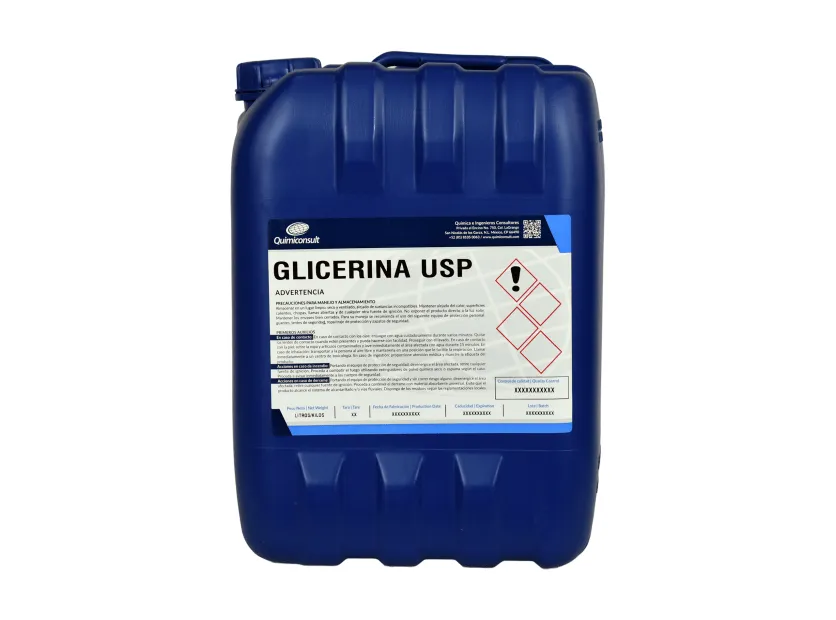
GLYCERIN USP PHARMACEUTICAL GRADE
View All Prices
| Quantity | Unit Price |
|---|---|
| kg | |
| 1 - 99 | USD 2.76 |
| 100 - 199 | USD 2.72 |
| 200 - 499 | USD 2.68 |
| 500 - 999 | USD 2.65 |
| 1000 - 4999 | USD 2.61 |
| 5000 - 9999 | USD 2.58 |
| 10000 - 17999 | USD 2.55 |
| 18000+ | USD 2.51 |
USP Glycerin Description
At Quimiconsult we offer USP Glycerin, a pharmaceutical-grade polyol with the chemical formula C₃H₈O₃, also known as glycerol, 1,2,3-propanetriol or by its food additive code E-422. It is a clear, colorless, odorless, highly viscous liquid with a characteristic sweet taste, with a minimum purity of 99.7% anhydrous glycerin and complete miscibility in water and alcohol. Its CAS number is 56-81-5, its EINECS number is 200-289-5 and its molecular weight is 92.10 g/mol.
USP Glycerin stands out as one of the most versatile and valuable ingredients in industry, functioning simultaneously as a humectant, emollient, solvent, preservative, sweetener, plasticizer and carrier for active ingredients. Its molecular structure, made up of three hydroxyl groups (-OH) attached to a three-carbon chain, is responsible for its extraordinary hygroscopic capacity: it attracts and retains up to the equivalent of 20% of its own weight in ambient moisture, a property that makes it the benchmark humectant in cosmetic, pharmaceutical and food formulations where the hydration, texture and shelf life of the final product must be maintained.
Unlike other synthetic polyols, glycerin is a natural, non-toxic product, classified as GRAS (Generally Recognized as Safe) by the US FDA and approved as a food additive in the European Union under the designation E-422. It is readily biodegradable, with an oral LD50 in rats of 12,600 mg/kg, which makes it one of the safest excipients on the pharmaceutical and food market. USP grade guarantees compliance with the United States Pharmacopeia (USP 41), with strict specifications for purity, water content below 0.3%, chlorides of 10 ppm maximum, sulfates of 20 ppm maximum, heavy metals of 5 ppm maximum and a maximum color of 10 on the APHA (Pt-Co) scale.
USP glycerin is used across a wide range of industries, including pharmaceutical, cosmetics and personal care, food and beverage, animal nutrition and veterinary, tobacco and vaping, industrial chemicals, textiles, explosives, eco-friendly antifreeze, biodiesel and tobacco treatment. Its combination of properties as a humectant, emollient, solvent, non-cariogenic sweetener, plasticizer, viscosity agent and stabilizer makes it one of the most sought-after raw materials in food-grade, pharmaceutical-grade and cosmetic-grade formulations worldwide.
For anyone searching what is glycerin used for, USP glycerin price or where to buy USP glycerin, Quimiconsult offers a certified product with technical support, certificates of analysis for every batch and an efficient supply chain. USP grade glycerin is available in Monterrey, Nuevo León, with shipping throughout Mexico.
USP grade glycerin details and properties
The USP glycerin we distribute meets the parameters established by the United States Pharmacopeia (USP 41), ensuring a level of purity and impurity control suitable for the most demanding applications in the food, pharmaceutical and cosmetic industries. Our product's technical specifications include a minimum purity of 99.7% anhydrous glycerin, a minimum specific gravity of 1.249 at 25°C, a maximum water content of 0.3% w/w, a maximum color of 10 APHA (Pt-Co) per ASTM D 1209, maximum individual impurities of 0.1% w/w, chlorides of 10 ppm maximum, sulfates of 20 ppm maximum and heavy metals of 5 ppm maximum, all determined using USP 41 methods.
Our package sizes are designed to suit different consumption volumes: 20 and 25 liter jerrycans, 200 liter drums and 1000 liter totes (IBC), as well as bulk deliveries for high-volume customers. Every batch comes with a certificate of analysis and, depending on origin, the product may carry Kosher, Halal, organic and non-GMO certifications, broadening its use in production lines that must comply with these standards.
Physicochemical properties of USP glycerin
USP glycerin has physicochemical properties that explain its broad industrial applicability. It is a clear, viscous liquid, colorless and odorless, with a pH between 5.5 and 8.0 in a 100 g/l aqueous solution at 20°C, making it compatible with most pharmaceutical, cosmetic and food formulation systems without the need for acidity adjustments. Its dynamic viscosity of 1,400 mPa·s at 20°C is the highest among commonly used polyols, a property formulators take advantage of to modify the rheology of creams, gels, syrups, personal lubricants and personal care products.
Its melting point is 20°C, its boiling point is 290°C and its flash point is 177°C, while its autoignition temperature is approximately 429°C, which means it has very low flammability and is safe to handle at room temperature. It has a density of 1.249 g/cm³ at 20°C, higher than that of water, and a vapor pressure of 0.01 mbar at 20°C, which ensures minimal evaporation during storage and processing. Glycerin is completely soluble in water and alcohol, partially soluble in ethyl ether and practically insoluble in benzene, chloroform, carbon tetrachloride and oils, characteristics that determine its compatibility with different formulation vehicles.
From a toxicological standpoint, glycerin is classified as a non-hazardous substance under GHS, with a single classification of Eye Irritation Category 2 (H319). It has an oral LD50 in rats of 12,600 mg/kg and an inhalation LC50 in rats greater than 570 mg/m³/1h, confirming its excellent safety profile. It is readily biodegradable (DOC >70%, BOD5/COD >50%) and has low toxicity to aquatic organisms (LC50 in fish greater than 10,000 mg/l), making it environmentally friendly. It does not undergo hazardous polymerization and is stable under normal storage conditions; the only things to avoid are contact with strong bases, extreme oxidizing agents and excessively humid environments, given its hygroscopic nature.
USP glycerin benefits and features
The benchmark humectant in cosmetics and personal care
USP glycerin is considered the benchmark humectant in the cosmetics and personal care industry because of its unique ability to attract moisture from the environment and retain it in the skin, creating a non-occlusive film that improves skin hydration without feeling greasy or clogging pores. Its humectant action comes from hydrogen bonds forming between glycerin's hydroxyl groups and water molecules, which allows it to draw moisture both from the environment and from the deeper layers of the skin toward the surface, improving the elasticity, softness and overall appearance of the skin.
This property makes it an essential ingredient in face and body creams, moisturizing lotions, serums, masks, toners, liquid and bar soaps, body washes, shampoos, conditioners, toothpastes, mouthwashes, deodorants, lipsticks, personal lubricants and shaving products. In cosmetic formulations, glycerin is typically incorporated at concentrations of 3% to 20%, acting simultaneously as a humectant, emollient, solvent for water-soluble actives, emulsion stabilizer and viscosity modifier.
A versatile excipient in the pharmaceutical industry
In the pharmaceutical industry, USP glycerin is one of the most widely used and valuable excipients thanks to its combination of solvent, preservative, humectant, sweetening and emollient properties. It serves as a carrier for active ingredients in syrups, elixirs, ear drops, eye drops, suppositories, soft gelatin capsules, salves, ointments, dermatological creams and topical gels. Its ability to form soft films on skin and mucous membranes gives it emollient and protective properties that are used in treating skin conditions such as xerosis, dermatitis, psoriasis, eczema and minor burns.
A particularly relevant application is its use as an osmotic laxative in the form of suppositories and micro-enemas, where its hygroscopic action draws water into the intestinal lumen to ease evacuation. It is also used as a plasticizer in gelatin shells for soft capsules, ensuring the flexibility and stability of the dosage form, and as a cryoprotectant in the preservation of red blood cells, semen for artificial insemination and other freeze-sensitive biological materials. In oral formulations, glycerin provides sweetness (approximately 60% of the sweetness of sucrose) without causing tooth decay, making it suitable for diabetic products and pediatric preparations.
A multifunctional agent in food and beverages
In the food industry, USP glycerin has GRAS status and is used under the code E-422 as a humectant, sweetener, solvent for colors and flavors, plasticizer in edible films and moisture-retention agent. It is used in baked goods to keep them fresh and extend shelf life, in confectionery and gummies to control texture and prevent sugar crystallization, in chocolate coatings to improve gloss, in cereal bars and energy products to maintain softness, in sausages and meat products as a moisture-retention agent, and in ice cream and frozen products to modify the freezing point and improve creaminess.
In the beverage industry, it acts as a carrier for flavor extracts and colors, as a humectant in cream liqueurs and as a sweetener in low-calorie drinks. In dairy products it works as an emulsion stabilizer and protects against crystallization during prolonged storage. Its use in food is especially valued because, unlike other synthetic humectants, glycerin is naturally metabolized by the human body as an energy source, without generating toxic residues or adverse effects in consumers on special diets.
Veterinary and animal nutrition applications
In the veterinary and animal nutrition industry, USP glycerin serves multiple functions, ranging from the formulation of veterinary drugs (oral syrups, suspensions, injectable solutions, carriers for vaccines and antibiotics) to direct use as an energy ingredient in balanced feeds for cattle, swine, poultry and aquaculture. In dairy cattle, it is used as a glucogenic energy source to prevent and treat ketosis in high-producing cows during the transition period around calving, administered as an oral drench at doses of 200 to 500 ml depending on the animal's weight and the severity of the energy imbalance.
In aquaculture, glycerin is used as a humectant and binder in feed pellets for fish and shrimp, improving the water stability of the feed and reducing losses from disintegration. In veterinary pharmaceutical formulations, it serves as a carrier for active ingredients in dermal preparations for treating dermatitis, wounds and burns in pets and production animals. It is also used as a calving lubricant in cattle and as an udder protectant in post-milking dip formulations in combination with iodine or chlorhexidine.
Solvent and plasticizer in the tobacco and vaping industry
USP vegetable glycerin (known in this context as VG - Vegetable Glycerin) is one of the two base components, together with propylene glycol, of e-cigarette and vaping device liquids. Its main function is to generate dense, visible vapor when heated in the atomizer, since it has higher viscosity and lower volatility than propylene glycol, producing the larger vapor clouds that vapers appreciate. It also adds a slight natural sweetness and smooths the inhalation experience, reducing throat irritation.
In the traditional tobacco industry, glycerin is used as a tobacco humectant during the curing process and in the manufacture of cigarettes, cigars and pipe tobacco, maintaining the leaf's optimal moisture so it does not dry out, crumble or lose its organoleptic properties. Typical concentrations of 2% to 5% of the tobacco's dry weight are enough to achieve the right moisture balance without affecting flavor or combustibility.
Industrial and chemical applications
In addition to its uses in consumer products, USP glycerin plays a fundamental role in numerous industrial and chemical applications. It is used as a raw material in the production of nitroglycerin (industrial explosives and dynamite), alkyd resins (paints and varnishes), polyurethanes, epichlorohydrin, acrylic acid, 1,3-propanediol and many high-value chemical derivatives. In the textile industry, it acts as a softening agent, fiber humectant and lubricant in spinning and weaving processes, particularly for synthetic fibers and cotton blends.
In eco-friendly antifreeze, glycerin is positioned as a non-toxic, biodegradable alternative to ethylene glycol and propylene glycol, especially valued in applications where contact with food, drinking water, agricultural soil or wildlife is possible. In the leather industry, it is used as a humectant and plasticizer during tanning, improving the flexibility of the final product. In cleaning products and the soap industry, it acts as a humectant, emollient and glycerinating agent for soap bars, giving glycerin soaps their characteristic transparency and softness. In biodiesel production, glycerin is the main by-product of transesterification, and refining it to USP grade is one of the most important ways to add value to this renewable biomolecule.
Industries that use USP glycerin
Pharmaceutical industry and manufacturing laboratories
In the pharmaceutical industry, USP glycerin is considered one of the most important monograph excipients, with official monographs in the USP, BP, EP, JP and FCC. It is used in the formulation of pediatric and adult syrups, oral solutions, suspensions, elixirs, nasal drops, ear drops, eye drops, rectal and vaginal suppositories, dermatological creams, ophthalmic ointments, topical gels, soft gelatin capsules, chewable tablets, throat lozenges and laxative products. Pharmaceutical laboratories value batch-to-batch purity consistency, the availability of detailed certificates of analysis and compliance with pharmacopeial specifications—all of which Quimiconsult guarantees with every delivery.
Cosmetics and personal care industry
Cosmetics manufacturers are among the main consumers of USP glycerin worldwide. It is incorporated into virtually every product category: skincare (creams, serums, toners, masks), haircare (shampoos, conditioners, hair treatments), oral care (toothpastes, mouthwashes), body care (soaps, body washes, deodorants), makeup (foundations, lipsticks, eyeliners), shaving and hair removal products, baby products and anti-aging products. The natural cosmetics and clean beauty trend has significantly increased demand for certified plant-based glycerin, one of the most sought-after ingredients in formulations free of parabens, silicones and petroleum derivatives.
Food and beverage industry
In the food industry, USP/FCC glycerin is used as a humectant (E-422) in bakery products, confectionery, chocolates, cereal bars, functional foods, dietary supplements, diabetic products, fondant, glazes, edible coatings, sausages, processed cheeses, functional beverages, cream liqueurs and flavor extracts. Its compatibility with Kosher, Halal and organic certifications makes it suitable for production lines serving markets with religious or specialized nutrition requirements.
Veterinary and animal nutrition industry
Livestock producers, balanced-feed formulators and veterinary laboratories use USP glycerin in feed for dairy and beef cattle, swine, poultry, aquaculture (fish and shrimp), dog and cat nutrition, equine supplements and veterinary drug formulations. Its exceptional safety profile and energy value (approximately 4.32 kcal/g) make it ideal for applications that require a quick energy supply with no risk of toxicity.
Chemical, tobacco and manufacturing industries
Chemical companies, tobacco producers, vaping liquid manufacturers, industrial explosives producers, ink and coatings formulators, biodegradable plastics manufacturers and textile treatment companies use USP glycerin as a raw material, synthesis intermediate or functional additive. The chemical versatility of glycerol, with its three reactive hydroxyl groups, makes it a fundamental building block of modern green chemistry.
Vegetable glycerin vs. animal glycerin vs. synthetic glycerin
A frequent question among buyers and formulators is the difference between the various sources of glycerin available on the market. Chemically, the glycerin molecule is identical regardless of its source (C₃H₈O₃), and when it meets USP specifications the final product is equivalent in purity, performance and properties. However, the source has important implications for certifications, specific applications and acceptance in certain markets.
Vegetable glycerin is obtained as a by-product of the hydrolysis, saponification or transesterification of vegetable oils (palm, coconut, soy, rapeseed, sunflower). It is the most common on today's market owing to the biodiesel boom and is preferred by formulators of natural cosmetics, vegan products, kosher and halal products, and food applications where plant origin is a relevant commercial attribute. Vegetable glycerin is also the type used in vaping liquids and in products certified as cruelty-free.
Animal glycerin is traditionally obtained from the saponification of animal fats (beef tallow, lard) during soap making. Although its use has declined significantly, it is still found in some industrial markets. This glycerin is not compatible with kosher, halal, vegan or vegetarian certifications, so buyers must verify its source when serving markets sensitive to these attributes.
Synthetic glycerin is produced from propylene (a petroleum derivative) through a chlorohydrination process followed by hydrolysis. Although its market share has shrunk drastically, it is still produced in some regions and is used mainly in industrial applications where natural origin is not a requirement. Its purity can be excellent, but it does not meet the expectations of consumers looking for natural or sustainable products.
At Quimiconsult, the USP glycerin we distribute is of vegetable origin, which lets us serve customers in the pharmaceutical, natural cosmetics, kosher and halal food, vegan products and vaping liquid industries without religious or dietary compatibility restrictions.
Frequently asked questions about USP glycerin
What is USP glycerin and what is it used for?
USP glycerin is a clear, viscous, odorless liquid polyol with the formula C₃H₈O₃, also called glycerol, that meets the specifications of the United States Pharmacopeia (minimum purity of 99.7%). It is used mainly as a humectant, emollient, solvent, preservative, sweetener, plasticizer and carrier for active ingredients in the manufacture of pharmaceuticals, cosmetics, food, beverages, personal care products, balanced animal feeds, vaping liquids and industrial formulations. Its ability to attract and retain moisture, together with its excellent safety profile (it is GRAS and E-422), makes it indispensable in modern formulation.
Is USP glycerin safe for human consumption?
Yes. USP glycerin is completely safe for human consumption at the doses used in food, pharmaceutical and cosmetic formulations. It is classified as GRAS (Generally Recognized as Safe) by the US FDA, approved as food additive E-422 in the European Union, and recognized by FAO/WHO with an ADI (Acceptable Daily Intake) of "not specified", meaning no limits have been set because it poses no toxicological risk. Its oral LD50 in rats of 12,600 mg/kg places it in the category of practically non-toxic substances. The only relevant precaution is to avoid direct contact with the eyes, as it can cause transient eye irritation (GHS Category 2).
What is the difference between USP glycerin and industrial glycerin?
USP glycerin meets the specifications of the United States Pharmacopeia, with a minimum purity of 99.7% and strict control of impurities (chlorides, sulfates, heavy metals, related compounds), and is certified for use in pharmaceuticals, food, cosmetics and animal feed. Industrial or technical grade glycerin has lower purity (typically 95-99%), may contain residual impurities from the manufacturing process (salts, glycols, water, colorants) and is used exclusively in applications with no contact with people, animals or food, such as resin production, industrial antifreeze, chemical synthesis, lubricants, hydraulic fluids and industrial tobacco treatment. For any application involving human, animal or food contact, USP grade is mandatory.
Is USP glycerin of vegetable or animal origin?
The USP glycerin distributed by Quimiconsult is of vegetable origin, obtained mainly from palm, coconut or soybean oils through transesterification, hydrolysis or saponification. This makes it compatible with Kosher, Halal, vegan and vegetarian certifications, meeting the requirements of the natural cosmetics, specialty foods and pharmaceutical industries serving consumers with dietary or religious restrictions. We provide our customers with certificates of vegetable origin and manufacturer commitment letters when required for supplier approval or audit processes.
Can USP glycerin be mixed with water and alcohol?
Yes. USP glycerin is completely miscible with water and ethyl alcohol in all proportions, forming clear, stable solutions. This property makes it extremely versatile as a co-solvent in liquid formulations, allowing it to be diluted to the required percentage with no risk of phase separation. However, glycerin is practically insoluble in oils, ethyl ether, benzene, chloroform and carbon tetrachloride, so in formulations where it must be incorporated into fatty systems it should be used with suitable emulsifiers (polysorbates, fatty acid esters, lecithin). Mixing glycerin with water produces a slight exothermic reaction (heat generation) that under normal conditions poses no operational problem.
What certifications does Quimiconsult's USP glycerin have?
The USP glycerin we sell carries USP 41 certification (United States Pharmacopeia), meets FCC (Food Chemicals Codex) requirements for food grade, can be accompanied by Kosher, Halal and non-GMO certificates depending on origin and customer requirements, and every batch is delivered with its Certificate of Analysis (COA), which includes the parameters for purity, identity, specific gravity, water content, APHA color, chlorides, sulfates, heavy metals, related compounds and microbiological test results where applicable. We also have an up-to-date Safety Data Sheet (SDS) in accordance with NOM-018-STPS-2015 and GHS.
How should USP glycerin be stored?
USP glycerin should be stored in tightly closed containers in a cool, dry, well-ventilated place, protected from atmospheric moisture because of its hygroscopic nature (it absorbs water from the environment, which can affect its concentration and properties). The recommended storage temperature is between 15°C and 30°C, avoiding direct sunlight and heat sources. Under suitable conditions, it has a shelf life of 2 to 3 years without significant degradation. It should be kept away from strong bases, extreme oxidizing agents (concentrated nitric acid, potassium permanganate, peroxides) and excessively humid environments. Stainless steel, high-density polyethylene (HDPE) and glass containers are compatible; prolonged contact with aluminum, copper and their alloys should be avoided.
Where can I buy USP glycerin in Mexico?
At Quimiconsult we offer USP grade glycerin of vegetable origin, with certificates of analysis for every batch, technical support and immediate availability. We are located in Monterrey, Nuevo León, and ship throughout Mexico. Our package sizes include 20 and 25 liter jerrycans, 200 liter drums and 1000 liter totes (IBC), suiting pharmaceutical laboratories, cosmetics manufacturers, food and beverage plants, animal nutrition formulators, vaping liquid producers and industrial operations of different volumes. Contact us at +52 (81) 8105 0063 or visit us at Privada El Encino No. 750, Col. LaGrange, San Nicolás de los Garza, N.L., where we will be happy to help you choose the package size best suited to your needs.
How much does USP glycerin cost?
The price of USP glycerin varies with conditions in the global oleochemicals market, particularly the price of palm oil and the level of biodiesel production, the main source of crude glycerin worldwide. Other factors that affect the price are purchase volume (jerrycan, drum, tote, bulk), package size, the certifications required (Kosher, Halal, organic, non-GMO) and logistics conditions. To get a personalized, up-to-date quote, contact us directly with your estimated monthly volume, the package size you want and the product's end application, and we will offer you the best price and commercial terms on the market.