Spanish
 English


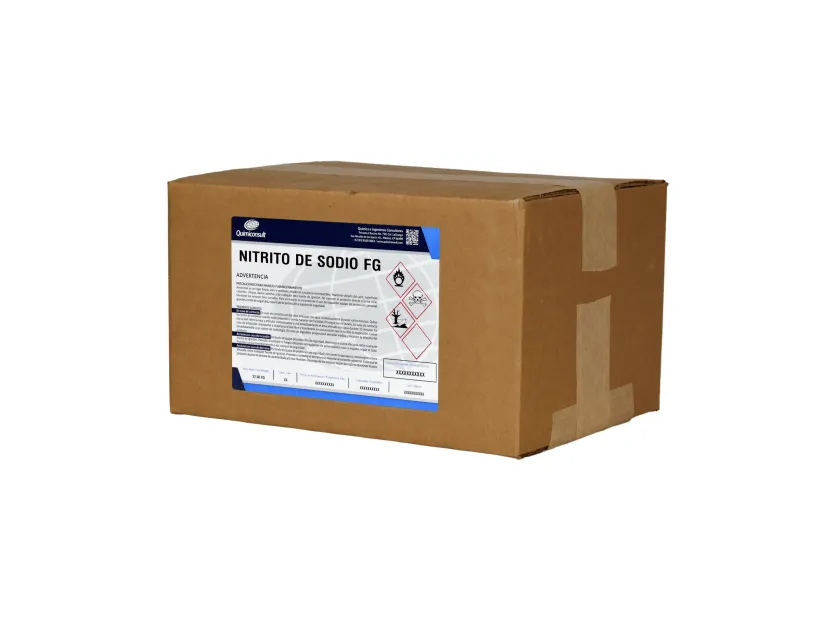
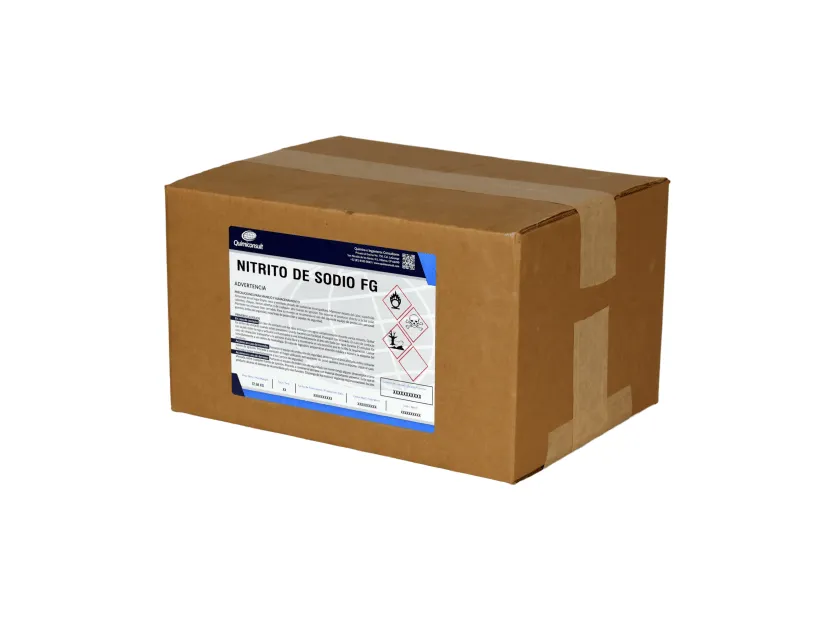
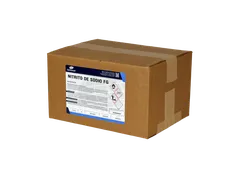
SODIUM NITRITE FOOD GRADE
View All Prices
| Quantity | Unit Price |
|---|---|
| kg | |
| 1 - 99 | USD 2.69 |
| 100 - 199 | USD 2.63 |
| 200 - 499 | USD 2.58 |
| 500 - 999 | USD 2.53 |
| 1000 - 4999 | USD 2.48 |
| 5000 - 9999 | USD 2.43 |
| 10000 - 17999 | USD 2.39 |
| 18000+ | USD 2.34 |
Food-grade sodium nitrite description
At Quimiconsult we offer food grade sodium nitrite, an inorganic compound with the chemical formula NaNO₂ and CAS number 7632-00-0, supplied as a white to slightly yellowish crystalline solid powder that is highly water-soluble and hygroscopic. With a minimum purity of 99.0% and Kosher certification, our sodium nitrite meets the specifications required for use as a preservative and curing agent in the food industry, where it is identified by the additive code E250.
Sodium nitrite is the most important preservative in the meat industry worldwide. Its role goes far beyond simply preserving food: it is responsible for inhibiting the growth of Clostridium botulinum, the bacterium that produces botulinum toxin, one of the most lethal substances known and the cause of foodborne botulism. Without sodium nitrite in processed meat products such as ham, sausages, bacon, cold cuts and canned meats, these foods would pose a severe microbiological risk to consumers. This anti-botulinum function is the main reason why the health regulations of virtually every country require or permit the use of sodium nitrite in meat curing.
In addition to its role as an antimicrobial preservative, sodium nitrite performs three further functions in meat products: it provides the characteristic pink or reddish color of cured meats through the formation of nitrosomyoglobin, it develops the typical cured flavor and aroma that distinguish ham from plain cooked pork, and it acts as an antioxidant, delaying oxidative rancidity of fats, which extends the product's shelf life and preserves its organoleptic characteristics.
For those wondering what sodium nitrite is or what curing salt (sal de nitro) is used for, it is an essential and irreplaceable ingredient in processed meat technology, backed by decades of scientific research and regulated by health authorities to ensure its safe use at the established doses.
Food grade sodium nitrite is available in Monterrey, Nuevo León, with technical support, certificates of analysis for every lot and shipping throughout Mexico.
Sodium nitrite details and properties
Our food grade sodium nitrite contains a minimum of 99.0% NaNO₂, with a strictly controlled impurity profile that includes sodium nitrate (NaNO₃) maximum 0.4 g/100g, carbonates maximum 200 mg/kg, chlorides maximum 50 mg/kg, sulfates maximum 100 mg/kg and loss on drying maximum 0.20 g/100g. These specifications ensure that the product meets the purity requirements needed for incorporation into food formulations where the safety of the end consumer is the priority.
From a physicochemical standpoint, sodium nitrite has a molecular weight of 69 g/mol, a melting point of 271°C, a boiling point of 320°C and a relative density of 2.17. The pH of a sodium nitrite solution is approximately 9.0, indicating its slightly alkaline nature. Its high water solubility is a fundamental property for practical use, as it makes it easy to prepare brines and curing solutions at the concentrations required by meat formulations.
The shelf life of sodium nitrite is 12 months when stored under proper conditions, that is, in an airtight container, protected from moisture and in a cool, ventilated place.
Functional properties of sodium nitrite in food
Sodium nitrite is a hygroscopic compound, which means it absorbs moisture from the air if it is not properly protected. This characteristic requires special attention during storage and handling to prevent caking and the loss of the flow properties needed for accurate dosing.
The most relevant property of sodium nitrite in the food context is its ability to react with the myoglobin in meat. When sodium nitrite dissolves in the curing brine and comes into contact with muscle tissue, it is reduced to nitric oxide (NO), which in turn reacts with myoglobin to form nitrosomyoglobin, the pigment responsible for the stable, characteristic pink color of cured products. Without this reaction, processed meats would have a gray color that is unappealing to consumers.
The antimicrobial action of sodium nitrite is particularly effective against spore-forming anaerobic bacteria, Clostridium botulinum being the most significant from a health standpoint. The inhibition mechanism involves nitric oxide interfering with the enzymes of the bacterium's energy metabolism, preventing its growth and toxin production. This action is enhanced in combination with other factors such as salt concentration, pH, storage temperature and the presence of other preservatives.
As an antioxidant, sodium nitrite inhibits lipid oxidation in meat products by chelating pro-oxidant metal ions such as iron and by stabilizing unsaturated lipids against oxidative degradation. This effect prevents the development of rancid flavors and odors that would reduce consumer acceptance of the product and shorten its shelf life.
It is important to note that, because of the potential formation of nitrosamines (compounds considered carcinogenic) when sodium nitrite reacts with secondary amines present in meat, its use is regulated at specific maximum doses and is usually complemented by the addition of ascorbic acid (vitamin C) or sodium erythorbate, antioxidants that inhibit nitrosamine formation and accelerate the conversion of nitrite to nitric oxide, maximizing curing efficiency and minimizing the associated risks.
Sodium nitrite applications and industrial uses
Food grade sodium nitrite's main field of application is the meat industry, but its usefulness extends to other food, pharmaceutical and industrial sectors where its properties as a preservative, antioxidant and chemical reagent are valued.
In the processed meat industry, sodium nitrite is an indispensable ingredient in the formulation of cooked and cured hams, bacon, sausages, chorizos, longanizas, mortadella, salami, pastrami, corned beef, cecina and virtually any meat product that requires curing. It is incorporated into formulations through curing mixes (commonly known as curing salt or sal nitro), which typically consist of a blend of sodium chloride (common salt) with a controlled percentage of sodium nitrite, usually 6.25% (known as Prague Powder #1 or Cure #1 in international terminology). This dilution is a safety measure that facilitates accurate dosing and reduces the risk of accidental overdosing.
When preparing curing brines, sodium nitrite is dissolved in water together with salt, sugars, phosphates and other ingredients to create the solution that is injected into cuts of meat such as hams and turkey breasts, or used for immersing cuts that require diffusion curing. The nitrite concentration in the brine is carefully calculated so that the final product complies with the maximum limits set by food regulations, which in most countries are between 120 and 200 ppm of residual nitrite in the finished product.
In the canned and preserved food industry, sodium nitrite can be used as a complementary preservative in meat products that will undergo heat treatment, providing an additional microbiological safety barrier alongside heat sterilization. Its presence is particularly relevant in products where Clostridium spores can survive moderate heat treatments.
In the fishing industry, sodium nitrite is used to cure certain smoked fish products and in the production of canned fish where the aim is to maintain color and prevent the development of oxidized flavors.
In the pharmaceutical industry, sodium nitrite is used as a raw material in organic synthesis processes for producing diazonium compounds and as a reagent in the manufacture of certain medicines. It has also been studied and used in clinical settings as a vasodilator and as an antidote for cyanide poisoning, where it is administered intravenously to generate methemoglobin, which binds to cyanide and facilitates its elimination from the body.
In laboratory applications, sodium nitrite is used as an analytical reagent in diazotization tests, in the determination of amines and in various organic chemistry procedures. Its food grade purity also makes it suitable for analytical applications that require a reagent with a low impurity content.
In the metallurgical and surface treatment industry, industrial grade (non-food) sodium nitrite is used as a corrosion inhibitor in cutting fluids, as a component in phosphating baths and as an additive in industrial antifreeze solutions. It is important to note that these applications correspond to technical grade and not to the food grade we offer, although the chemical compound is the same.
To learn about more food preservation solutions, visit our categories Food & Beverage, Preservatives, Moisture Control and Pharmaceutical & Wellness
Sodium nitrite vs sodium nitrate: differences and which to use
A very common source of confusion in the food industry and among buyers is the difference between sodium nitrite (NaNO₂) and sodium nitrate (NaNO₃). Although their names are similar and both take part in the meat curing process, they are distinct chemical compounds with different functions, speeds of action and applications.
Sodium nitrite (NaNO₂, E250) is the active curing agent. It is the compound that reacts directly with myoglobin to produce the pink color, inhibits Clostridium botulinum and acts as an antioxidant in the meat product. Its action is fast, making it ideal for short-cure products such as cooked ham, sausages, bacon and cold cuts that are manufactured and consumed within relatively short periods.
Sodium nitrate (NaNO₃, E251), on the other hand, has no direct curing action. Its role is to serve as a nitrite reservoir: bacteria naturally present in meat (such as Micrococcus and Staphylococcus) slowly reduce nitrate to nitrite over weeks or months. This gradual release of nitrite is what makes sodium nitrate suitable for long-cure products such as fermented salamis, Serrano hams, Iberian ham, prosciutto and other dry or semi-dry sausages that mature over long periods. In these products, the slow, sustained release of nitrite from nitrate maintains antimicrobial protection and color development throughout the entire maturation process.
In practice, many long-cure formulations use a combination of sodium nitrite and sodium nitrate: the nitrite provides immediate protection at the start of the process, while the nitrate ensures nitrite availability throughout maturation. Curing mixes containing both compounds are known internationally as Prague Powder #2 or Cure #2.
The general rule for choosing between them is straightforward: for fast-production meat products that will be consumed within days or weeks, sodium nitrite is the appropriate curing agent. For long-cure products that mature over weeks or months, sodium nitrate is used alone or in combination with nitrite.
At Quimiconsult we offer food grade sodium nitrite with the purity and documentation needed for incorporation into meat formulations that comply with current regulations.
Regulation and permitted doses of sodium nitrite in food
The use of sodium nitrite in food is regulated by each country's health authorities and by international bodies such as the Codex Alimentarius, which sets global guidelines on food additives. These regulations define the maximum permitted doses, the types of food in which it may be used and the conditions of use, seeking a balance between the food safety role nitrite plays (preventing botulism) and minimizing the risks associated with nitrosamine formation.
In Mexico, the use of sodium nitrite in meat products is regulated by COFEPRIS regulations and NOM-213-SSA1 (Products and services. Processed meat products), which sets the maximum limits for residual nitrites permitted in the finished product. These regulations are consistent with Codex Alimentarius guidelines and with European Union and US FDA regulations.
Typical sodium nitrite use levels in the meat industry are calculated so that the finished product does not exceed the established residual nitrite limits. In practice, the amount of nitrite added to the formulation is greater than the amount that remains in the final product, since a significant portion reacts with myoglobin, another portion oxidizes to nitrate and another breaks down during thermal processing. For this reason, food technologists must consider both the addition dose and the expected residual nitrite when designing their formulations.
The use of antioxidants such as ascorbic acid (vitamin C), sodium erythorbate or sodium ascorbate in combination with sodium nitrite is standard practice in the industry, backed by scientific research and recommended by regulatory authorities. These antioxidants accelerate the reaction of nitrite with myoglobin, improve curing efficiency, reduce the amount of residual nitrite in the product and, most importantly, significantly inhibit nitrosamine formation during the processing and cooking of meat products.
For formulators and quality managers who need guidance on the right doses for their specific products, our technical support team can provide additional information.
Storage and handling of curing salt (sal nitro)
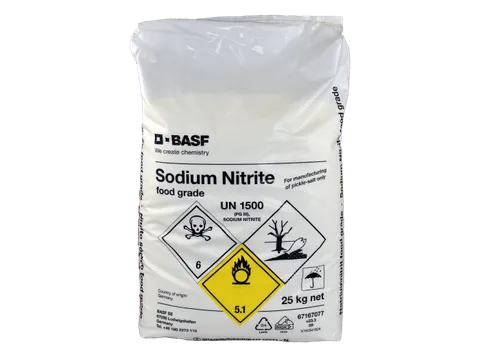
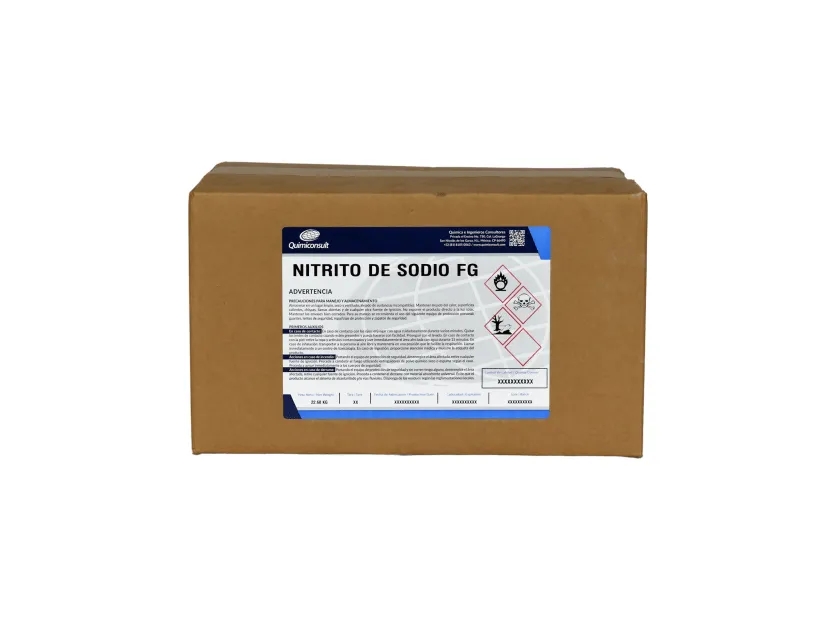
Storing and handling sodium nitrite requires special precautions beyond those usual for food ingredients, because it is classified as an oxidizing solid, category 3, with acute oral toxicity, category 3, under the Globally Harmonized System (GHS). Its UN number for transport is 1500, with hazard class 5.1 (6.1) and packing group III.
To preserve the quality of food grade sodium nitrite, store the product in plastic or stainless steel containers, tightly closed and protected from light and moisture. The storage area should be cool, dry, well ventilated and away from combustible materials, flammable organic substances, strong acids, reducing agents and ammonium salts. Sodium nitrite is an oxidizer, which means it can intensify a fire by releasing oxygen, so it must never be stored near flammable materials such as solvents, oils, sawdust, paper or fabric.
Because of its hygroscopic nature, sodium nitrite absorbs moisture from the air and can cake if it is not kept in an airtight container. This caking not only makes dosing difficult but can also affect the uniformity of the curing mixes in which it is incorporated.
During handling, personal protective equipment should be used, including chemical-resistant gloves, safety glasses or a face shield, an apron or coveralls and, if dust is generated, a high-efficiency particulate filter. Sodium nitrite is toxic if swallowed (oral LD50 in rats: 157.9 mg/kg), so it must be handled with extreme care and kept out of the reach of untrained people. It is essential that all personnel who handle this product are trained in its hazards and in the corresponding first-aid procedures.
In case of accidental ingestion, rinse the mouth immediately, drink plenty of water and call a poison control center or doctor immediately. In case of eye contact, rinse with water for at least 15 minutes and seek specialized medical attention.
When preparing brines or curing mixes, sodium nitrite should be dissolved in potable water at the concentrations recommended by food regulations, using clean containers and utensils dedicated exclusively to this purpose.
Frequently asked questions about sodium nitrite
What is sodium nitrite and what is it used for in food?
Sodium nitrite is an inorganic salt with the formula NaNO₂ that serves as the main curing agent in the processed meat industry. It performs four essential functions: inhibiting the growth of Clostridium botulinum (the botulism bacterium), developing the characteristic pink color of cured meats, providing the typical cured flavor and acting as an antioxidant to prevent fat rancidity. It is identified by the food additive code E250, and its use is regulated at specific doses by each country's health authorities.
Is sodium nitrite dangerous?
Sodium nitrite is toxic when ingested directly in significant amounts (oral LD50 in rats: 157.9 mg/kg), which classifies it as acute oral toxicity, category 3. For this reason, it must never be ingested in its pure form and must be handled with personal protective equipment. However, at the extremely low doses used in meat curing (typically 120 to 200 ppm of residual nitrite in the finished product), its use is considered safe by international health authorities and is essential for preventing botulism. The risk of nitrosamine formation is mitigated by adding antioxidants such as ascorbic acid.
What is the difference between sodium nitrite and curing salt (sal nitro)?
Sal nitro, or curing salt, is the trade name used in the meat industry for pre-dosed blends of sodium chloride (common salt) with a controlled percentage of sodium nitrite, usually 6.25%. This dilution makes safe, accurate dosing of nitrite in meat formulations easier. Pure sodium nitrite, like the product we offer at Quimiconsult, is the raw material used to prepare these curing mixes or that is incorporated directly into industrial formulations by trained personnel.
Can sodium nitrate be used instead of sodium nitrite?
They are not directly interchangeable. Sodium nitrate (NaNO₃) has no immediate curing action; it needs to be reduced to nitrite by bacteria over several weeks. It is suitable for long-cure products such as fermented salamis and Serrano hams. Sodium nitrite (NaNO₂) acts immediately and is the right choice for fast-cure products such as cooked ham, sausages and bacon. Using nitrate in short-cure products would not provide sufficient antimicrobial protection, and using nitrite in long cures would result in protection that runs out before the product completes its maturation.
Which antioxidants are combined with sodium nitrite?
The antioxidants most commonly used in combination with sodium nitrite are ascorbic acid (vitamin C), sodium ascorbate and sodium erythorbate. These compounds accelerate the conversion of nitrite to nitric oxide, improve curing efficiency, reduce residual nitrite in the finished product and, above all, inhibit nitrosamine formation. Their combined use with sodium nitrite is standard practice in the meat industry and is recommended by the main regulatory authorities.
Where to buy food grade sodium nitrite in Mexico?
At Quimiconsult we offer food grade sodium nitrite with a minimum purity of 99.0%, Kosher certification, certificates of analysis for every lot and technical support. We are located in Monterrey, Nuevo León, and ship throughout Mexico. Our product meets the specifications required for use in the meat and food industries.
Other names and synonyms for sodium nitrite
Sodium nitrite is known by various names depending on the context of use, the industry and the language, which can cause confusion if the variants are not correctly identified.
Nitrito de sodio is the Spanish name used in Mexican and Latin American trade, technical data sheets, safety data sheets and regulatory documentation, while sodium nitrite is the name used in international trade and by the FDA and other international agencies.
Sal nitro or sal de nitro is the term most widely used in the Mexican and Latin American meat industry to refer both to pure sodium nitrite and to the curing mixes that contain it. It is worth clarifying that historically "salitre" or "sal de nitro" referred to potassium nitrate (KNO₃), but in modern meat industry usage the term has shifted to refer to mixes containing sodium nitrite as the active ingredient.
E250 is the food additive code assigned to sodium nitrite by the European Union and used internationally on ingredient labels and in regulatory documentation.
Nitrito sódico is the name used in the nomenclature for the transport of dangerous goods (UN number 1500) and in safety data sheets written in formal Spanish.
Curing salt (sal de cura), Prague Powder #1 or Cure #1 are trade names for pre-dosed blends of salt and 6.25% sodium nitrite, widely used in artisanal and semi-industrial meat processing.
Likewise, in purchasing and sourcing it is common to see searches such as sodium nitrite price, buy curing salt, food grade sodium nitrite Mexico, meat preservative or sodium nitrite safety data sheet, where variations in the product description or its function are used to find options available on the market. These variations help you, as purchasing, formulation and quality managers in the meat industry, identify the product within the market for preservatives and food additives.