Spanish
 English


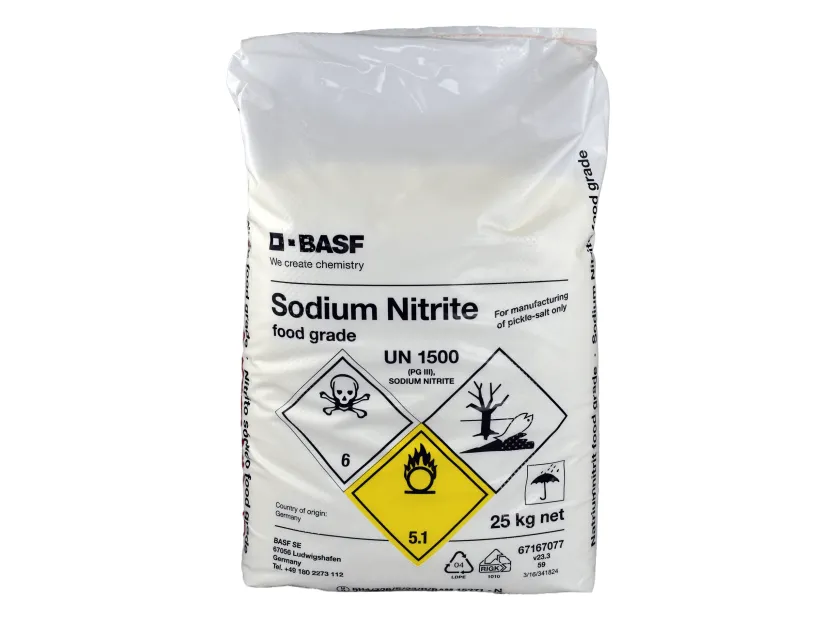
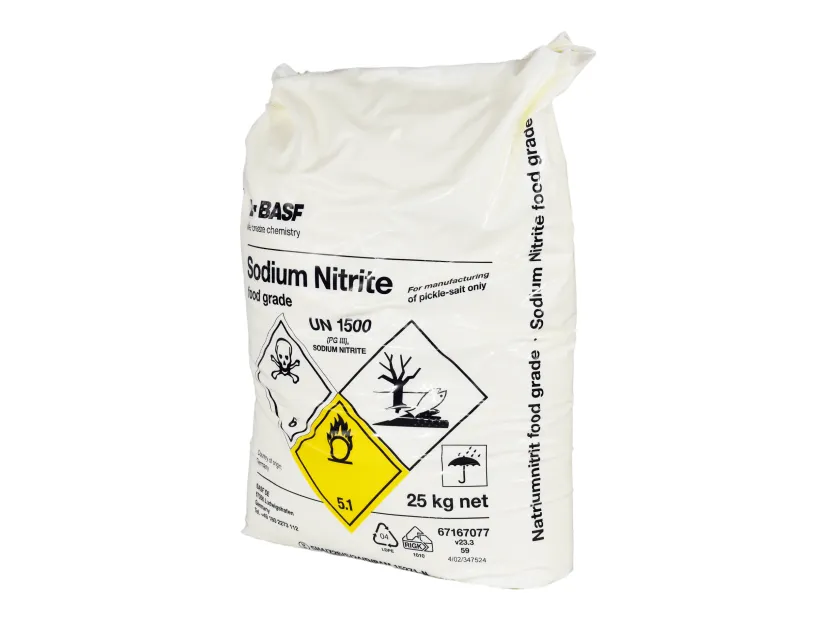
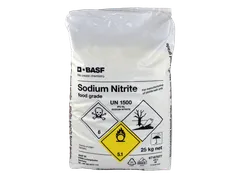
SODIUM NITRITE BASF® FOOD GRADE
View All Prices
| Quantity | Unit Price |
|---|---|
| kg | |
| 1 - 99 | USD 3.37 |
| 100 - 199 | USD 3.32 |
| 200 - 499 | USD 3.26 |
| 500 - 999 | USD 3.21 |
| 1000 - 4999 | USD 3.16 |
| 5000 - 9999 | USD 3.11 |
| 10000 - 17999 | USD 3.07 |
| 18000+ | USD 3.02 |
Food Grade Sodium Nitrite Description: Curing Agent and Preservative for Meat Products
At Quimiconsult we offer BASF® food grade Sodium Nitrite, a yellowish-white crystalline solid powder with a minimum purity of 99.0 g NaNO₂ per 100 g, intended for the meat food industry. It is a hygroscopic compound that is very soluble in water, so it dissolves quickly and evenly in injection brines, curing solutions and premixes, and it is used mainly as a preservative and curing agent in processed meats and in the preparation of curing salts.
Sodium nitrite is the ingredient that sets a cured meat apart from a merely salted one. It works through three simultaneous effects: it fixes the characteristic pink color of ham, sausages and bacon; it inhibits the growth of pathogenic bacteria, in particular Clostridium botulinum, the cause of botulism; and it delays fat oxidation, preventing rancid flavors and giving cured products their typical taste. No other additive combines these three functions in a single ingredient, which is why sodium nitrite remains the basis of virtually all industrial charcuterie.
Thanks to its low nitrate content (maximum 0.4 g/100 g), its tight limits on chlorides, sulfates and carbonates and its maximum moisture of 0.20 g/100 g, this sodium nitrite allows precise, reproducible dosing from lot to lot, a critical requirement for an additive whose concentration in the finished product is regulated.
Available in Monterrey, with shipping throughout Mexico. Supplied in a 25 kg bag and a 200 g sample for formulation trials. Shelf life of 12 months under proper storage conditions.
Technical Specifications and Physicochemical Properties of Food Grade Sodium Nitrite
Chemically it is identified as sodium nitrite, formula NaNO₂, CAS number 7632-00-0. It is a hygroscopic granular solid, slightly yellowish white in color, with a pH of 7.0 to 9.0.
Its minimum sodium nitrite content is 99.0 g/100 g, which ensures that the amount weighed matches the amount of active nitrite reaching the formulation. Sodium nitrate (NaNO₃) is limited to a maximum of 0.4 g/100 g, so the curing effect comes almost entirely from nitrite rather than from a slow, irregular conversion of nitrate. Loss on drying (moisture) is limited to a maximum of 0.20 g/100 g, an important parameter in a hygroscopic product, since low moisture supports powder flowability and weighing accuracy.
As for impurities, carbonate is limited to a maximum of 200 mg/kg, chloride to a maximum of 50 mg/kg and sulfate to a maximum of 100 mg/kg. These low limits on accompanying salts ensure a clean product, suitable for direct incorporation into curing salts and food brines.
From an industrial handling standpoint, sodium nitrite is an oxidizing solid (it may intensify a fire) and is toxic if swallowed in its concentrated form, so it must never be added neat to a food: it is always dosed diluted, either in a curing salt or in a brine. It is stable under the recommended storage conditions and must be kept away from acids, ammonium salts, amines, reducing agents and combustible organic materials. For transport it is classified as UN 1500, class 5.1 (6.1), packing group III.
Applications of Food Grade Sodium Nitrite — Uses by Industry
Food grade sodium nitrite is the reference curing agent in the meat industry. Below are its main applications by sector:
Cooked Sausages and Cold Cuts
In the production of cooked ham, frankfurters, mortadella, cooked salami, meat loaf and cold cuts, sodium nitrite is added to the injection brine or directly to the meat batter. During processing, nitrite turns into nitric oxide, which binds to the myoglobin in the meat and, on cooking, forms the stable pigment responsible for the characteristic pink color of cured products. Without nitrite, the same products turn grayish-brown after cooking.
Beyond color, sodium nitrite plays a microbiological safety role: in vacuum-packed or modified-atmosphere products, where oxygen is scarce, it inhibits the growth of Clostridium botulinum and helps control other microorganisms such as Listeria monocytogenes. Used together with sodium ascorbate or erythorbate, it speeds up the curing reaction and improves color stability throughout shelf life.
Bacon, Smoked Ribs and Smoked Products
In bacon, smoked pork chops and smoked ribs, sodium nitrite provides the typical cured flavor and protects the fat against oxidation, preventing the rancid taste that develops in uncured meat products during storage. It is applied by brine injection, immersion or dry curing with curing salt, before the smoking and cooking stages.
Raw Cured and Dry-Aged Products
In chorizo, longaniza, cecina, dry-cured ham and fermented sausages, sodium nitrite protects the product during resting, fermentation and drying, when the meat stays uncooked for days or weeks. In these applications, the combination of nitrite, salt and reduced water activity is what makes the product safe and stable, while developing its deep red color and characteristic aroma.
Preparation of Curing Salts and Premixes
One of the applications listed in the technical data sheet is the preparation of curing salts. Because sodium nitrite is used in very small amounts relative to the weight of meat, standard industry practice is to pre-dilute it in common salt (sodium chloride) to obtain a curing salt or nitrite salt with a low, known nitrite concentration. The operator then doses the curing salt in proportion to the meat weight, minimizing the risk of weighing errors with pure nitrite.
Manufacturers of seasonings, premixes and functional systems for the meat industry use sodium nitrite as a raw material for ready-to-use curing blends that combine salt, nitrite, ascorbate or erythorbate, phosphates, sugars and spices. The product's high purity and low moisture make for homogeneous mixing and good premix stability.
Dosing and Regulatory Compliance
Sodium nitrite is an additive with regulated maximum levels. In Mexico, its use in processed meat products must comply with the Ministry of Health's Additives Agreement and NOM-213-SSA1-2018 for processed meat products; in other markets, Codex Alimentarius, FDA/USDA or European Union rules apply. We recommend validating the dose of each formulation with your quality or regulatory affairs lead, weighing the product on calibrated scales and keeping a record of every batch of curing salt prepared.
Food Grade Sodium Nitrite Packaging and Availability
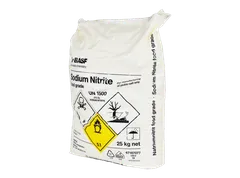
BASF® food grade Sodium Nitrite is available in a 25 kg bag, the standard pack for meat plants, curing salt manufacturers and premix formulators. For development labs, pilot trials and validation of new formulations we offer a 200 g sample.
The product is in stock in Monterrey, Nuevo León, with shipping throughout Mexico, and comes with volume-based tiered pricing. The technical data sheet and safety data sheet can be downloaded from this page. Shelf life is 12 months in the original closed packaging under proper storage conditions.
Safe Storage and Handling of Sodium Nitrite
Storage Conditions
Sodium nitrite must be stored in its original, tightly closed packaging, in a dry, cool, well-ventilated place, protected from moisture and heat, as it is very hygroscopic and readily absorbs water from the air. Being an oxidizing solid (H272), it must be kept away from combustible materials, solvents, sawdust, paper, flammable substances and ignition sources. It is incompatible with acids, ammonium salts, amines, reducing agents and powdered metals.
The pure product must be stored locked up and separated from food, beverages and animal feed, in a labeled, restricted-access area, to avoid any confusion with table salt or other white ingredients. In case of a spill, collect it with inert material such as dry sand or vermiculite (never sawdust), place it in labeled containers and keep it out of drains, since it is very toxic to aquatic life.
Required Personal Protective Equipment (PPE)
Concentrated sodium nitrite is toxic if swallowed (H301), causes serious eye irritation (H319), may cause an allergic skin reaction (H317) and may irritate the respiratory tract (H335). For eye and face protection, safety glasses and a face shield are required. For hand and body protection, chemical-resistant gloves, an apron or coveralls and boots. For respiratory protection, a high-efficiency particulate filter when transferring or weighing large quantities, or when local exhaust is not available. Do not eat, drink or smoke in the handling area, and wash hands after handling the product.
Other Names, Synonyms and Search Terms
Nitrous acid, sodium salt is the systematic chemical name listed as an alternative identifier in the safety data sheet and in chemical substance databases, linked to CAS number 7632-00-0.
NaNO₂ is the chemical formula of sodium nitrite, frequently used in technical data sheets, certificates of analysis and purchase specifications to identify the compound unambiguously.
E250 or INS 250 is the food additive code assigned to sodium nitrite in the European system and in the Codex Alimentarius International Numbering System, identifying it as a preservative. It appears on meat product labels and matters to manufacturers who export or follow harmonized regulations.
Curing salt, nitrite curing salt or pink salt are the names of blends of common salt with a small proportion of sodium nitrite, prepared from this product. Butchers, charcutiers and plants that make their own curing blends search for it under these terms.
Nitrito de sodio grado alimenticio is the Spanish name used by buyers and plants in Mexico and Latin America, on purchase orders and in local regulatory documentation.
Meat curing agent or sausage preservative are the functional terms ham, sausage, chorizo and bacon producers use to identify sodium nitrite in their formulations.
Food grade sodium nitrite suppliers in Mexico is the most frequent search term among industrial buyers who need a local distributor with stock on hand, complete technical documentation and nationwide delivery without import lead times.