Spanish
 English


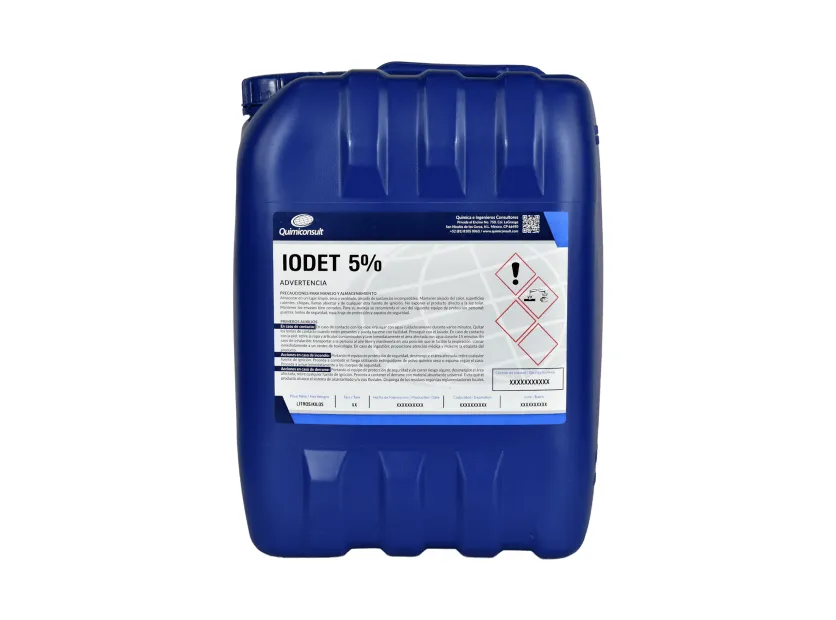
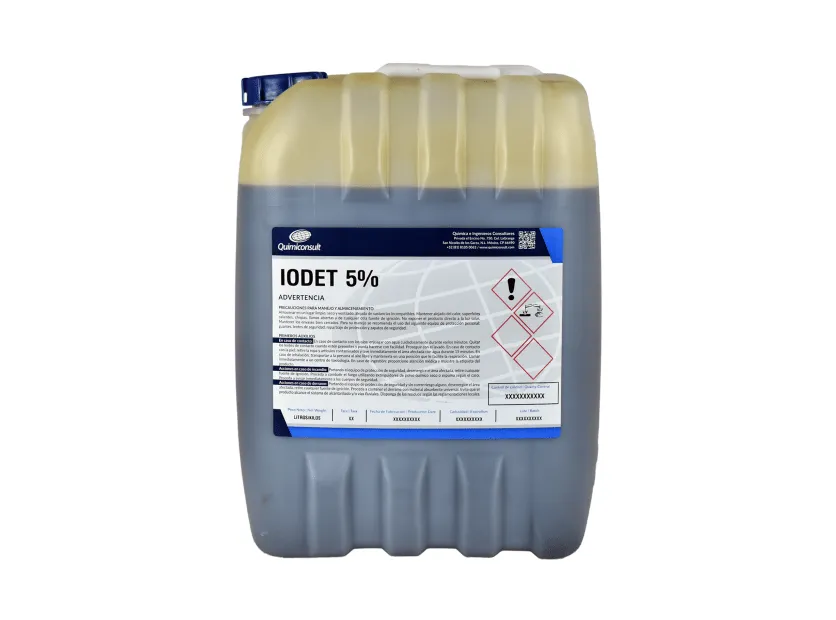
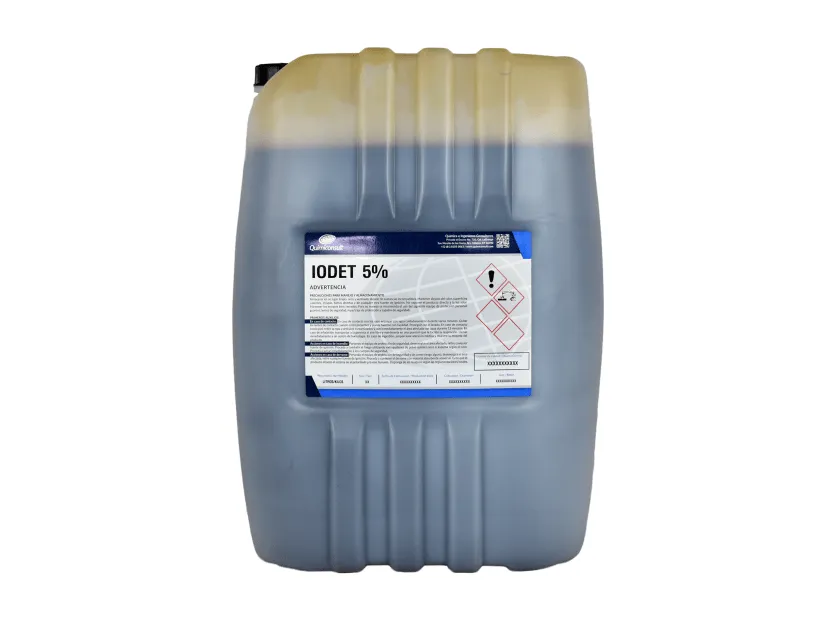
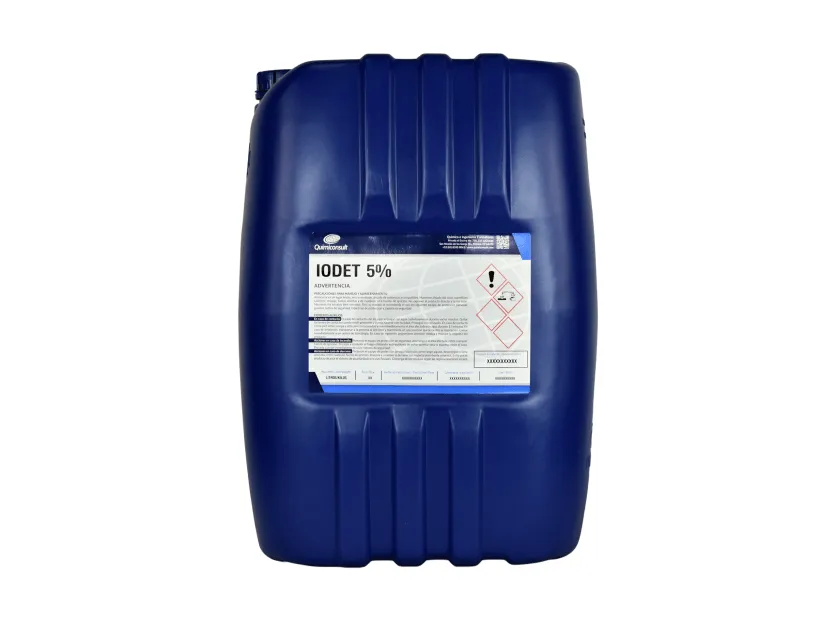
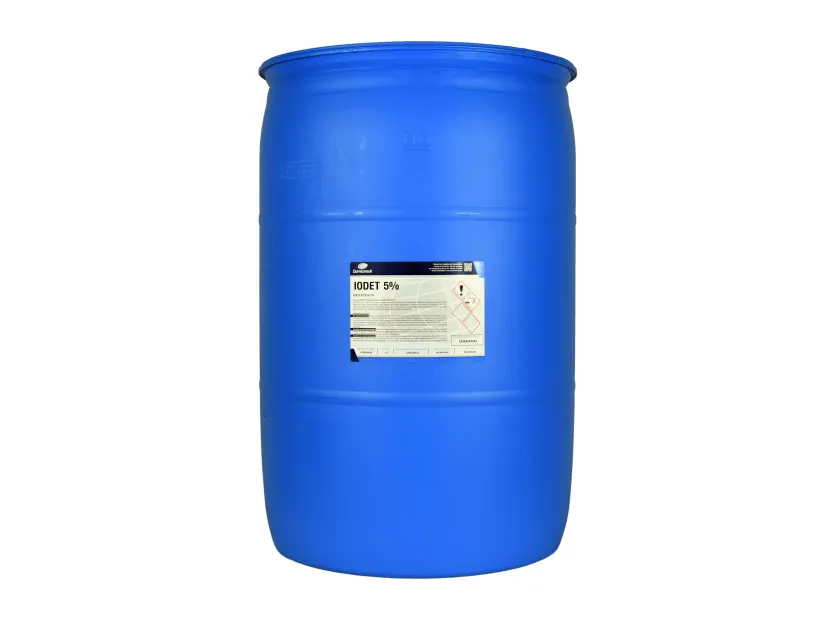
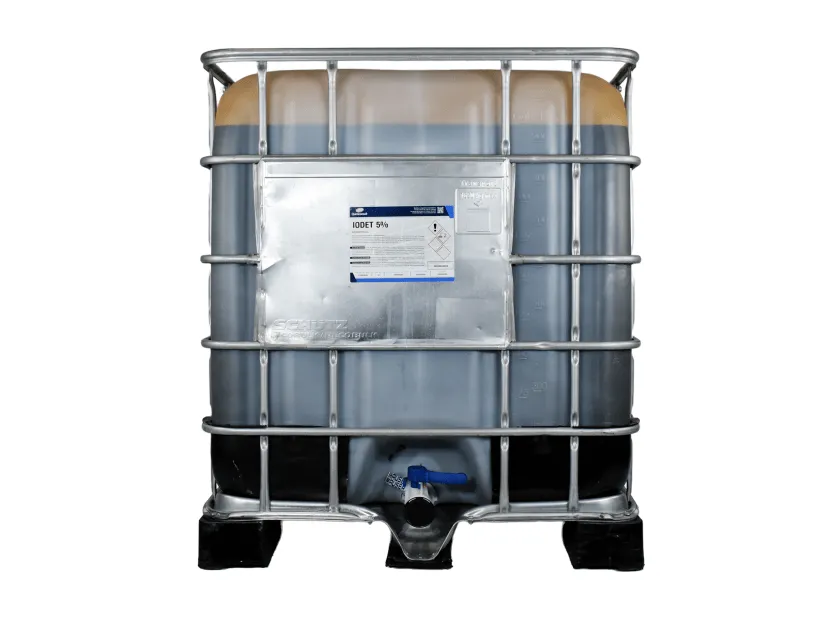
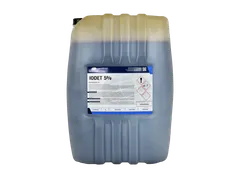
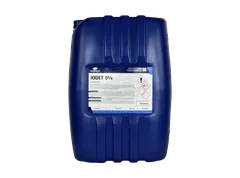
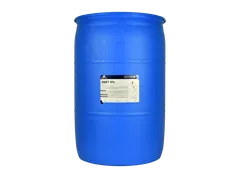
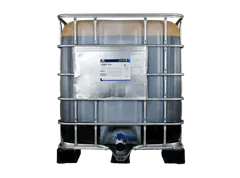
IODET 5% STABILIZED IODOPHOR FOR DISINFECTION
View All Prices
| Quantity | Unit Price |
|---|---|
| kg | |
| 1 - 99 | USD 9.33 |
| 100 - 199 | USD 9.06 |
| 200 - 499 | USD 8.81 |
| 500 - 999 | USD 8.57 |
| 1000 - 4999 | USD 8.34 |
| 5000 - 9999 | USD 8.12 |
| 10000 - 17999 | USD 7.92 |
| 18000+ | USD 7.72 |
Description of the 5% concentrated iodophor for professional disinfection
At Quimiconsult we offer Iodet 5%, a concentrated iodophor in our portfolio of iodine-based biocides. With a minimum of 50,000 ppm of active iodine (5 %), this product is designed for operations that demand maximum yield per liter of concentrate: large-scale industrial plants, livestock biosecurity programs across multiple facilities, sanitation service companies and distributors that need a high-potency base product to prepare significant volumes of disinfectant solution.
Iodet 5 % is a biocide that delivers excellent stability and high solubility in aqueous media. It acts on a wide range of microorganisms, including Gram-positive and Gram-negative bacteria, fungi and yeasts, with instant action on contact. Its formulation lowers the surface tension of water, helping the disinfectant penetrate cracks, pores, joints and irregular surfaces where microorganisms find protection, a property that sets it apart from more basic iodine formulations.
The efficiency of Iodet 5 % is not compromised by very hard water, which eliminates the need to pretreat water in many industrial and rural applications. It does not stain equipment or surfaces thanks to its complete solubility, and its detergent properties complement its disinfecting action by helping remove light organic residues during sanitizing. For buyers weighing iodine disinfectant price against yield, 5% iodine offers the lowest cost per liter of prepared solution within Quimiconsult's iodophor family.
Available in Monterrey, Nuevo León, with shipping throughout Mexico, specialized technical support and complete documentation for quality and food safety audits.
Technical specifications and data sheet for 5 percent iodine
Understanding the specifications of a 5 percent iodine is essential for designing precise dosing protocols and getting the most out of the product. Iodet 5 % has been formulated to offer a high concentration of available active iodine within our line, while keeping the same stability and solubility properties that characterize all our iodophors.
The product is a dark reddish-brown liquid with a characteristic odor. Its minimum concentration is 5.0 % active iodine (50,000 ppm), making it a high-potency concentrate. Density at 20 °C is between 1.00 and 1.25 g/cm³, and the pH measured in a 1 % aqueous solution ranges from 2.5 to 4.0. This acidic range boosts the biocidal activity of iodine and helps create a hostile environment for most pathogens of sanitary concern.
The high concentration of Iodet 5 % means that relatively small volumes of product yield large quantities of working solution. To prepare 1,000 liters of solution at 200 ppm, for example, only 4 liters of Iodet 5 % are needed. The same amount of solution using a 1.75 % iodophor would require approximately 11.4 liters. This volumetric efficiency translates into lower storage, transport and logistics costs, factors that are especially relevant for operations spread across multiple sites or located in rural areas far from distribution centers.
Key benefits of the high-concentration formulation
Iodet 5 % is not simply a more concentrated iodophor; its formulation has been optimized so that the high concentration of active iodine remains stable throughout the product's shelf life and is released in a controlled way upon dilution. The key benefits that distinguish this formulation include reduced surface tension, which speeds up contact between the disinfectant and contaminated surfaces; detergent action, which allows light cleaning at the same time as disinfection; and resistance to inactivation by hard water, which ensures consistent results regardless of the quality of the water available at each facility.
Dosing guide by application type for the 5% iodophor
One of the most valuable features of the Iodet 5 % Technical Data Sheet is that it includes specific dosing recommendations by type of disinfection. Below we expand on these recommendations with practical context for each scenario. Final doses should be adjusted according to the condition and type of surface and the bacterial load remaining after cleaning.
Barns, poultry and swine farms, veterinary clinics and hospitals (100 – 400 ppm)
This is the highest concentration range recommended for Iodet 5 %, and it applies to environments where the organic load is high and the presence of resistant pathogens is a constant concern. Disinfecting dairy barns, poultry grow-out houses, swine farrowing units, veterinary clinics, large-animal hospitals, hatcheries and animal transport vehicles requires solutions that remain effective even in the presence of residual organic matter.
To prepare a 200 ppm solution with Iodet 5 % (50,000 ppm), you need 4 ml of product per liter of water. For 400 ppm, 8 ml per liter are required. In a 1,000-liter tank for a wheel dip or spray system, this equals 4 or 8 liters of concentrate respectively, a remarkably efficient consumption for the scale of livestock operations.
Footbaths deserve special mention: at concentrations of 200 to 400 ppm, Iodet 5 % stays active longer than chlorine in these applications, because iodine is less susceptible to inactivation by organic matter (manure, soil, feed residue) that inevitably builds up in footbaths during the day. The dark color of the solution also allows immediate visual control — when the footbath loses its color, it is time to replace the solution.
Hand washing and disinfection of work equipment in food plants (75 – 100 ppm)
In food processing plants, disinfecting staff hands and work surfaces requires lower concentrations that ensure pathogens are eliminated without irritating the operator's skin with repeated use. The 75 to 100 ppm range offers this balance: enough biocidal activity to eliminate Salmonella, E. coli, Listeria and Staphylococcus aureus, but with a manageable skin contact profile when used according to the quality control laboratory's specifications.
For 100 ppm with Iodet 5 %, only 2 ml of product per liter of water are required. This efficiency makes it possible to run hand washing stations and utensil sanitizing points with minimal consumption of concentrate, ideal for plants with multiple stations along the production line.
Process area equipment in produce packing houses (25 – 75 ppm)
Processing and packing fruits and vegetables calls for more moderate concentrations, since the treated produce will be eaten directly. The 25 to 75 ppm range ensures effective disinfection of the surfaces of sorting, grading, washing and packing equipment without the risk of transferring excessive iodine levels to the final product.
For 50 ppm, just 1 ml of Iodet 5 % per liter of water is needed. In a 500-liter wash tank, this translates into 500 ml of concentrate, an extraordinarily small amount that demonstrates the efficiency of the 5 % product. This dosage should be validated against the specifications set by each facility's quality control laboratory.
What is an iodophor and how does it work as a disinfectant?
One of the most common questions among professional buyers is what is an iodophor and how it differs from conventional iodine. This section answers that question with the level of detail that quality, biosecurity and industrial purchasing managers need.
An iodophor (from the Greek iodos = violet and phoros = carrier) is a chemical complex made up of elemental iodine and a solubilizing-stabilizing agent, usually a nonionic surfactant or a polymer. This complex "carries" the iodine in a stable form and releases it gradually on contact with water and organic matter, providing controlled and sustained disinfecting action.
The mechanism of action of iodine as a biocide is based on the irreversible oxidation of essential cellular components of microorganisms. Active iodine penetrates the cell wall and reacts with amino acids (especially cysteine and methionine), nucleic acids and unsaturated fatty acids in cell membranes, causing multiple, simultaneous dysfunctions that prevent repair and the development of microbial resistance. This multi-site mechanism is one of the main reasons why, after more than 150 years of use, no significant cases of bacterial resistance to iodine have been documented.
Iodophors such as Iodet 5 % offer decisive advantages over free iodine: lower volatility (the iodine does not evaporate before it acts), less staining potential (the complex prevents iodine from depositing on surfaces), greater storage stability (the concentration holds throughout the shelf life), less irritation for the operator (the free iodine concentration in the working solution is lower than with pure iodine), and the ability to reduce surface tension thanks to the surfactant, improving wetting and penetration of the disinfectant.
Iodet 5% in comprehensive livestock biosecurity programs
Biosecurity in livestock production is not limited to a single control point; it covers the entire production cycle. Iodet 5 % can be the core biocide of a comprehensive biosecurity program thanks to its dosing versatility (25 to 400 ppm depending on the application) and its proven efficacy at every link in the chain.
For access control, Iodet 5 % is applied in sanitizing arches and footbaths for vehicles and personnel at concentrations of 200 to 400 ppm, creating effective barriers against the introduction of pathogens from outside. In production areas, poultry houses, feedlot pens, swine farrowing units and barns, floors, walls, ceilings, feeders, drinkers and equipment are disinfected between batches or production cycles, with emphasis on eliminating agents such as Salmonella, Newcastle, Avian Influenza, PRRS, Porcine Circovirus and environmental mastitis in cattle.
In hatcheries, disinfecting incubation facilities and equipment is critical to prevent vertical transmission of pathogens. The sporicidal and fungicidal capacity of iodine makes it especially valuable in these environments, where humidity and temperature conditions favor microbial growth. In veterinary hospitals and clinics, Iodet 5 % is used to disinfect operating rooms, recovery rooms, isolation areas and non-surgical instruments.
Treating animal drinking water is another fundamental component. Contaminated water is one of the main transmission routes for enteric diseases in intensive production. Water chlorination is the most common practice, but iodine offers advantages where water quality is variable (high organic matter, turbidity) or where a disinfectant is wanted that does not form trihalomethanes or other chlorinated disinfection byproducts.
Storage and safe handling of 5% iodine
Given the higher concentration of Iodet 5 %, handling the product correctly is especially important. The following recommendations are based on the product's Safety Data Sheet, in accordance with NOM-018-STPS-2015 and the Globally Harmonized System (GHS).
Store Iodet 5 % in its original, tightly closed container in a cool, dry place protected from direct sunlight. Keep it away from strong bases and metals, materials with which it is incompatible. The product is stable under normal storage conditions, is not flammable (NFPA: health 3, flammability 0, reactivity 0) and its transport is not regulated as dangerous goods under UN regulations.
Personal protective equipment is essential: neoprene gloves, splash goggles, synthetic apron and boots. In enclosed spaces or where ventilation is limited, use a gas respirator. Because it is a 5 % concentrate, direct contact with the undiluted product carries a greater risk of irritation than lower-concentration formulations. The GHS hazard statements classify the product as harmful if swallowed (H302), a skin irritant (H315) and an eye irritant (H320). Chronic exposure through ingestion can damage the thyroid.
In case of contact with skin or eyes, rinse with plenty of water for at least 15 minutes. If swallowed, give water or milk without inducing vomiting and seek immediate medical attention. In the event of a spill, contain it with diatomaceous earth or inert materials and avoid discharge into water sources. Waste and empty containers must be managed in accordance with hazardous waste legislation through authorized companies.
Always prepare dilutions at the point of use, adding the concentrate to the water (never the other way around) and mixing well before applying. Because of its high concentration, dosing errors have a greater impact than with more dilute products, so calibrated dosing equipment (peristaltic pumps, proportional dosers or graduated containers) is recommended to ensure accuracy.
Frequently asked questions about the Iodet 5% iodophor
What is an iodophor and how is it different from tincture of iodine? An iodophor is a stabilized complex of iodine with a solubilizing agent that allows controlled release of the active iodine. Tincture of iodine is a solution of free iodine in alcohol, which is more irritating, more likely to stain and more volatile. Iodophors such as Iodet 5 % are the modern evolution of iodine for industrial use: safer, more stable and more efficient.
How much product do I need to prepare a 1,000-liter tank? It depends on the desired concentration. For 100 ppm: 2 liters of Iodet 5 %. For 200 ppm: 4 liters. For 400 ppm: 8 liters. These are the most common ranges according to the product's Technical Data Sheet.
Can Iodet 5 % be used to disinfect animal drinking water? Yes, it is one of its main applications. The dosage for water treatment should be adjusted according to the quality of the incoming water and the requirements of the type of animal production. Consult our technical team to determine the optimal dose.
Can it be used to disinfect wounds in animals? Iodet 5 % is formulated as a disinfectant for surfaces, equipment and facilities, not as an antiseptic for direct use on living tissue. For disinfecting animal wounds there are specific antiseptic iodine formulations with concentrations and carriers suited to that purpose. Although the term iodine for disinfecting wounds is searched frequently, it is important to use the right product for each application.
Is 5% iodine compatible with other cleaning products? Iodine is incompatible with quaternary ammonium compounds, strong alkalis and reducing agents. It must not be mixed directly with these products. In a cleaning and disinfection protocol, it is recommended to apply the detergent or alkaline cleaner first, rinse thoroughly and then apply the iodine solution as the final sanitizing step.
What is the price of the 5% iodophor? The iodine disinfectant price of Iodet 5 % varies by pack size and purchase volume. As the highest-yield concentrate in our line, it offers the lowest cost per liter of prepared solution. Contact us for a personalized quote.
Other names and synonyms for iodophor
Iodophors are known in the industry and in commercial searches by various names that reflect both their chemical nature and their practical applications:
Iodophor / iodophore / iodophors (yodóforo / yodoforo / yodóforos): the correct technical term for stabilized complexes of iodine with solubilizing agents. It is the category Iodet 5 % belongs to and the most technically relevant search for industry professionals.
5% iodine / 5 percent iodine / iodine 5: direct ways of referring to the product by its concentration, widely used in quote requests, purchase orders and commercial communications in the Mexican chemical market.
Iodine disinfectant / iodine-based disinfectant: functional names that describe the product's main use. They are generic terms covering both iodophors and other iodine formulations.
Yodes: a colloquial term used in some markets, particularly in the veterinary and livestock sector, to refer generally to iodine-based disinfectant products.
Antiseptic iodophors: although this term suggests use on living tissue, in practice it is often used to refer to industrial iodophors. It is important to clarify that Iodet 5 % is a surface disinfectant, not a medical or veterinary antiseptic for direct topical use.
Iodine for disinfecting wounds: a frequent query that, although it does not match the main use of Iodet 5 %, reflects general interest in iodine's antimicrobial properties. Specific formulations with suitable concentrations and carriers exist for this application.
Iodinated water / what is iodinated water used for: phrases that describe the diluted working solutions prepared from concentrates such as Iodet 5 %. The resulting iodinated water is used to disinfect surfaces, equipment, facilities and animal drinking water.
Veterinary iodine disinfectant / iodine for disinfecting chicken coops / iodine for disinfecting poultry houses: livestock and poultry sector terms that reflect the most in-demand applications of concentrated iodophors in Mexico and Latin America.